Tamron 35-100mm f2.8 Di III review
-
-
Written by Thomas
Verdict
With their new 35-100mm f2.8 Di III zoom lens, Tamron has combined a unique zoom range with a bright and constant f2.8 focal ratio in a relatively small and light package. The lens is well-featured with full weather sealing, a separate focus ring, plus a customizable L-Fn button and switch. AF is powered by a very quiet voice coil drive and at minimum object distance the lens achieves a maximum magnification of 1:3.1.
It performed quite well in almost all of my tests especially at the short end where the lens is very sharp across the full frame at normal distances even in demanding 180MP pixel shift shooting on a 45MP Nikon Z8 body.
What’s not to like, apart from the softening towards the long end? Well, AF consistency is one issue, as quality of focus often changes by 5-10% from shot to shot, longitudinal color aberrations are pretty strong at f2.8, and close-up shots at 35mm are very soft outside the center and need a lot of stopping down to expand the area of good resolution. Better to shoot close-ups at 100mm focal length which also helps to expand the working distance from a meagre 7cm to 46cm.
But the major question which potential buyers have to ponder is this: Does the zoom range fit my needs, is it wide enough at the short end and/or long enough at the telephoto end?
Let’s put this into perspective and have a closer look at how the Tamron 35-100mm f2.8 Di III compares to other zoom lenses.
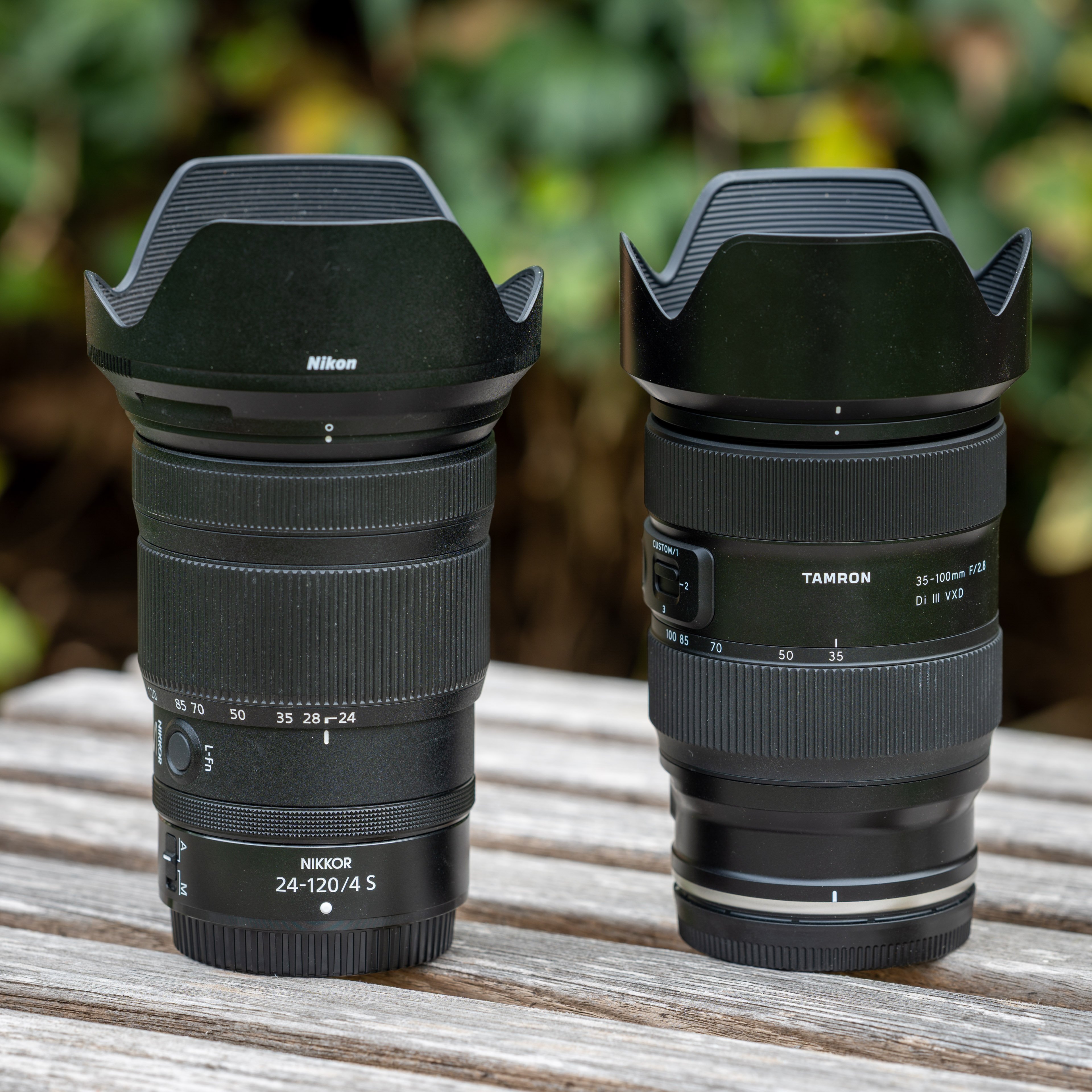
Above: Nikon Z 24-120mm f4 S, Tamron 35-100mm f2.8 Di III
Compared to Tamron 28-75mm f2.8 Di III G2
The Tamron 28-75mm f2.8 Di III G2 is optically right up there with the best from other manufacturers and it offers a 12 degrees wider angle of view at the short end (75 vs. 63 degrees). But then it only reaches 75mm at the long end which would need a 1.33x crop to get the same angle of view as a shot at 100mm focal length – reducing resolution from e.g. 45MP to 25MP. Or you consider complementing Tamron’s 28-75mm with their 70-180mm zoom lens which came Highly Recommended in my Tamron 70-180mm f2.8 Di III VC G2 review. But that would add another 900g to your camera bag and subtract around 1000 EUR/USD/GBP from your wallet.
For more details see my Tamron 28-75mm f2.8 Di III G2 review where the lens came Highly Recommended.
Compared to Nikon Z 24-120mm f4 S
Nikon’s Z 24-120mm f4 S may be one stop slower than the Tamron 35-100mm f2.8 Di III but it offers 20% more reach at the long end and a 21 degrees wider angle of view at the short end (84 vs. 63 degrees). These differences should not be underestimated: At the long end you’d need to crop an image shot at 100mm focal length 1.2x to get the same angle of view as a shot at 120mm. This reduces resolution from e.g. 45MP to 31MP. And on the short end it is often not possible to step back far enough to get the same image frame as with 24mm focal length especially in landscape and architecture photography. So, as size, weight, price, and optical performance are pretty close deciding between both lenses boils down to whether you need the brighter focal ratio or the broader zoom-range.
For more details see my Nikon Z 24-120mm f4 S review where the lens came Highly Recommended.
Compared to Tamron 35-150mm f2-2.8 Di III
Tamron’s 35-150mm f2-2.8 Di III is a compelling all-round zoom with a 50% longer reach than their new 35-100mm f2.8 Di III and a one stop brighter focal ratio at 35mm (f2.2 at 41mm, f2.5 at 61mm, f2.8 from 81mm focal length onwards). But the 35-100mm has the advantage of being considerably smaller, 50% lighter and almost 40% less expensive. So, with comparable optical performance choices are clear: Do you need/want the longer reach and the brighter aperture or do you prefer smaller and lighter (on your neck and wallet)?
For more details see my Tamron 35-150mm f2-2.8 Di III review where the lens came Recommended.
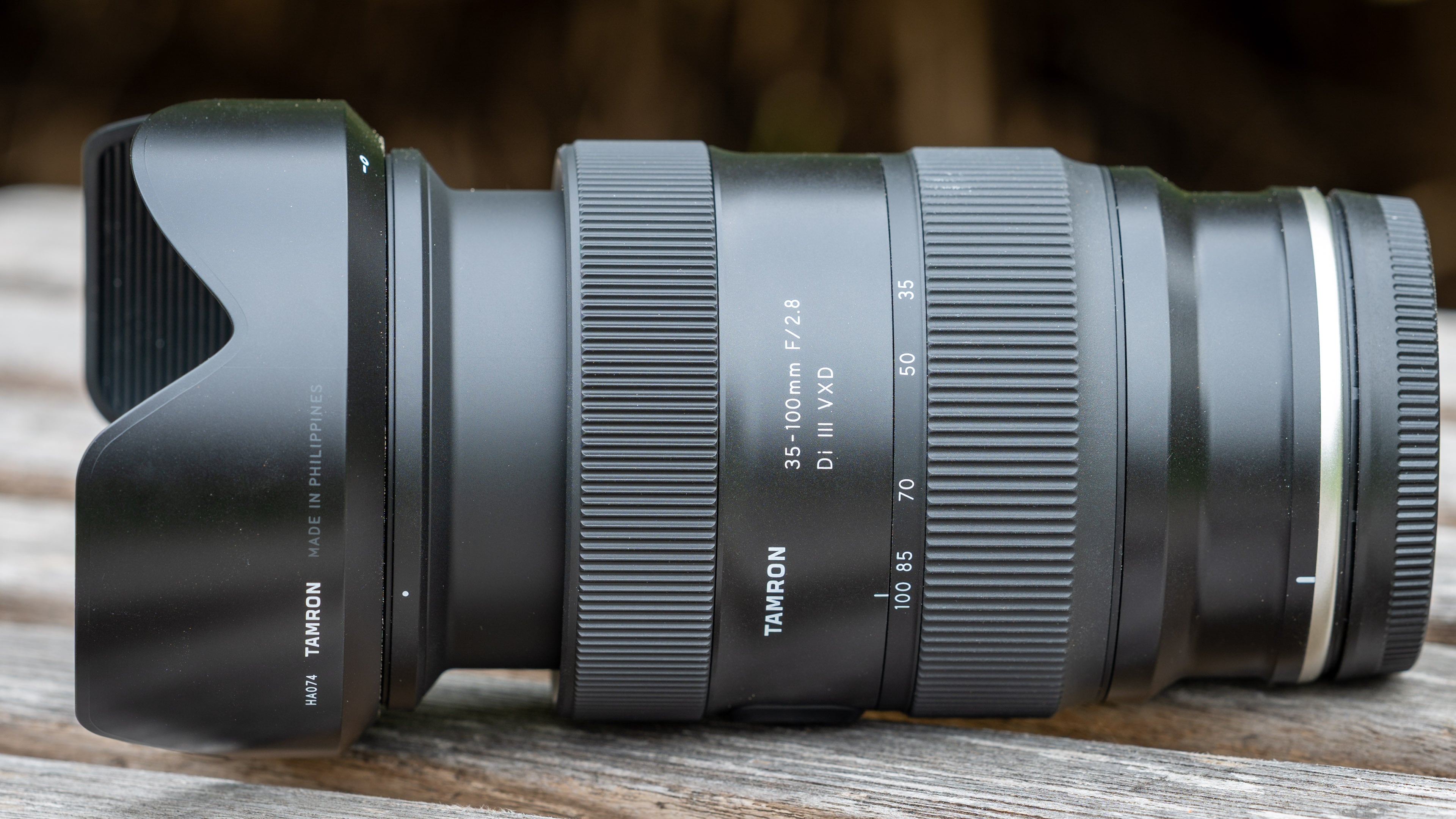
Tamron 35-100mm f2.8 Di III final verdict
The Tamron 35–100mm f2.8 Di III offers an unusual zoom range with a constant bright aperture in a compact, lightweight design. It features weather sealing, a dedicated focus ring, customizable controls, and quiet autofocus, while also delivering useful close-focus capability. In testing, it performed strongly overall, especially at 35mm, where it produced very good sharpness across the frame even at 180MP resolution. Its main drawbacks are inconsistent autofocus accuracy, noticeable longitudinal chromatic aberration at f2.8, and soft close-up rendering at 35mm outside the center. But overall, I’d still recommend this versatile and capable lens – if the zoom range fits your needs.
Good points:
- Very good resolution and contrast across the full-frame sensor at the short end.
- Pretty good resistance against flare, (veiling) glare, and ghosting.
- Fast AF operation and low focus breathing.
- Little field-curvature at normal distances.
- Nice Bokeh.
- Useful maximum magnification.
- Extensive weather sealing against moisture and dust.
- Customizable lens function button plus switch.
Bad points:
- Becomes softer towards the long end.
- Strong longitudinal color aberrations at f2.8.
- AF could be more consistent.
- Close-up shots are soft outside the center at 35mm.
- Lens shows some focus shift.
- Relatively expensive.
Check prices or buy the Tamron 35-100mm f2.8 Di III VXD at B&H, Adorama, WEX UK or Calumet.de. Buy used gear from MPB. Sell your used gear to MPB. Or why not treat yourself to a copy of my In Camera book, an official Cameralabs T-shirt or mug, or treat me to a coffee! Thanks!