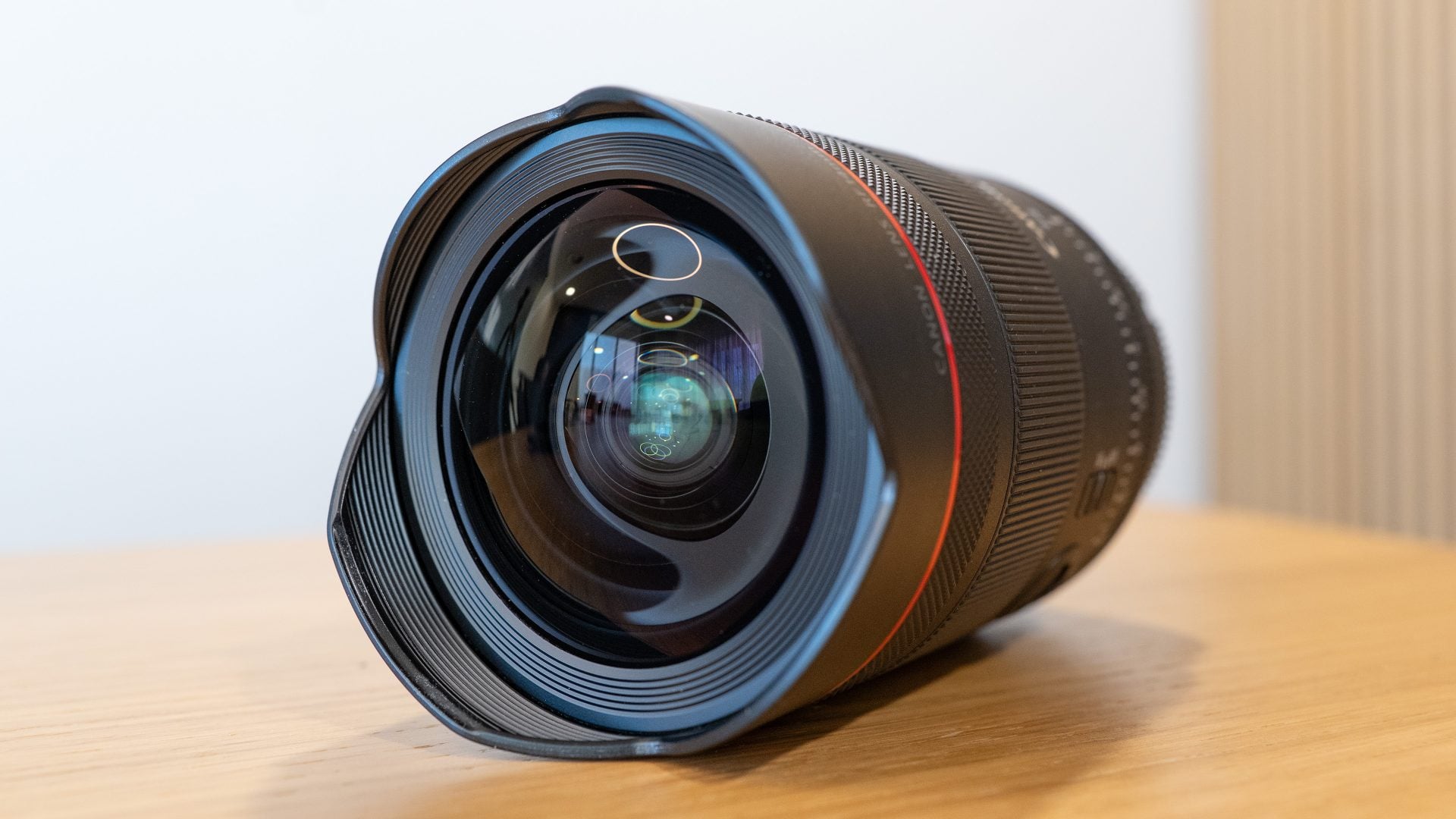
 The Canon RF 14mm f1.4L VCM expands their hybrid series to six prime lenses with the widest-angle to date. Sure Canon has an RF 10-20 zoom that can go wider still, but the 14 is a prime lens with a much brighter aperture and claims superior quality to the zooms. In my early tests it’s certainly very sharp across the frame, although like most modern wide-angles employs a software profile to correct the barrel distortion. Canon’s also maintained essentially the same size and weight across the series, which also makes it not only considerably smaller than Sigma’s recent 14 1.4, but half the weight (although note the Sigma was not available for Canon RF at the time of writing). We’ll need proper side-by-side tests to see which takes the lead under which conditions, but it remains a physically impressive feat, especially when you consider it’s two stops brighter than the old EF 14 2.8 without being much larger, and is priced only a little higher than that model's original RRP without even taking inflation into account.
Canon RF 14mm f1.4L VCM review
-
-
Written by Gordon Laing
The Canon RF 14mm f1.4L VCM is an ultra-wide angle lens designed for full-frame EOS R mirrorless cameras. I had a chance to briefly try it out and in the video below you’ll see some initial tests and results for it in action. Or if you’d prefer the written highlights, keep scrolling!
Like other bright aperture ultra-wides, it’s aimed at astro-photography, as well as landscape and architecture. The dramatic wide field of view also works well in video, especially for extreme sports at close range.
Announced in February 2026, it’s Canon’s widest prime lens in the RF series to date and the sixth model in their hybrid series which also includes 20, 24, 35, 50 and 85 focal lengths, all sharing f1.4 apertures and essentially the same barrel size and design.
It’s the successor of sorts to the EF 14mm f2.8L launched almost 20 years earlier back in 2007 in its most recent Mark II guise. This lens is still on sale in some regions for around $2100, and bargains can be had on the used market.
EF 14mm f2.8L II: 80x94mm, 645g // RF 14mm f1.4L: 77x112mm, 578g
You can see the old EF 14 f2.8L II on the left here, alongside the new RF 14 f1.4L on the right. They’re roughly similar in diameter, 80mm for the old model vs 77 for the new, but clearly the new RF lens on the right is longer at 112 vs 94mm. That said, once you’ve fitted an adapter to the older EF lens on the left to use it on a mirrorless EOS R camera, they become similar in length.
Weighing 578g, Canon’s also shaved 67g from the weight of the new model even before taking an adapter into account, and that’s particularly impressive considering the new lens is now two stops brighter than before.
Sigma 14mm f1.4 DG DN: 100x150mm, 1170g // RF 14mm f1.4L: 77x112mm, 578g
In fact, let’s briefly compare it to the only other 14 1.4 with autofocus I’m aware of: Sigma’s 14mm f1.4 DG DN Art from 2023. While it’s sadly not available in the RF mount, we can still compare the specs. The Sigma is comfortably cheaper than the new Canon at around $1500 or pounds, but it’s an unapologetically hefty lens, measuring just over 100mm in diameter, 150mm long, and weighing a considerable 1.17kg. That’s roughly 50% wider and longer and over double the weight, in turn requiring a tripod collar to support it. A very different prospect.
If you’d like an ultra-wide prime in the native RF mount, but your budget won’t stretch to the new L model, Canon offers their RF 16mm f2.8 for around $300 or pounds. It’s understandably far from perfect but a really fun lens at that price and I have a review all about it.
Or if you’re willing to trade auto for manual focus only, there’s a wealth of third-party primes at 14mm or even wider in the RF mount from the likes of Laowa, Samyang, TT Artisan, and 7 Artisans. These start at as little as $200, but most are around f2.8 and again are manual focus only. That may be fine for landscape and architectural use though.
Right, now we’ve put it in context, let’s take a look at the design and controls which are unsurprisingly almost identical to the other hybrid primes in the series.
So you start with a dedicated aperture ring, turning smoothly without clicked feedback, and aimed at videographers. Recent Canon bodies also support it for stills photography modes, but most Canon owners will lock the ring to A and control the aperture with a body-based dial as usual.
Next are the three controls: an AF MF switch, a customisable function button, and the locking lever to keep the aperture ring set to A if preferred.
After these comes the manual focusing ring, which like other L lenses turns smoothly.
And finally towards the end of the barrel, a customisable and clicky RF control ring. Up to this point, the design and control positions are the same as previous members of the hybrid prime series, but the new 14 breaks from tradition by including a built-in lens hood to help protect the bulbous front element. In this respect the same as the EF 14 2.8.
Meanwhile Canon supplies a substantial cap which slides over the hood and is held in place by friction.
Like many ultra-wides, there’s no filter thread at the front, but the RF 14 1.4 will accommodate rear-mounted gelatin filters measuring 36.7×29.4mm. And while we’re looking at the mount, you’ll also see the rubber grommet as the lens is fully weather-sealed.
In terms of the optical design, it has 18 elements in 13 groups, a closest focusing distance of 24cm, and like other members of this hybrid series, no optical stabilisation.
Ok now for some quick optical tests and like most modern mirrorless lenses, the RF 14 1.4 employs a software profile to correct geometric distortion, as well as some vignetting. This is applied by default on JPEGs in-camera, but you must enable the profile in your RAW converter to use the lens as it was designed.
Interestingly Adobe Camera RAW already had a profile ready for the lens prior to launch, which gives me a chance to turn it on and off to see what’s happening behind the scenes. As expected, the profile is performing a geometric stretch to eliminate barrel distortion, and deliver a corrected image. Again this is academic as the profile is part of the lens design.
Out of fairness, here’s a RAW I took with the Sigma 14 1.4 DG DN Art, toggling its profile on and off, and again you can see it correcting some barrel distortion, albeit not as much as the Canon.
There has to be some benefit to the Sigma being so much larger and heavier, although Canon does claim the optical quality of their RF 14 1.4 is better overall, not to mention superior to the RF 15-35 at 15 and the RF 14-35 at 14mm. I hope to put that to the test in a future video.
To give an idea of the sharpness across the frame on the new Canon, I took this shot of an office building with the RF 14mm f1.4L on an EOS R6 III body at all apertures. I’m showing out-of-camera JPEGs here with the profile applied automatically as that’s how it’s designed to be used.
So here’s the lens with the aperture wide-open at f1.4 and taking a closer look in the middle where the lens was focused shows a high level of detail out of the gate. Closing the aperture doesn’t appear to bring any visible benefit here, so a good start for the lens.
So let’s return to the 1.4 sample before heading into the corner. Here the detail looks maintained and I’m not seeing any negative effect to the geometric corrections made by the profile in this example.
There is very minor darkening in the corner due to vignetting but this quickly lifts as the aperture is closed, and even at f2 to 2.8 it’s looking fully-corrected.
I also retested the lens focused in the corner and the result for this subject and distance looked no different from my first samples. So it’s looking like a nice flat field.
The lens has an 11-bladed diaphragm system which means 22 diffraction spikes. Here’s how it looks at the minimum aperture of f16 pointing directly at a hazy UK Winter Sun. Despite the rounded blades, it’s looking quite well defined here and shows potential for crisper conditions or city lights at night.
How about flare? Here I’ll pan away from the Sun with the lens at f8, filming video on the R6 III, where you’ll see some flare artefacts over the dark building details. Some of you love’em, some of you hate‘em, but this is how they look.
Next for a quick focusing test with the lens at f1.4 on an EOS R6 III body, focusing back and forth between the wall and a cap near to the closest focusing distance of 24cm. As you can see the focusing is almost instant and in person the VCM motors were essentially silent.
And here’s how it looks for continuous Servo AF for video, again at f1.4 on the EOS R6 III with human subject recognition. Get close and you’ll see the potential for shallow depth of field effects, not huge but certainly more than the EF 14 2.8, although like all ultra-wides there will be some distortion at very close range.
Step back only a little though and you can achieve some quite natural-looking results while capturing a huge amount of your surroundings. Great for environmental presentations or even portraits.
Just before wrapping-up, Canon launched the RF 14 1.4L alongside the RF 7-14 f2.8-3.5L Fisheye zoom which includes the same focal length. But these are very different lenses, with the 14 1.4L being a rectilinear design that attempts to deliver geometrically square images, while the Fisheye embraces distortion to capture a giant 190 degree field of view.
To illustrate this, here’s both lenses at 14mm, with the 14 1.4L on the left and the Fisheye Zoom on the right, where you’ll see their different approaches to imaging.
Here the Fisheye is delivering 180 degrees across the diagonal, but zoom-out a little and it’ll grab 190 degrees at around 13mm without revealing the imaging circle.
Although twist the zoom ring all the way to 7mm and it’ll deliver the same 190 degree diagonal but with a fully circular Fisheye image. I have a separate video all about it if you’re interested.
And that’s all I can say until I’ve tested a sample for a longer period of time, so let me know if that’s something you’d like to see.
Verdict so far
The Canon RF 14mm f1.4L VCM expands their hybrid series to six prime lenses with the widest-angle to date. Sure Canon has an RF 10-20 zoom that can go wider still, but the 14 is a prime lens with a much brighter aperture and claims superior quality to the zooms. In my early tests it’s certainly very sharp across the frame, although like most modern wide-angles employs a software profile to correct the barrel distortion. Canon’s also maintained essentially the same size and weight across the series, which also makes it not only considerably smaller than Sigma’s recent 14 1.4, but half the weight.
We’ll need proper side-by-side tests to see which takes the lead under which conditions, but it remains a physically impressive feat, especially when you consider it’s two stops brighter than the old EF 14 2.8 without being much larger, and is priced only a little higher than that model’s original RRP without even taking inflation into account.
I wonder if they can squeeze even wider or longer lenses into this same barrel size while maintaining an f1.4 aperture. I guess it depends how many corrections we’re all willing to accept.
Check prices or buy the Canon RF 14mm f1.4L VCM at B&H, Adorama, WEX UK or Calumet.de. Buy used gear from MPB. Sell your used gear to MPB. Or why not treat yourself to a copy of my In Camera book, an official Cameralabs T-shirt or mug, or treat me to a coffee! Thanks!