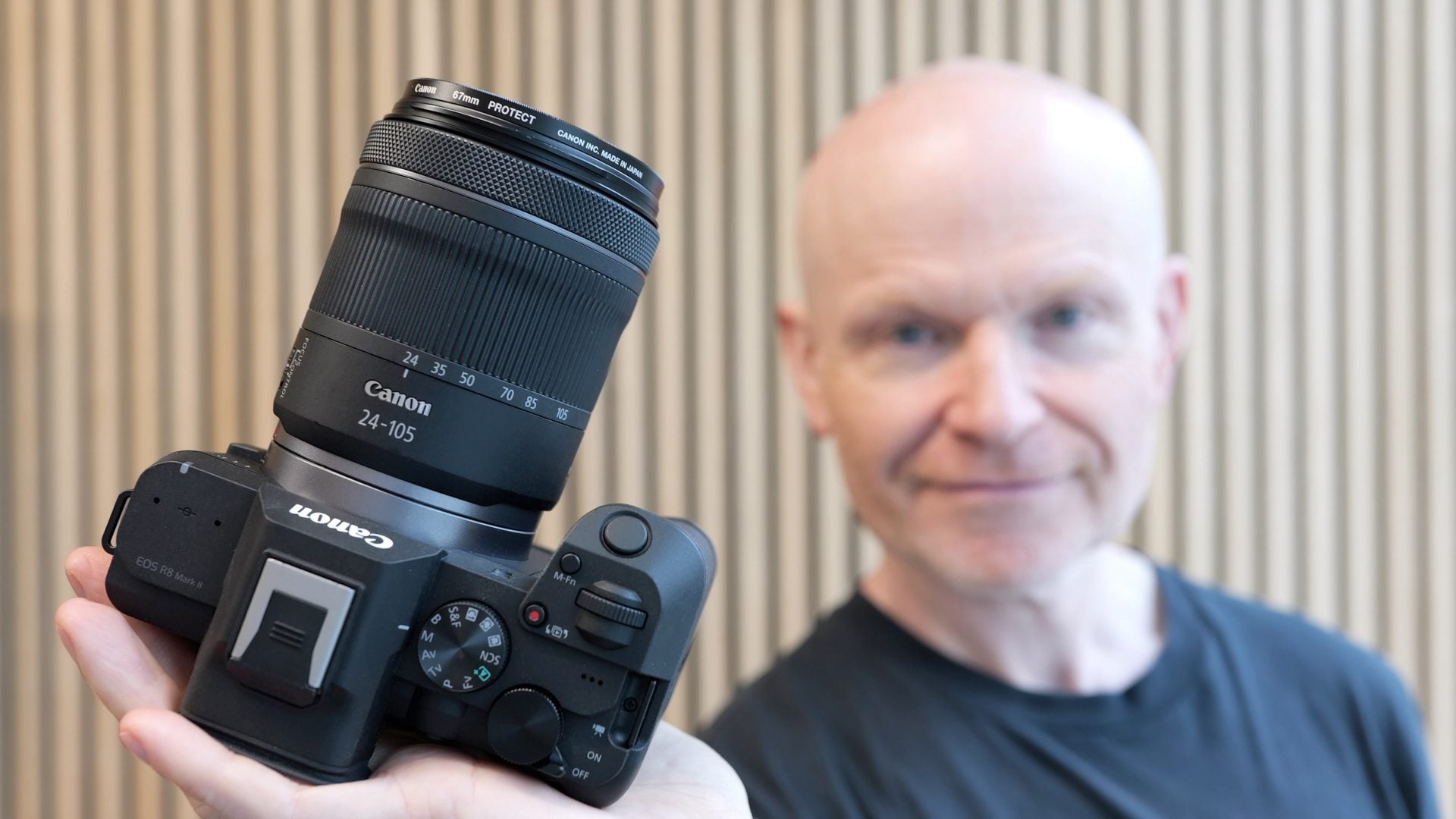
 Canon’s EOS R8 Mark II builds upon the compact R8, inheriting the same 24 Megapixel full-frame sensor with uncropped 4k up to 60p, but now coupled with IBIS stabilisation and packs it into a more angular-looking body reminiscent of some film SLRs from the 80s. Canon’s also fitted a joystick, improved the buffer and low-light focusing, but the viewfinder, screen, and small battery remain the same as before, and while the card slot has moved, there’s still only one. Of these, the modest battery life is arguably the biggest issue, but equally it allows a fairly compact body. In Canon’s range the R8 Mark II makes sense, slotting between the R8 and higher-end R6 II and III, with the more sophisticated models giving you a bigger battery, more detailed viewfinder, twin card slots and optional battery grips. Previously you’d need to step up to these if you wanted IBIS, but now the R8 II gives you this and a bonus joystick at a lower price. Indeed for many people the presence of both means they no longer need to invest more in an R6 or higher, and still enjoy it in a fairly compact body. But many of those higher-end bodies are now old enough to be discounted during sales. For example the Sony A7 IV, Lumix S5 II, Nikon Z6 III and Canon’s own R6 II all feature bigger batteries, more detailed viewfinders, twin card slots and the chance to use battery grips. All have fluctuating prices which at certain times come close to the launch price of the R8 Mark II, although all are also a little larger and heavier. So the value of the R8 Mark II depends when you’re shopping, as well as how important are its size, weight and styling. I think Canon’s done a good job at equipping the R8 II with the extra features most people desire without the greater heft and complications of higher-end bodies. At the right price, the R8 II will make a lot of sense to a lot of people, and if you can live without IBIS and a joystick, the discounted original R8 becomes the bargain in the series.
Canon EOS R8 Mark II review
-
-
Written by Gordon Laing
The Canon EOS R8 Mark II is a mid-range full-frame mirrorless camera with IBIS and an angular design reminiscent of vintage Canon film SLRs and, dare I say, a current rival brand. Launched in September 2026, it comes three and a half years after the original R8, a model that was pitched as the most affordable and lightest full-frame model in the EOS R lineup.
The R8 Mark II inherits the same 24 Megapixel sensor as the R8, itself originally deployed on the R6 II, but now includes sensor-shift IBIS stabilisation, addressing the biggest downside of its predecessor. Canon’s also included an AF joystick along with a raft of features inherited from other recent models including pre-burst capture, but in doing so the R8 II has become a little heavier and – depending on region – more expensive.
It’ll launch at around $1900 or £1700 for the body alone, while kits are available with either the 24-50 or 24-105 STM depending on region. Meanwhile the old R8 will remain on sale as a more affordable option especially with holiday discounts, so the new Mark II slots between it and the R6 II in the series. Everything I know so far is in the video below, or keep scrolling for the written highlights!
For many people the R8 Mark II’s upgrades mean there’s now less need to spend more on the R6 II or R6 III. But equally the price places it in a very competitive market where a number of older but higher-end models including Sony’s A7 IV, Nikon’s Z6 III and the Lumix S5 II are now discounted to a similar ballpark. Even Canon’s own R6 Mark II can be snapped-up at roughly the same price at certain times, so always check the links in the description for the latest deals. Either way stick around and I’ll show you what’s new on the R8 II and how it compares to both rivals and other Canon bodies.
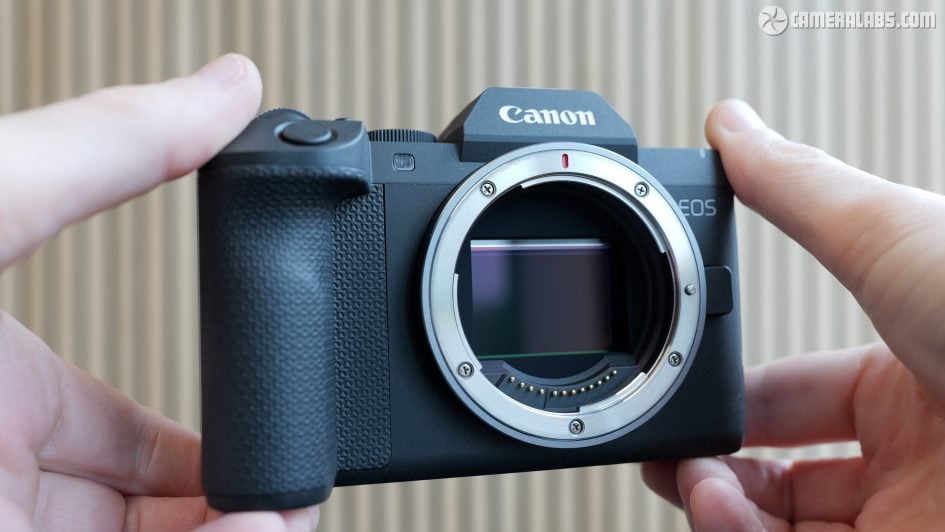
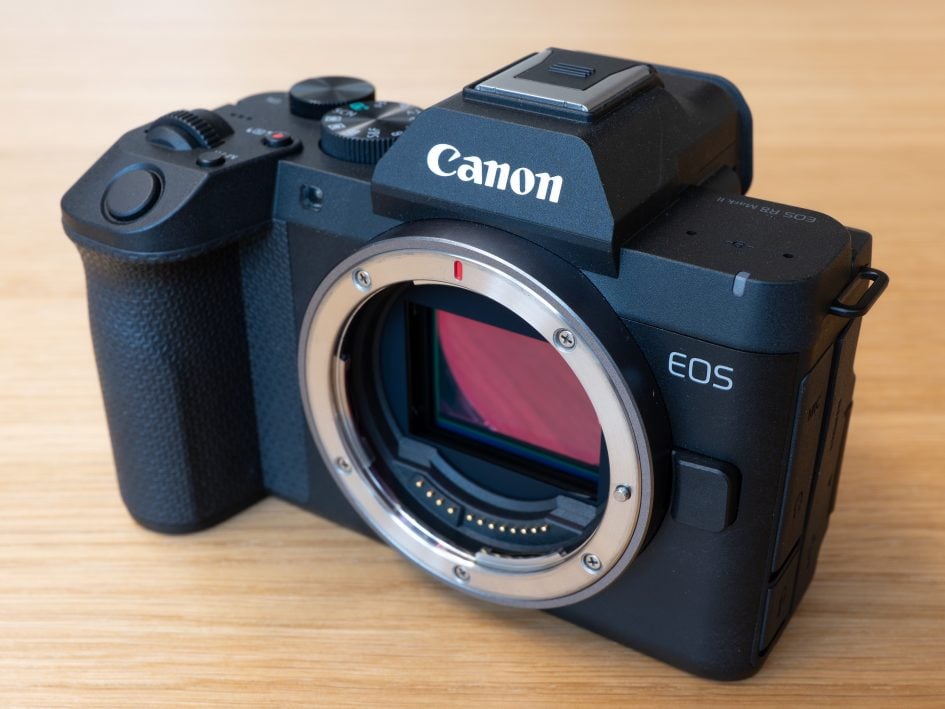
In terms of design, the new R8 Mark II represents a departure not just from its predecessor, but Canon’s recent EOS R system as a whole. You can see how the curved head and sloping shoulders of the older model have been switched for an angular design, that’s also slightly larger and heavier overall. Don’t get me wrong, it’s still a fairly compact and light camera, but it’s definitely beefed-up a bit. Canon quotes a similar degree of sealing to the R8, so you’re getting basic dust and moisture resistance, but I wouldn’t expect miracles. EOS R8 Mark II: 131x90x80mm, 546g // EOS R8: 133x86x70mm, 461g
Anyone familiar with Canon’s film SLR heritage from the 70s and 80s may be reminded of the T-series or maybe an F1 or A1, but in modern visual language there’s certainly more than a whiff of Sony here which will surely polarise opinion. I admit when I first saw the R8 II, I wasn’t fond of the look, but as I’ve lived with it for a short while, I’ve warmed to it. I’d love to hear what you all think of the new look, and whether you’d like it deployed across the range. I know some of you were hoping for something even more retro, and I still think there’s room for a Canonet-styled rangefinder camera.
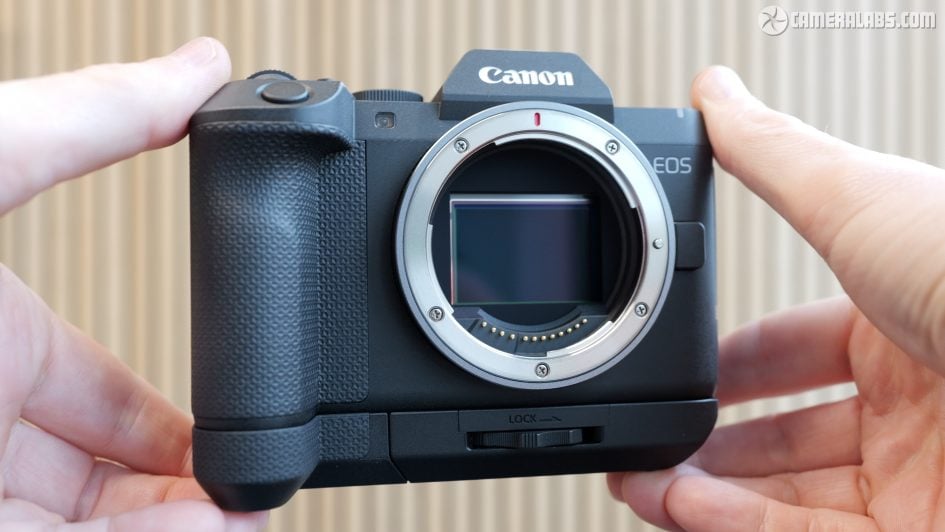
Regardless, Canon remains a master of ergonomics with the R8 II feeling good in your hands. The grip is slightly bigger than the original R8, and the controls fall easily to hand. If you’d like more to hold onto, Canon offers an optional EG-2 grip, pictured above, for around £90 which simply boosts the height of the grip so your pinkie isn’t left dangling. It may not offer portrait controls or accommodate extra batteries, but it considerately includes a cut-out to more easily access the screen-flip, as well as a whole section that angles out so you can access the battery compartment. Note a traditional battery grip is not available for this model.
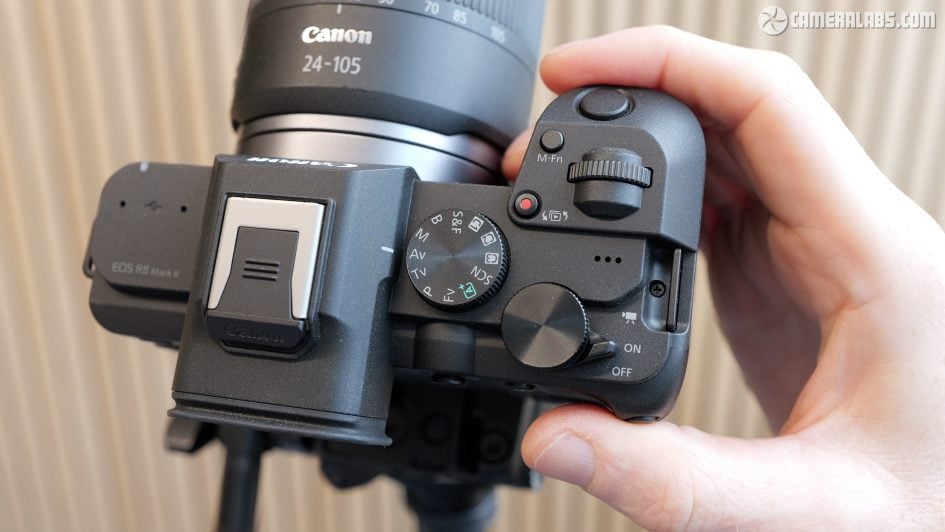
The top plate control layout has changed from the R8 with a single dial in the corner for power and switching into photo or video modes, so the dual dials and lock control of the R8 are gone. That upper left side is now looking bare like a Sony, although it does now include a new Tally lamp to indicate when you’re recording video.
The shutter release remains atop the grip, albeit now at a shallower angle, and there’s both front finger and rear thumb dials, both of which turn with very positive clicky feedback. Then there’s dedicated Function and movie record buttons before you reach the exposure mode dial, now raised versus the recessed version on the R8. There’s a couple of changes here including a Slow and Fast video option and three rather than two custom positions. Note the colour effects are now accessed from the menu. Just before leaving the top plate, there’s no popup flash, but there is a Multi Function accessory shoe. Canon’s also launched an updated flashgun, the EL-5 which increases the range to 50m. Oh and again note the new tally lamp on the far side.
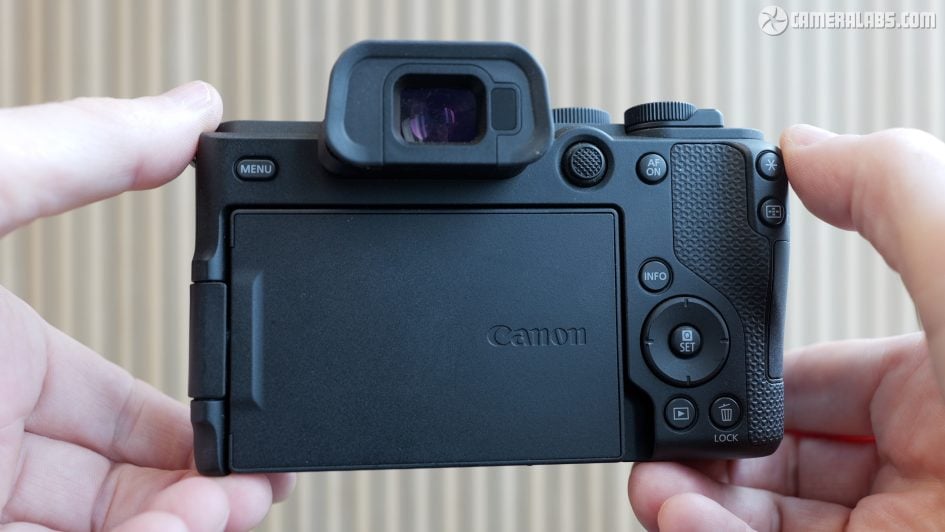
Turning to the rear, at first glance the R8 II appears to share much the same button and joypad layout as its predecessor, but what’s this to the right of the viewfinder? Yes, a joystick! This small addition is a big deal for many of us, myself included, as it allows quick and tactile adjustment of the AF area, not to mention navigating settings. It was previously a differentiator between the lower priced models and the R6 series and above, but now it allows the R8 II to cross into higher-end territory and is an important upgrade over the R8. I can’t emphasise enough how happy I am about this, and I could reach it just fine with my thumb. Unsurprisingly though, the R8 II still lacks the flat thumb wheel of the higher-end models, so if you’re after one of these you’ll still need an R6 or higher.
Moving onto composition, the R8 Mark II inherits the same viewfinder and screen as its predecessor. So starting with the EVF, the R8 II uses a 2.36 million dot OLED panel with 0.7x magnification. In Canon’s World, you need to step-up to the R6 series to enjoy a more detailed viewfinder, but it’s important to note most of the R8 II’s rivals from other brands already have better viewfinder specs. Both the Sony A7 IV and Lumix S5 II have 3.69 million dot viewfinders, while Nikon’s Z6 III is better still. So while the R8 II’s viewfinder is ok, this is becoming a modest spec for the price point.
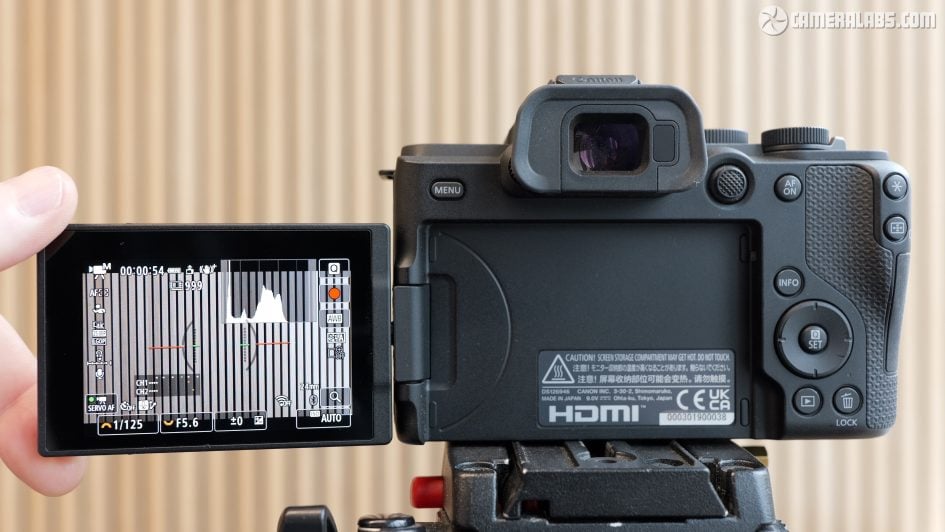
Meanwhile the screen employs a 3in panel with 1.62 million dots and a side-hinged mechanism which allows it to face forward for vlogging and selfies, twist up and down for framing at unusual angles, and back on itself for protection. Again I’d have preferred more detail at this price point, and as a side note to all camera companies, can we please start having OLED panels? Anyway, so far so normal for Canon, but I was disappointed not to find a vertical UI option that keeps the shooting information upright when framing in the portrait orientation.
Behind three flaps on the left side are the same ports as the R8, but in a slightly different order. So now the 3.5mm mic and headphone jacks are positioned higher than before, allowing a mic plug to not block the screen as much when it’s flipped out. Below this is a terminal for a remote accessory, while the third flap reveals Micro HDMI and USB C. As usual, USB C is used for data, charging, or to use the camera as a standard UVC UAC webcam with the R8 II now supporting 4k 60. FTP is also now supported via the CTP app, but RAW video over HDMI is still reserved for the R6 and higher. There is of course also Wifi, which Canon has now upgraded to support both 2.4 and 5GHz bands, versus just 2.4 on the R8.
In terms of memory, Canon’s relocated the single SD card slot from the battery compartment to the grip, allowing you to access it more easily. A welcome update, although the camera still lacks the twin card slots of the R6 and above, or indeed many rivals including the A7 IV, Lumix S5 II and Nikon Z6 III.
Under the camera you’ll find a tripod thread in-line with the optical axis and a door to access the battery compartment. As you’d expect for its position in the range, the R8 II is powered by the same LP-E17 pack as the R8. Canon quotes 340 shots under CIPA conditions, and as a modest-sized battery, you do have to keep your eye on consumption, especially if you’re filming a lot of video or of course enjoying the IBIS for stabilization. Again a bigger battery is available on higher-end bodies like the R6 series, and again thanks to discounts these may be close to the R8 II. Most higher-end bodies can also take optional battery grips.
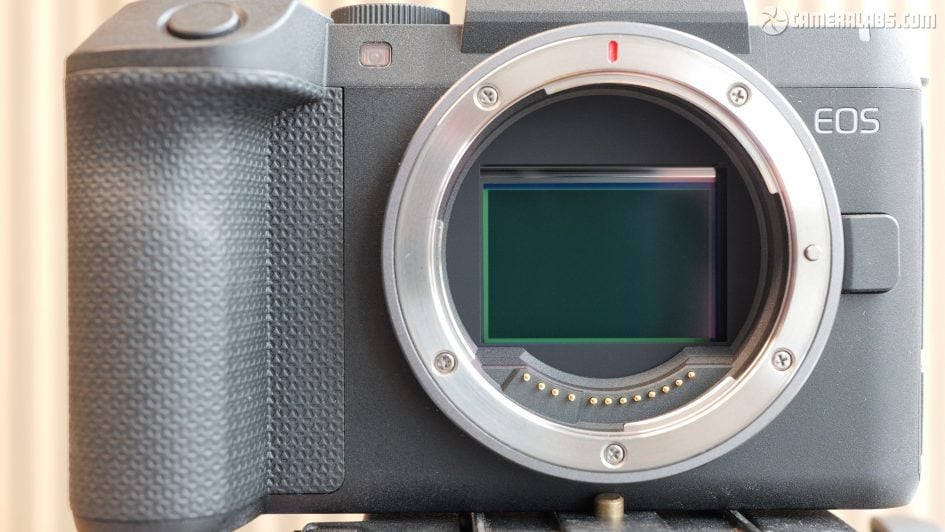
Moving on, as an EOS R camera, the R8 II has an RF lens mount, which right now means the only native full-frame lenses with autofocus are made by Canon. Sadly there’s still no third party full-frame lenses with AF in the native RF mount, but you can adapt older EF DSLR lenses from both Canon and others. And while Canon now offers a wealth of RF lenses from affordable to premium, owners will currently miss out on the chance to use third parties even with restrictions. Just look at my recent Sigma lens reviews, available for both Sony and Lumix cameras which makes those systems very attractive.
Depending on your region, a variety of kits will be available. In the UK the R8 II kit will use the RF 24-105mm STM, while in North America I believe it’ll use the more compact RF 24-50mm STM. I have reviews of both lenses if you’re interested.
Moving onto imaging, the R8 Mark II inherits the same sensor as the original R8, which itself was first deployed on the EOS R6 II. As such you’re getting 24 Megapixel photos and uncropped, oversampled 4k up to 60p. This is coupled with an updated DIGIC X processor to support a number of new features over the original R8. Note like other more affordable Canon bodies, the sensor remains exposed when powered-off, unlike their higher-end ones which give you the option to close the shutter curtain. This may help reduce dust, but the mechanism is delicate and easily damaged so the option is reserved for higher-end models aimed at more experienced owners.
The headline feature of the R8 Mark II is the addition of sensor-shift IBIS stabilisation, with Canon claiming up to 7.5 stops of compensation, although in practice your mileage will vary. You can see it in action in my video above. In Canon’s World, IBIS is a step-up feature of higher-end bodies, so it allows the R8 II to bridge the gap between them and the lower-priced models. Indeed for some it may eliminate the need to spend more on an R6 or higher. It’s certainly very welcome, but equally necessary given most of the competition also offer it at this price point.
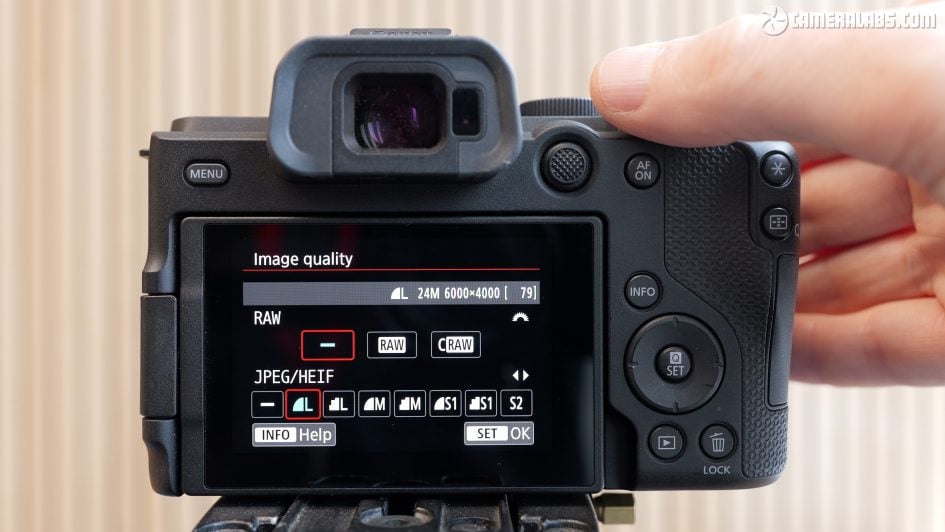
Moving onto photo quality, the R8 II captures images with up to 6000×4000 pixels. JPEG shooters have the choice of four resolutions: 24, 11, 5.9 or 3.8 Megapixels, with all but the smallest available with two different compression levels. You can also switch the camera to record 10 bit HEIF rather than JPEG if preferred. You can also record RAW in Standard or Compressed formats, both at the full 24 Megapixels, but the Compressed version occupying roughly two thirds the file size while still giving you the flexibility of post processing. Under the aspect ratio menu you can choose 3:2 in full-frame or cropped formats – the latter applying the same 1.6x field reduction as Canon’s APS-C models – or the full frame cropped to 1:1, 4:3 or 16:9.
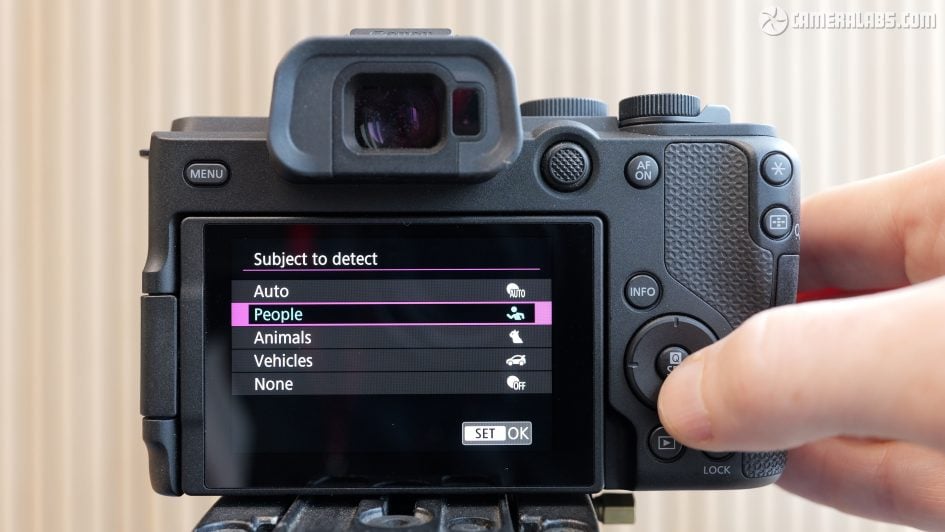
Focusing has been improved, especially in low light, now operating down to -7.5 EV to match the EOS R3 and R1 pro bodies. As before there’s the usual wealth of focus area options from spot to wide with custom shapes, as well as Canon’s latest subject detection for people, animals or vehicles. There’s also an excellent Auto option which does a great job at figuring out the subject and is my default for day-to-day use. You can also register important people, such as the boss at an event or the happy couple at a wedding to give them priority over others, and as before the user interface makes it easy to toggle between multiple recognised subjects using the joystick.
There’s the choice of electronic front curtain (EFC) or fully electronic shutters with maximum shutter speeds of 1/4000 and 1/16000, and fastest burst speeds of six and 40fps respectively. Canon tells me RAW files are recorded in 14 bit with either shutter type, but I’ll try to confirm for the e-shutter in later tests. The buffer has been improved with the R8 II now able to capture 190 JPEGs or 73 RAWs at the top electronic burst speed of 40fps. The electronic shutter also now supports Canon’s latest pre-burst mode which is much more practical than the RAW pre-burst mode of the previous model.
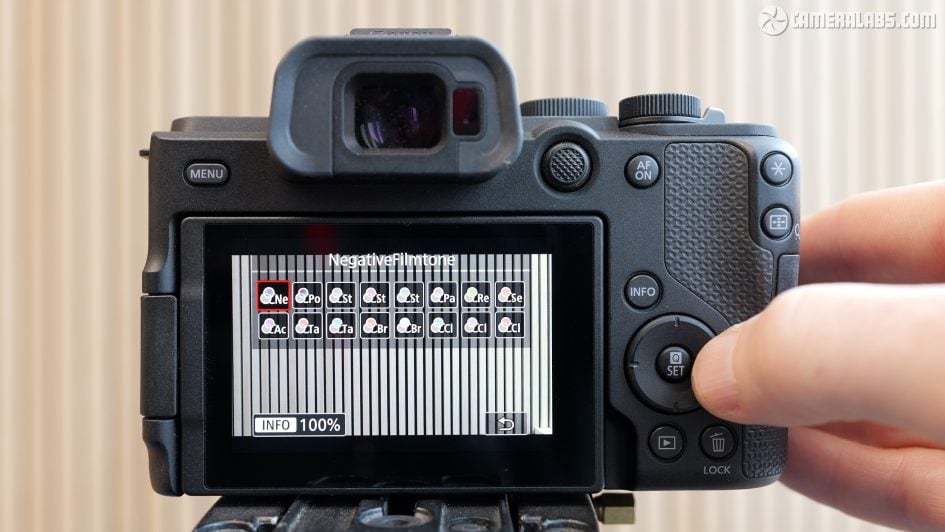
The effect position on the old mode dial may have gone but delve into the Colour Filter menu and you’ll find an expanded array of 16 options including positive and negative film tones.
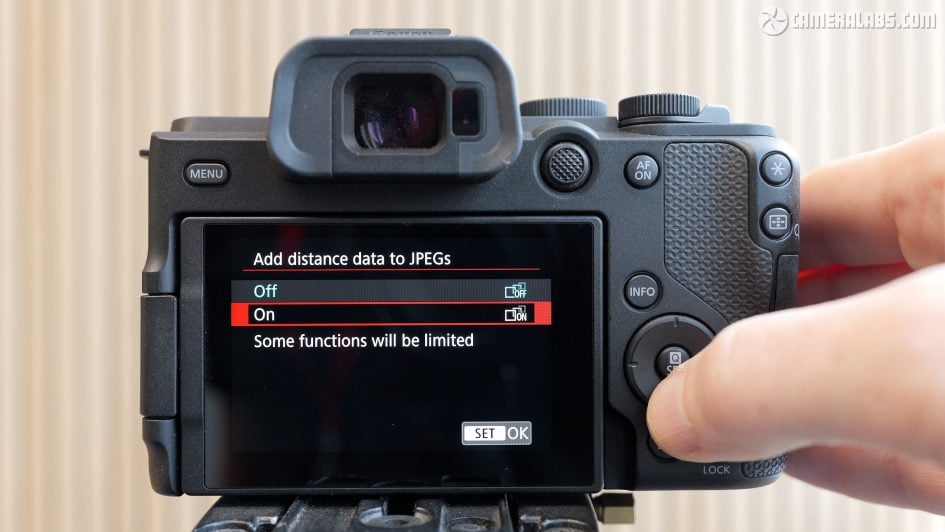
Explore the menus and you’ll also find the option to add distance data to JPEG images. This works with upcoming software to make mild adjustments to the perspective similar to recent phones. I believe it exploits the dual pixel capabilities of the sensor, a little like Dual Pixel RAW previously allowed. Not exactly 3D, but it’ll be interesting to see what’s possible.
The R8 II also inherits a powerful Multiple Exposure function combining up to nine frames and allowing you to choose the first from your card. There’s also focus bracketing including the chance to generate a stacked result in-camera which is great for checking your work in the field and may even be good enough to make post processing redundant. I realise both features have been around for a while on Canon bodies, but they’re still beyond what many rivals offer.
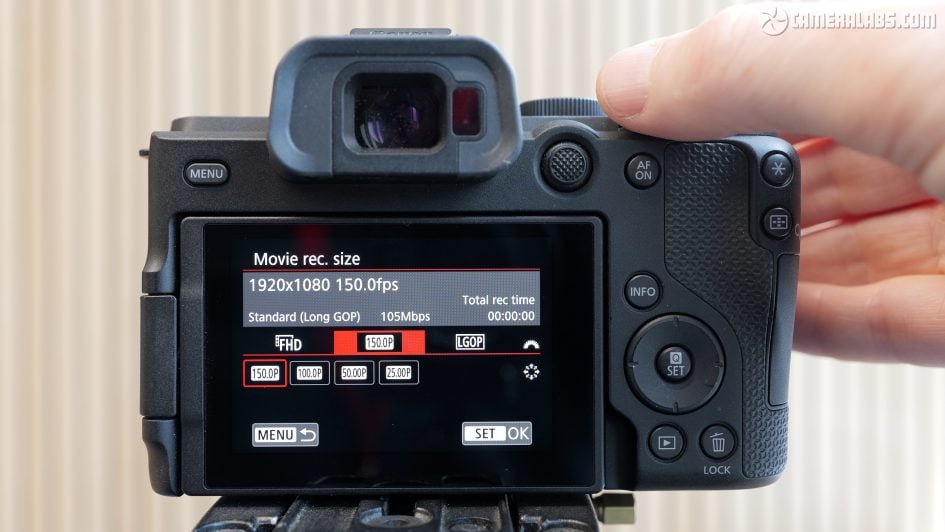
Moving onto video, the R8 II unsurprisingly inherits the core capabilities of the R8 and R6 II, which fortunately were ahead of most rivals at the time and still are in some instances. So while there’s no Open Gate or anything higher than 4k, you can record uncropped 1080 from 24 to 180p, and uncropped 4k from 24 to 60p, the latter oversampled from 6k. All video is encoded in IPB, so no All-i options, but unlike some models, all of these video modes including 1080 180p include sound, autofocus and subject detection.
Uncropped and oversampled 4k 60 was a key benefit of the R6 II and even several years later allows the R8 II to surpass many rivals. I’m also pleased to report the maximum recording time has been extended from two to six hours, although you will need to be under USB power as the battery is unlikely to last much more than an hour of video. As before, under the Custom picture menu you’ll find options for C-Log 3 as well as PQ and HLG.
There’s also a Defocus mode which you first assign to a custom button. Pushing this before or during filming gradually defocuses the image at a preset speed, before allowing it to gradually return to focus once you decide to let go. It’s a little like manually focusing away from a subject before then switching to autofocus to slowly bring it back into sharpness. So nothing you couldn’t do before, but now more easily deployed and at customisable speeds.
Digital, sensor-shift and optical stabilisation are also used in the Tracking IS mode, which allows the camera to keep a tracked subject positioned near the centre of the frame. Again this is the combined effort of all the image stabilization systems and as such can only compensate for modest movements, but it can still be handy especially for single operators. Remember that subject could be you in front of the frame.
Canon EOS R8 Mark II verdict so far
Canon’s EOS R8 Mark II builds upon the compact R8 from the more affordable end of the full-frame series. It inherits the same 24 Megapixel full-frame sensor with uncropped 4k up to 60p, but now couples it with sensor shift stabilisation or IBIS for short, and packs it into a more angular-looking body reminiscent of some film SLRs from the 80s. On top of that, Canon’s also fitted a joystick, improved the buffer, enhanced low-light focusing and added a bunch of other features, but the viewfinder, screen, and small battery remain the same as before, and while the card slot has moved, there’s still only one. Of these, the modest battery life is arguably the biggest issue, but equally it allows a more compact body.
Plus while I sound like a broken record, I’ll still call Canon out for not supporting third party full-frame lenses with autofocus. I realise they now offer a broad range of their own lenses and price points, but I’d still like to use Sigma’s and others even if it involves some commercial, I mean technical, restrictions.
In Canon’s range the R8 Mark II’s feature-set makes sense, slotting between the now discounted R8 and the higher-end R6 II and III, with the more sophisticated models giving you a bigger battery, more detailed viewfinder, twin card slots and optional battery grips. Previously you’d also need to step up to these if you wanted IBIS, but now the R8 II gives you this and a bonus joystick at a lower price. Indeed for many people the presence of both means they no longer need to invest more in an R6 or higher, and still enjoy it in a fairly compact body. All of this makes the R8 II a compelling prospect.
As I noted at the start though, the biggest problems for the R8 II are a number of higher-end models that are now old enough to be discounted to a similar price point. This means features previously considered reasons to spend more could be had for roughly the same price, especially during holiday periods. For example the Sony A7 IV, Lumix S5 II, Nikon Z6 III and Canon’s own R6 II all feature bigger batteries, more detailed viewfinders, twin card slots and the chance to use battery grips. All have fluctuating prices which at certain times come close to the launch price of the R8 Mark II, although all are also a little larger and heavier.
Of course it’s the same story with any new gear, with the launch pricing initially looking uncompetitive versus older models, but this will settle over time with the R8 II gradually finding its place below them price-wise. So the value of the R8 II depends on when you watch this review, as well as how important are its size, weight and styling. I think Canon’s done a good job at essentially equipping the R8 II with the extra features most people desire without the greater heft and complications of higher-end bodies. At the right price, the R8 II will make a lot of sense to a lot of people, and if you can live without IBIS and a joystick, the discounted original R8 becomes the bargain in the series.
Check prices or buy the Canon EOS R8 Mark II in the USA from B&H or Adorama. Buy it in the UK from WEX, or in Europe at Calumet.de. Buy used gear from MPB. Sell your used gear to MPB. Or why not treat yourself to a copy of my In Camera book, an official Cameralabs T-shirt or mug, or treat me to a coffee! Thanks!