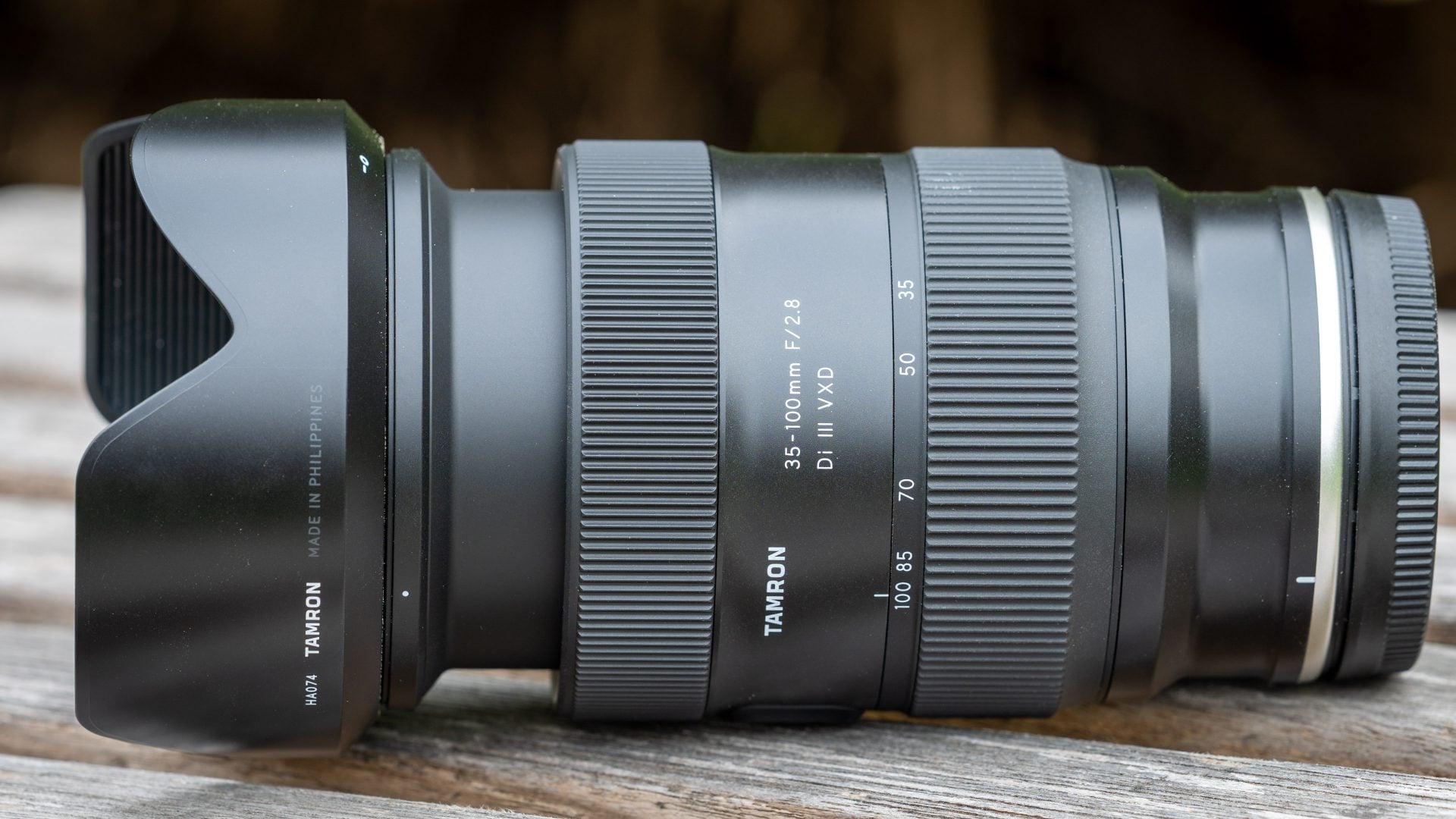
 The Tamron 35–100mm f2.8 Di III offers an unusual zoom range with a constant bright aperture in a compact, lightweight design. It features weather sealing, a dedicated focus ring, customizable controls, and quiet autofocus, while also delivering useful close-focus capability. In testing, it performed strongly overall, especially at 35mm, where it produced very good sharpness across the frame even at 180MP resolution. Its main drawbacks are inconsistent autofocus accuracy, noticeable longitudinal chromatic aberration at f2.8, and soft close-up rendering at 35mm outside the center. But overall, I'd still recommend this versatile and capable lens - if the zoom range fits your needs.
Tamron 35-100mm f2.8 Di III review
-
-
Written by Thomas
Intro
The Tamron 35-100mm f2.8 Di III VXD (model A078) offers an interesting combination of a bright and constant f2.8 focal ratio and a 2.9x zoom which covers the range from mild wide-angle to short telephoto. The lens is designed for full-frame Nikon Z and Sony Alpha mirrorless cameras and Tamron positions it as a “portrait zoom” which also can be put to good use in art, sport, people, and travel photography.
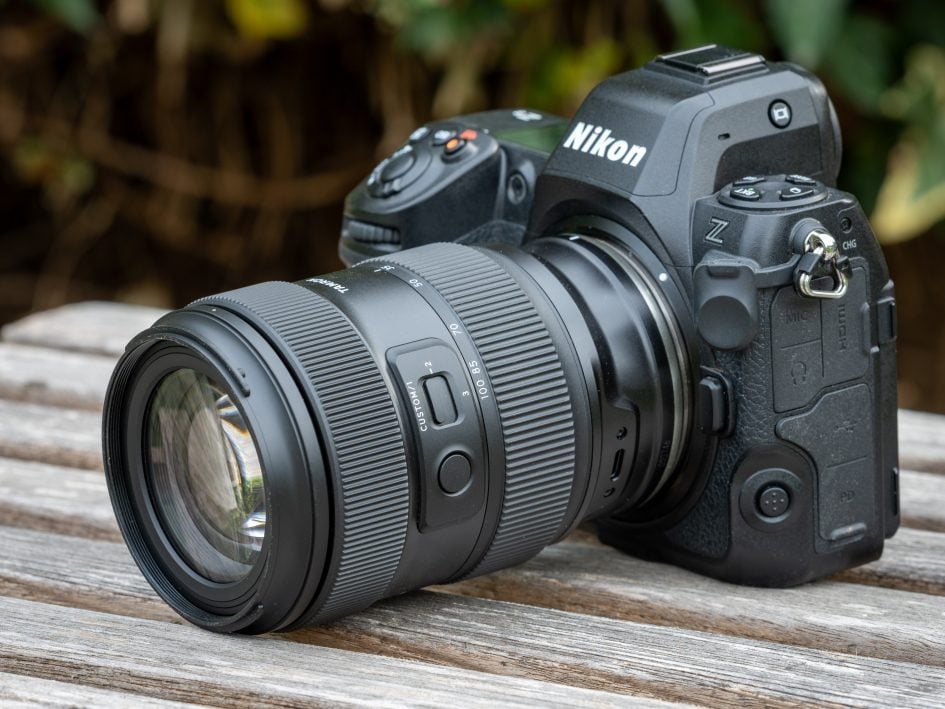
The lens is much smaller and 50% lighter than Tamron’s 35–150mm f2–2.8 Di III VXD from 2021, and at 929 EUR (incl. 19% VAT) / 929 USD / 799 GBP almost 40% cheaper too. And Tamron did not skimp on features: The new lens is fully weather-sealed and has a separate focus ring plus a customizable lens function button and switch with three positions. The latter can be customized via Tamron’s lens utility TLU and the USB-C connector on the lens.
The Tamron 35-100mm f2.8 Di III is made in Vietnam and already available in shops. To find out all about Tamron’s newest lens I tested it thoroughly on a Nikon Z8 and had a very close look at its optical qualities – using pixel shift shooting which quadruples the resolution of the camera to 180MP.
Facts and features
Let’s compare the Tamron 35-100mm f2.8 Di III (“Tamron 35-100” for short) to the Tamron 28-75mm f2.8 Di III G2 (“Tamron 28-75”) and Nikon Z 24-120mm f4 S (“Nikon 24-120”). As usual I’ve rated the features with a [+] (or [++]), when it’s better than average or even state of the art, a [0] if it’s standard or just average, and [-] if there’s a disadvantage.
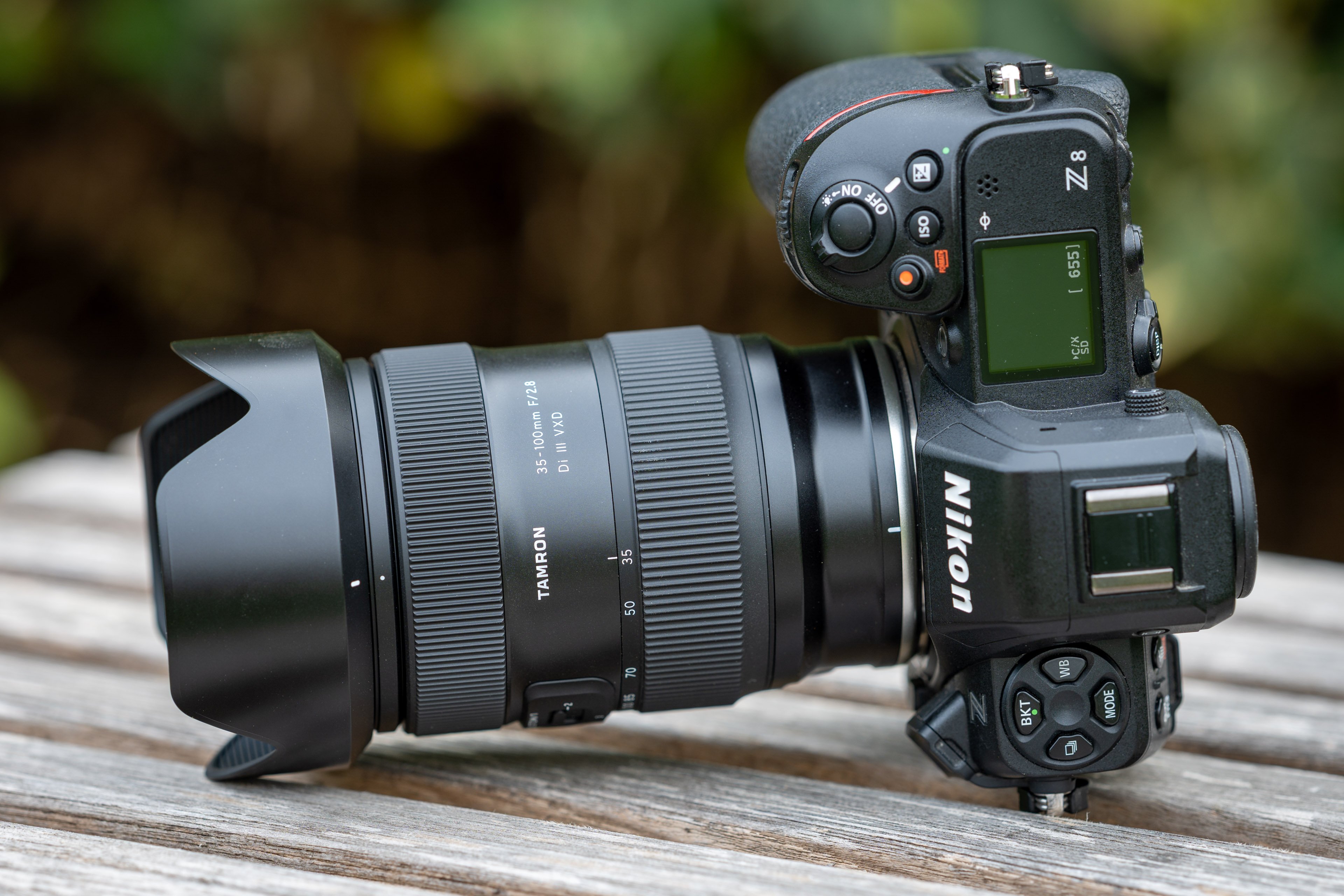
Size (diameter x length): 81 x 122mm (3.2 x 4.8in.) plus 33mm for the lens hood (91mm diameter). The lens extends 18mm when zoomed in to 100mm focal length. The Tamron 28-75 is 76 x 120mm + 28mm lens hood + 18mm extension. The Nikon 24-120 is 84 x 118mm + 43mm lens hood + 55mm extension. [0]
Weight: 571g (1.3 lb) plus 35g for the plastic lens hood. The Tamron 28-75 is 550g + 27g lens hood, the Nikon 24-120 is 630g + 27g lens hood. [+]
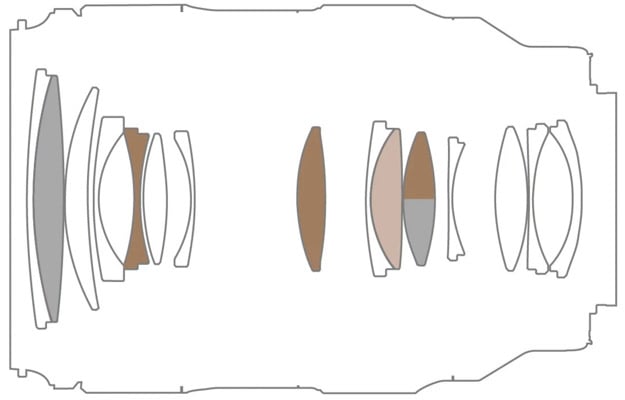
Optics: 15 elements in 13 groups including 3 special dispersion and 3 aspherical elements. The other lenses in this comparison have optical formulas of similar complexity. [+]
Minimum object distance is 0.21m (0.69ft.) at 35mm focal length and 0.62m (2.03ft.) at 100mm zoom position. Maximum magnification is 1:3.1 at 35mm and 1:5.1 at 100mm. This results in a working distance of only 7cm at the short end and 46cm at the long end. At 100mm focal length a magnification of 1:10 is achieved at 1.11m. The Tamron 28-75 achieves 1:2.5 at 28mm focal length and 4cm working distance or 1:3.7 at 75mm focal length and 22cm working distance. The Nikon 24-120 achieves its maximum magnification of 1:2.4 at 120mm focal length and 16cm working distance. [+]
Use with teleconverter: None of the lenses in this comparison can be used with teleconverters. [0]
Filter-thread: Both Tamron lenses use 67mm filters while the Z-Nikkor takes 77mm filters. [+]
Image stabilization: None of the lenses in this comparison offers optical stabilization. They solely rely on the body-based stabilization in modern mirrorless full-frame cameras. [0]
Autofocus: All lenses in this comparison offer autofocus with built-in focus drive. Both Tamron lenses have a voice coil drive “VXD” while the Z-Nikkor has a stepper drive. Manual-focus override is by simply turning the dedicated focus ring. The focus ring has the usual variable gearing which allows for very precise manual focus when turned slowly. You can reverse the focus ring direction and switch to linear response with different settings for focus throw in camera or via Tamron lens utility “TLU”. [+]
All lenses in this comparison cover full frame sensors or can equally be used on a cropped APS-C/DX sensor. The angle of view of a 35-100mm zoom lens is equivalent to a 53-150mm zoom lens on a cropped sensor. The Tamron 28-75 becomes equivalent to a 42-113mm zoom, the Nikon 24-120 equivalent to a 36-180mm zoom. [+]
Price: 929 EUR (incl. 19% VAT) / 929 USD / 799 GBP. The Tamron 28-75mm f2.8 Di III G2 currently goes for 699 EUR / 849 USD / 599 GBP, the Nikon Z 24-120mm f4 S is currently at 999 EUR / 997 USD / 819 GBP. [0]
Accessories: Both Tamron lenses come without a pouch while the Z-Nikkor comes with a flimsy pouch which has no strings to pull it close. All three lenses come with a lens hoods which is reversible for transport. [0]
Aperture ring and other control elements: None of the lenses in this comparison has a dedicated aperture ring. But you can assign the focus set button on the Tamron lenses to switch the focus ring to operate the aperture. You can also assign other functions to the focus set button (and custom switch) apart from the usual focus preset e. g. make the focus automatically shift between two focus positions A and B or assign a function from the camera body. Some of these functions can be set from the camera (menu f2: Custom controls) but for others you need Tamron’s Lens Utility (TLU) and connect the lens to a computer or smartphone via USB-C cable or the new Tamron-Link TL-01. This is also the way to update the firmware of the lens. On the Z-Nikkor the multi-function control ring can be assigned to operate the aperture, exposure compensation, or ISO sensitivity – or simply switched off. The Nikon 24-120 also has a function button which normally operates as a focus lock button but can be assigned other functions from the camera. [+]
Lens profile: All three lenses come with an integrated lens profile which can be controlled from the camera. Vignette control offers the usual options of High, Normal, Low and Off. Diffraction compensation and Auto distortion control can be activated or deactivated (except distortion control on the Nikon 24-120). [+]
Sealing: All lenses in this comparison have a rubber grommet at the lens-mount plus further special weather-sealing throughout the construction. But the Tamron 35-100 misses out on the fluorine coating on the front lens which the other two lenses have to repel water, dust, and dirt and should make for easier cleaning. [+]
At a score of 0[-]/5[0]/9[+] the Tamron 35-100mm f2.8 Di III is a well featured design – albeit not exactly cheap. It is relatively small and pretty light for a zoom lens with a bright and constant f2.8 focal ratio combined with a unique 35-100mm coverage. Its major limitation might be that it does not go wider than 35mm at the short end.
Two mid-range zoom lenses
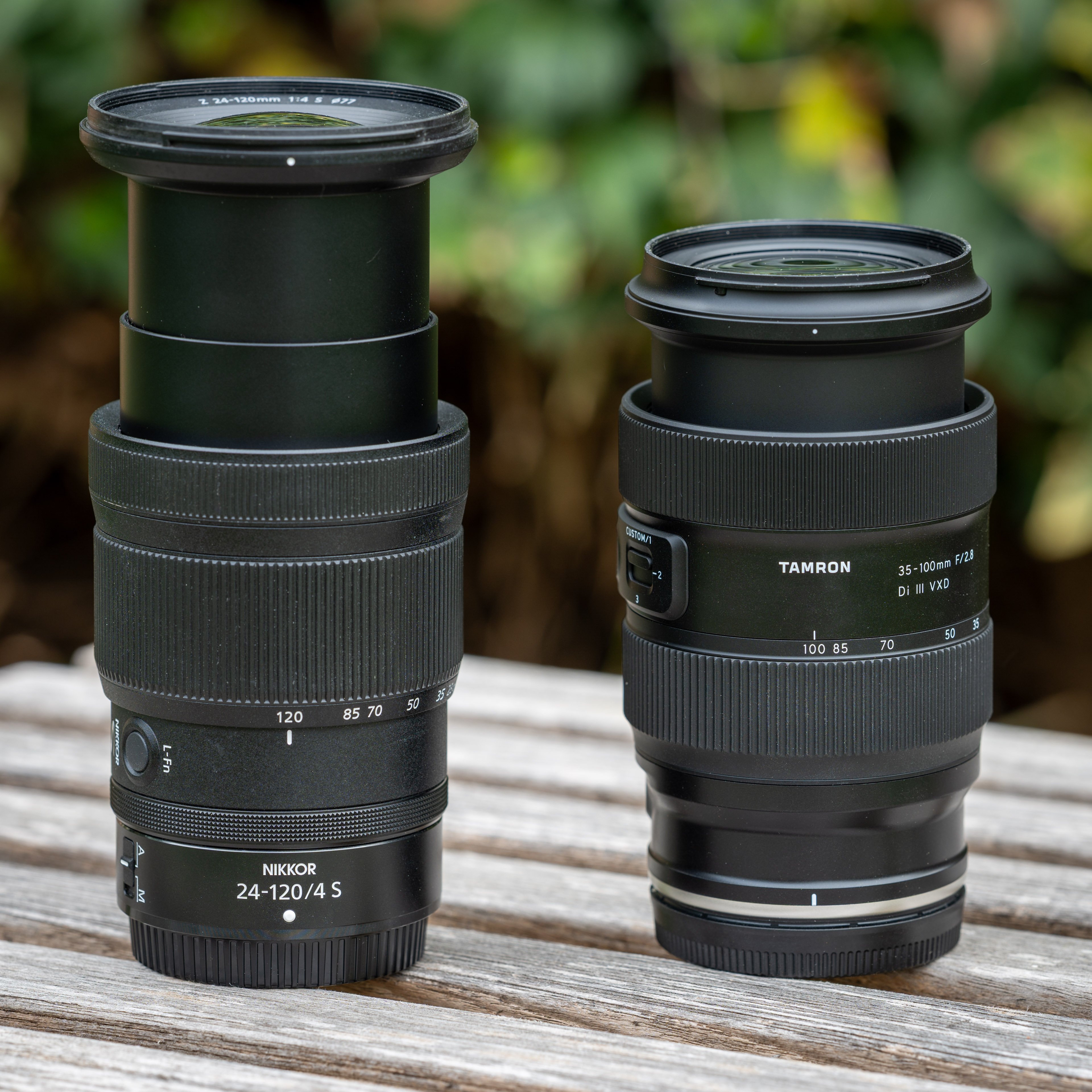
Above: Nikon Z 24-120mm f4 S, Tamron 35-100mm f2.8 Di III
Coverage
The Tamron 35-100mm f2.8 Di III has a 2.9x zoom-range and covers a unique range of focal lengths from mild wide-angle to short telephoto at a constant f2.8 focal ratio. There are other lenses with a larger zoom-range but (apart from the Tamron 35–150mm f2–2.8 Di III) only at f4.0 like the Nikon Z 24-120mm f4 S or the Sony FE 24-105mm f4 G OSS. Or you have the classical 24-70mm f2.8 (or 28-75mm f2.8) zoom lenses. Here is the angle of view that the Tamron 35-100mm f2.8 Di III covers compared to other lenses (Distortion control set to On):
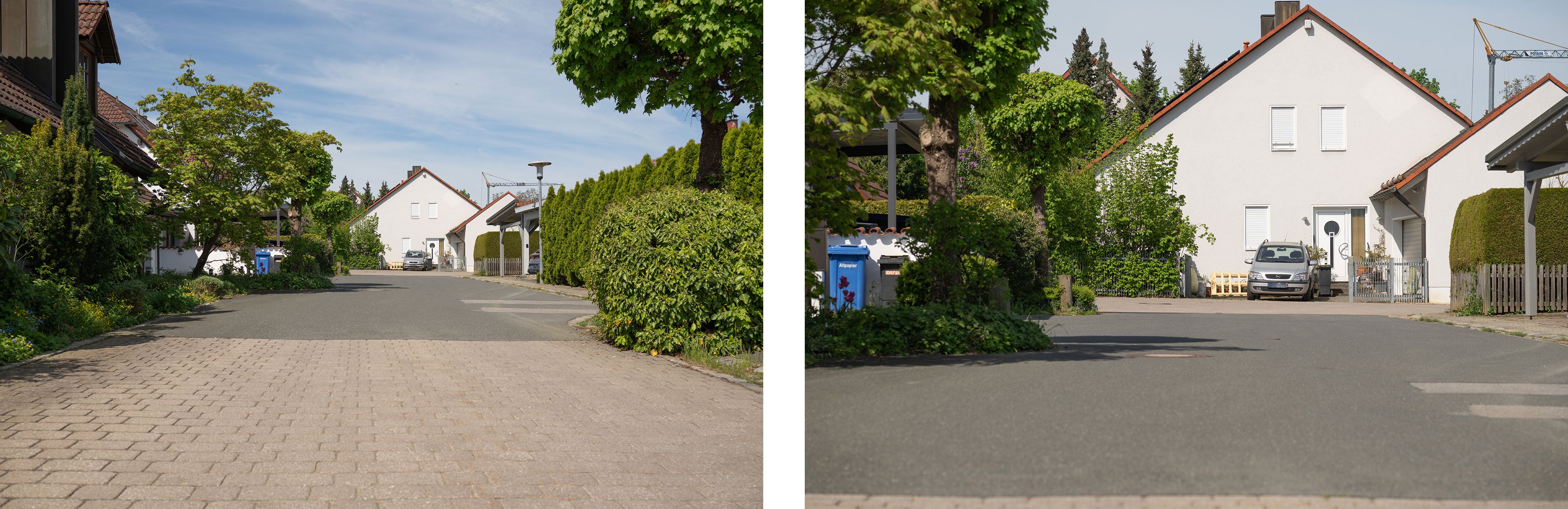
Above: Tamron 35-100mm f2.8 Di III coverage on a full-frame camera at 35mm (left) and 100mm (right); click image for 4k version

Above: Tamron 35–150mm f2–2.8 Di III coverage on a full-frame camera at 35mm (left) and 150mm (right); click image for 4k version
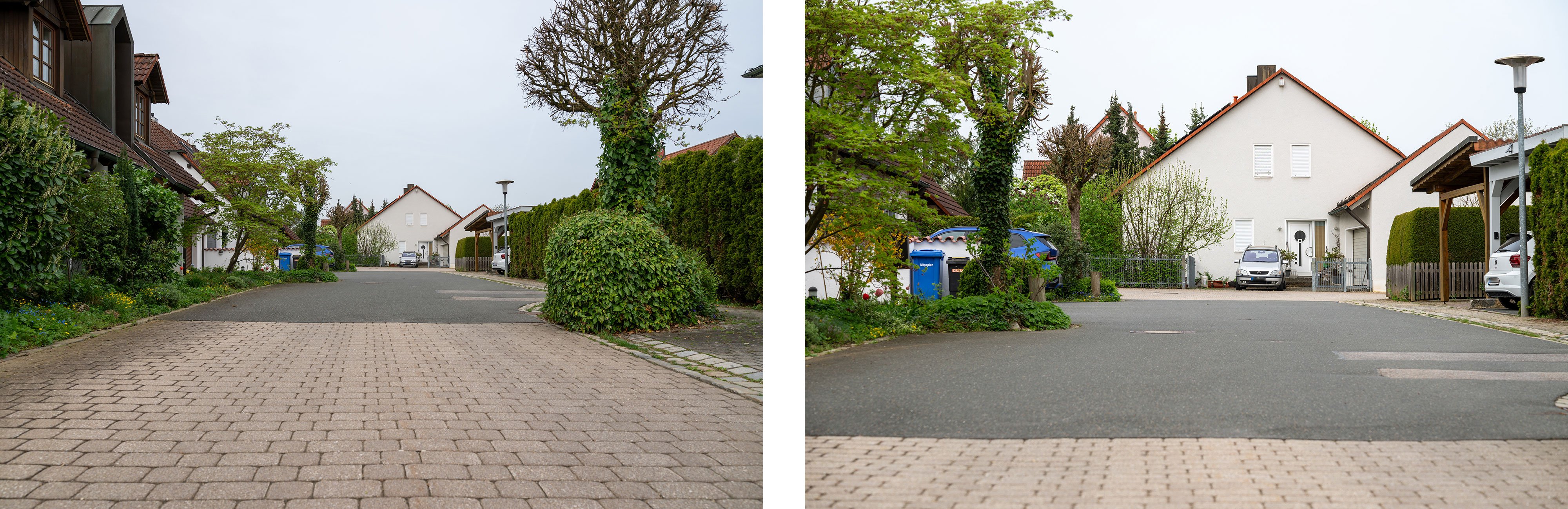
Above: Tamron 28-75mm f2.8 Di III G2 coverage on a full-frame camera at 28mm (left) and 75mm (right); click image for 4k version
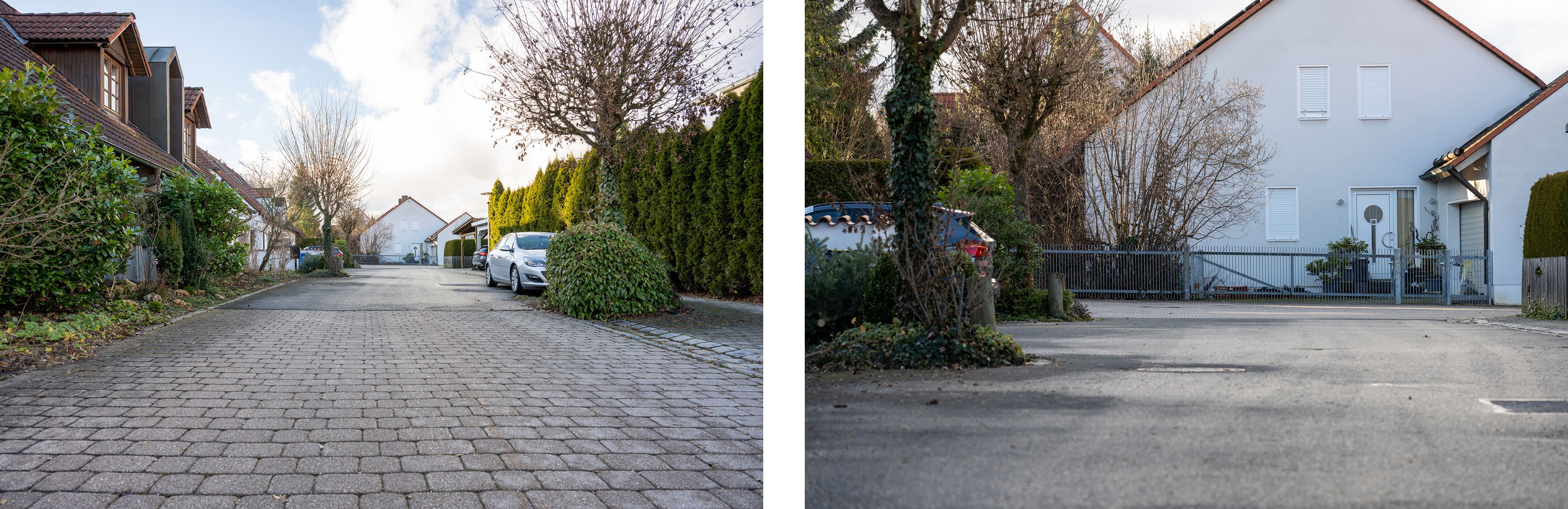
Above: Nikon Z 24-120mm f4 S coverage on a full-frame camera at 24mm (left) and 120mm (right); click image for 4k version
At both the long and the short end the differences in angle of view are quite pronounced and cannot always be compensated for by stepping back or cropping. So it’s important to understand your photographic needs when deciding between one of those lenses – and also to take into account which other lenses might cover the range below 35mm or beyond 100mm focal length.
Focus and zoom
Focus accuracy and repeatability is critical to consistently produce sharp shots. Repeatability (the accuracy of focus on the same subject after repeated focus-acquisition) of the Tamron 35-100mm f2.8 Di III is not the best at the long end (93.3% measured with Reikan FoCal). There were no real outliers over a series of 40 shots on the well lit and contrasty focus test target but quality of focus often changed by 5-10% from shot to shot. AF consistency of the Tamron 28-75mm f2.8 G2 was slightly better on average (94%) but produced two clear outliers, the Nikon Z 24-120mm f4 S measured 98.8% with no outliers.
On a Nikon Z8 and at 100mm focal length the 35-100mm f2.8 Di III focuses at around 0.3 sec from infinity to 1.11m (1:10 magnification) which is fast but I’ve seen faster voice coil drives. Another consequence of the new drive technology: When powered down the focus group(s) inside the lens can move freely which leads to a low clunking sound when you shake the lens. But that’s the same with every other voice coil driven lens I tested so far.
The zoom ring has a throw of about 64 degrees and a 20mm wide rubber surface with a good grip. Rotation is pretty stiff but the lens still shows a bit of zoom creep. The focus ring is 19mm wide and is located at the front. It also has a rubberized surface, moves smoothly, and can easily be operated even with your pinky.
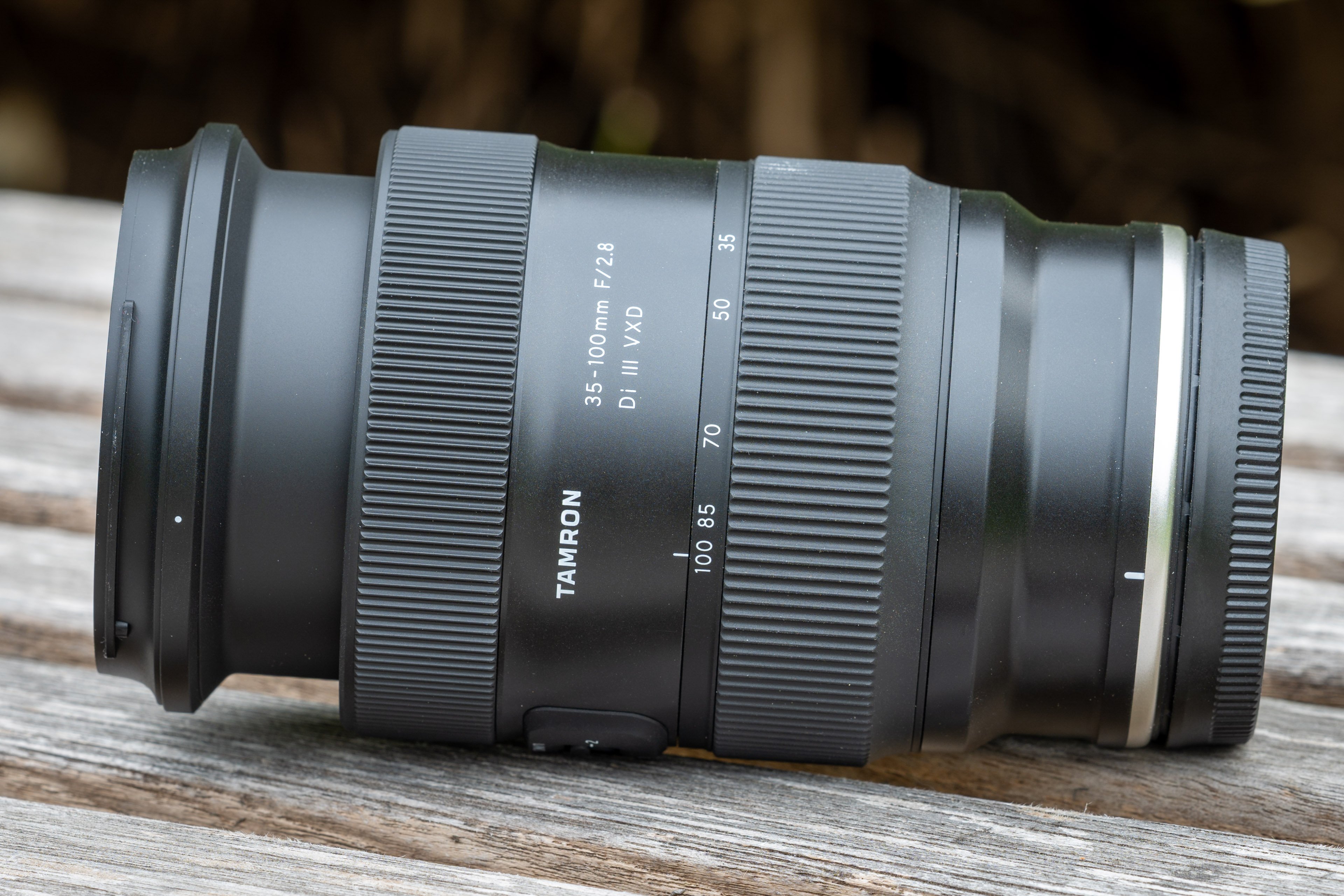
In photo mode AF-operation is inaudible from the outside. If you record video with the built-in microphone the AF-drive and operation of the zoom ring is quiet – until you hit the limits of the zoom range with a slight “tock”.
As you pull focus, you’ll notice only little focus breathing: The image became 2.3% more magnified when I adjusted focus from infinity to 1.11m at 100mm focal length. The same test at 35mm focal length produced a 0.4% increase in magnification.
I also tested whether Tamron’s zoom lens allows you to change the focal length without altering its focus. This characteristic is called parfocal. I focused the lens at 100mm and then slowly zoomed back checking focus on the way. The 35-100mm f2.8 Di III kept its focus perfectly over the complete zoom-range.
Next check out my quality results!
Check prices or buy the Tamron 35-100mm f2.8 Di III VXD at B&H, Adorama, WEX UK or Calumet.de. Buy used gear from MPB. Sell your used gear to MPB. Or why not treat yourself to a copy of my In Camera book, an official Cameralabs T-shirt or mug, or treat me to a coffee! Thanks!