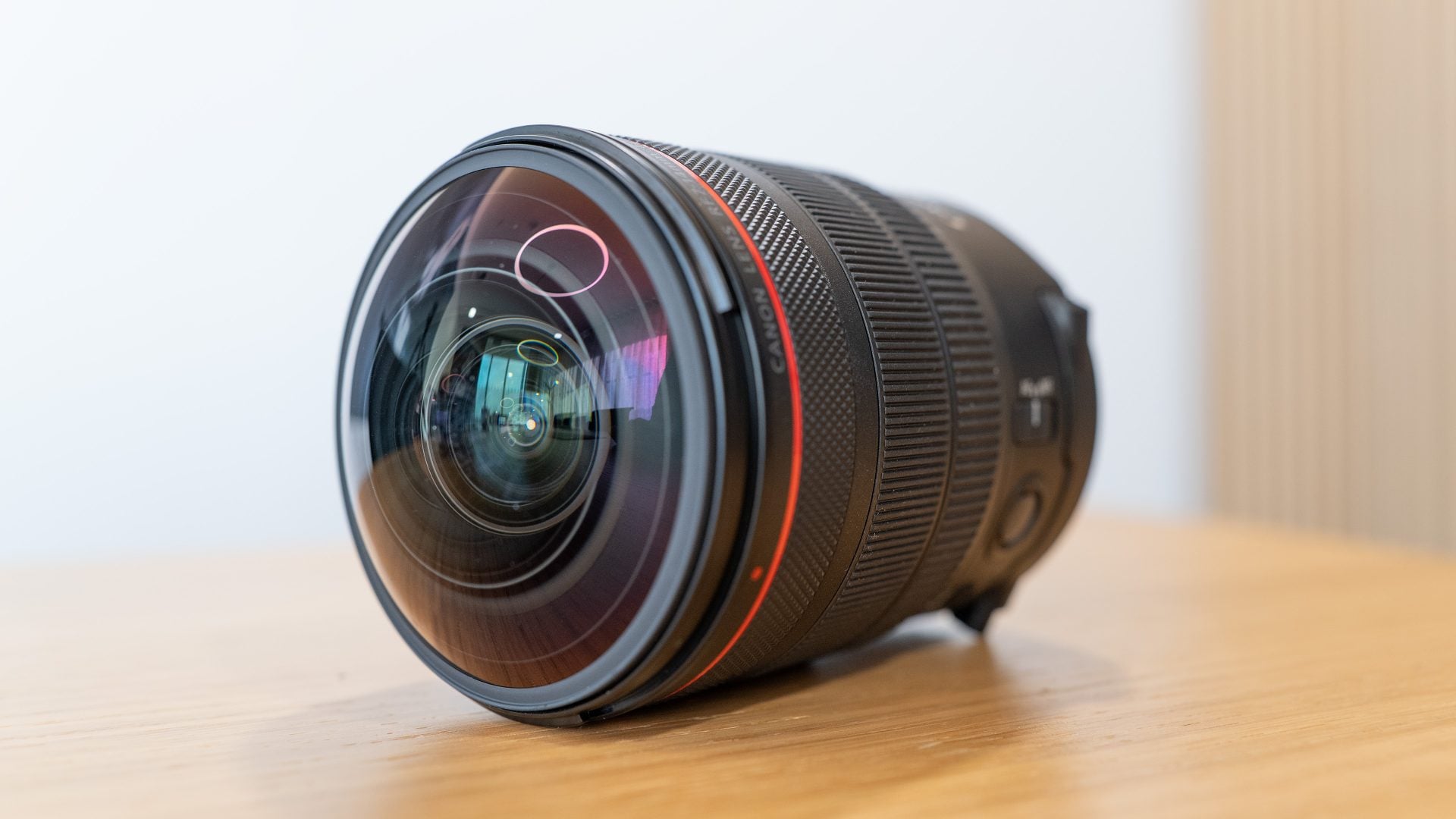
 The Canon RF 7-14mm Fisheye may be an unapologetically specialist lens but remains a welcome addition to the EOS R lens catalogue, delivering both diagonal and fully circular Fisheye images on full-frame systems. Lest we forget native mirrorless Fisheye lenses are still a rarity from the main camera companies, leaving most options to third parties which on Canon’s mount have to be manual focus.As you’d expect, it’s a well-featured lens with excellent optical quality in my tests so far and solid build quality too, as well as having autofocus and a handy drop-in filter system. It’s also brighter and wider than Canon’s previous EF Fisheye zoom. As always there’s a price difference to weigh-up, with the older EF lens available for around two thirds the price new if you can find it, or cheaper still on the used market. Then there’s Laowa’s 8-15 Fisheye which is also available for EOS R, sports a constant f2.8 aperture, and sells for less than half, albeit without autofocus, weather-sealing or a slot-in filter system. Ultimately the new RF 7-14 Fisheye Zoom is an unashamedly premium option with a high-end feature-set and price tag to match.
Canon RF 7-14mm f2.8-3.5L Fisheye review
-
-
Written by Gordon Laing
The Canon RF 7-14mm f2.8-3.5L Fisheye zoom is their first traditional Fisheye lens for the EOS R mirrorless system. I say their first traditional as there’s already three different dual Fisheye lenses for EOS R designed specifically for creating 3D and VR content.
This new lens however has just one set of optics and is aimed more at photography or 180 degree VR. For example astrophotography or big sky views, dramatic landscapes, large interiors or extreme sports like skate-boarding, snow boarding or skiing.
I had a chance to briefly try it out and in the video below you’ll see some initial tests and results for it in action. Or if you’d prefer the written highlights, keep scrolling!
Announced in February 2026, it’s a specialist lens that can deliver both diagonal and circular Fisheye images on full-frame cameras. Both types embrace distortion to squeeze a huge field of view – in this case up to 190 degrees across the diagonal. But a diagonal Fisheye image fills the whole frame, while a circular Fisheye reveals the whole imaging circle, intentionally surrounded by black. This lens gives you both types when using full-frame bodies.
And while the field-reduction of Canon’s cropped bodies rules out a fully-circular image at the short-end, this lens can still deliver a diagonal Fisheye image on an APSC sensor, and even includes a zoom range limiter switch to avoid the shorter focal lengths where some corner darkening can become visible.
It’s actually Canon’s second Fisheye zoom, following the EF 8-15mm f4L launched 15 years previously in 2011. This DSLR lens is still on sale in some regions for around $1400 and can be adapted to mirrorless systems.
EF 8-15mm f4L Fisheye: 77x83mm, 540g // RF 7-14mm f2.8-3.5L Fisheye: 79x112mm, 476g
Here’s the old EF model on the left alongside the new RF lens on the right, both fitted with their removable hoods. They share a similar barrel diameter, 77mm for the old model versus 79 for the new one, but the latest RF model is 26mm longer.
That said, the EF lens is designed for a DSLR and once you add an adapter for a mirrorless camera they become essentially the same length, interestingly with their zoom rings now at roughly the same position.
I wonder if they share some design elements, but there are certainly key differences. Optically the new lens captures a wider field of view of 190 vs 180 degrees and is a little brighter too at f2.8-3.5 vs f4.
Canon also says the new lens also uses Equidistant projection to allow 2D 180 degree VR video conversion, versus the EF 8-15mm which used Equisolid-angle projection.
More obviously, pick them up and you’ll notice the new RF version is lighter at 476g versus 540g for the old one, and that’s also before factoring-in a mirrorless adapter if you’re using one.
While it is possible to adapt the old EF model successfully to mirrorless, Canon owners actually have a third Fisheye zoom option to consider. In 2024, Laowa launched an 8-15mm f2.8 Fisheye zoom in a variety of mounts including Canon RF, and that was allowed since it’s a manual focus lens with no electronic communications.
Measuring 76mm in diameter and 95mm long, the Laowa is also in a similar ballpark size-wise, although heavier at 650g due partly to its constant f2.8 aperture.
It costs around $700 or pounds, so less than half the price of the new Canon, albeit lacking autofocus, weather-sealing and a slot-in filter solution. I have a review of it if you’re interested.
Ok let’s start with coverage since that’s the really exciting part of a Fisheye Zoom. When set to 7mm on a full-frame body, this exotic lens delivers a full circular fisheye image with a 190 degree field of view, ten degrees broader than the EF 8-15. Notice the dark area outside of the imaging circle. This is intentional.
As you zoom the lens to longer focal lengths, the imaging circle grows and gradually becomes cropped by the sensor until the image fills the frame with a rectangular image at between 12 and 13mm. This is still delivering the same 190 degree field of view as before, but now only across the diagonal.
Then for the remainder of the zoom range to 14mm, the field crops a little across the diagonal, until it delivers around 180 degrees. Compare that to the EF 8-15 which captured a maximum of 180 degrees, before narrowing slightly to 175.
So if this is the first Fisheye zoom you’ve come across, the first point to note is this 7-14 does not give you a 2x range like a traditional 7-14 would. Instead it’s closer to 1.1x and is more about delivering two Fisheye lenses in one: a circular fisheye and a diagonal full-frame fisheye, with the latter giving you a little extra adjustment to the crop.
If you’re filming 16:9 shaped video as seen here, the image will be cropped vertically. So here’s how it looks at the longest length of 14mm, and as I reduce the focal length you’ll see the imaging circle begin to appear, but of course the full circle from top to bottom isn’t possible in this format.
But if you couple the lens with a full-frame body that can film in Open Gate, like the R6 III used here, you can capture the full height of the sensor with the chance for an uncropped full circular Fisheye image on video – take that Sony, no amount of stepping back will give you this!
So here the coverage is identical to shooting stills, and both are in the 3:2 shape, which becomes apparent here from about 11mm upwards as the circle is gradually cropped-out to become a full rectangle.
If you’re using a Canon body with a cropped APSC sensor, then you’ll obviously not get a fully circular image for photo or video. Here’s how it looks at the shortest 7mm length. But you will get a full diagonal Fisheye at 9mm with no vignetting between here and 14mm.
Interestingly the lens is fitted with a limit switch that can lock the range between 9 and 14mm for cropped bodies. The switch can also be used to lock the lens at 7mm for anyone who just wants to use it at the shortest length during a session, for example full-frame owners who want the full circular image without accidentally nudging the zoom ring and cropping.
In terms of design, the barrel maintains a pretty uniform diameter, and as an L-lens, is weather-sealed throughout, including a rubber grommet at the mount.
Closest to the lens mount is a drop-in filter system that’s compatible with the same filters as the EF to EOS R adapters. The lens is supplied with a clear filter for normal use, but this can be swapped for optional Circular Polariser or Variable ND filters, both of which include small dials to turn them within the frame.
You can see the variable ND filter here where you can turn the wheel to adjust its opacity. Very useful for maintaining motion-friendly shutter speeds when filming video.
And here’s the view through the lens when adjusting the optional Circular Polariser filter. You can see the sky darkening and the reflections on windows reduce as I adjust the wheel, here with the lens at 7mm.
And now at 14mm where again notice the sky colour and window reflections.
Of course you can achieve the same functionality when using the earlier EF 8-15mm Fisheye Zoom coupled with the EF to EOS R filter adapter, but it’s still nice to see it built-into a native RF mirrorless lens. That said, if there’s room for the filter system at this end of the barrel though, I do wonder how much of the new lens is based on the earlier DSLR design.
Next up are three controls, the AF / MF switch, a custom focus hold button and the Limit switch discussed earlier.
Next comes the first of three rings to operate the zoom, which like all L lenses turns very smoothly. If you watch the front, you may see some internal elements moving as you zoom, but the barrel and front element themselves don’t extend. This is in contrast to the earlier EF 8-15 f4L where the inner barrel shifted up and down by a couple of mm as you zoomed.
Again notice how the Limit switch prevents the zoom from shortening beyond about 9mm to avoid vignetting with cropped APSC bodies whether from the imaging circle or the lens hood, which I’ll demonstrate in a moment. And again it can also be locked at 7mm to stay as a fully-circular Fisheye on full-frame systems.
Next is the manual focusing ring, which like most mirrorless lenses is free-spinning versus the mechanically-linked one with distance markings on the EF model. Like the EF model though, the focusing is internal.
And finally at the end is a clicky RF control ring, a handy extra which can be customised as desired.
Like all Fisheye lenses, there’s a bulbous front element which you’ll need to take care of. Canon supplies a hood that twists onto the end of the barrel, and a substantial cap that slides over the top and clips into place.
Note like the EF 8-15 before it, the lens hood should only be used at the longer focal lengths as it will cause quite dramatic vignetting if left on at the short-end. But you will need the hood fitted in order to then slide-over the protective cap, so you will be taking it on and off quite a lot. So whereabouts does it become an issue in the range?
Here’s a sequence of shots taken on a full-frame body with the hood fitted, where at 12mm you’ll notice the imaging circle just appearing in the corners, but from 11mm onwards, the shape of the hood appears and becomes progressively intrusive.
I’ll now toggle between the hood on and off at the shortest focal length of 7mm. To be fair, this is no different from the earlier EF 8-15mm, where you also had to remove the hood at shorter lengths, and Laowa’s zoom doesn’t even have a hood at all. But it is something to bear in mind as it will need to be removed below 12mm, but fitted when you want to use the cap.
If you’re using a cropped APSC body, it’s obviously less obtrusive. I’ll toggle the worst-case scenario here at the shortest length of 7mm where it’s clearly visible but not disasterously-so.
And the hood becomes invisible from 9mm upwards, which also coincides with the locked range. So APSC owners could lock the range between 9 and 14mm and keep the hood fitted without issues.
A quick note on the aperture which varies between f2.8 at the short-end, dimming two thirds of a stop to f3.5 at the long-end. Not a huge drop, but as always worth noting where the changes take place.
So the lens starts at f2.8 at 7mm, but quickly dims to f3.2 at 8mm. This is maintained until 11mm when it dims to f3.5 for the rest of the range up to 14mm.
This still makes it brighter throughout the range than the earlier EF 8-15mm which had a constant f4 aperture, although Laowa trumps both Canon’s with a constant f2.8 aperture.
Ok, now let’s have a look at the quality of the lens. It’s going to be brief as I didn’t get to spend long with it for this initial report, but it was a reviewable sample, and I tested it on an EOS R6 III body.
So you’re looking at an image taken at 14mm with the aperture wide-open at f3.5. Taking a closer look in the middle shows a good degree of sharpness out of the gate.
As I close the aperture, there doesn’t appear to be much to gain in terms of sharpness and detail in the middle.
So let’s return to the f3.5 sample and head into the corner, where again the details look nice and crisp. And as in the middle, closing the aperture doesn’t make much difference to the corner details. So a good start in this first test.
Next let’s take a look at the short-end of the range at 7mm on full-frame where you see the whole imaging circle. You’re looking at an image taken at the maximum aperture of f2.8.
Taking a closer look in the middle again shows nice sharp details out of the gate and nothing to complain about. Closing the aperture one stop at a time to f8 again doesn’t seem to show any benefits in terms of sharp details.
So let’s return to the f2.8 sample and head towards the edge of the imaging circle. Here you’ll see sharp details are maintained right up to the edge with the transition from image to darkness being marked only by a thin blueish border. Remember for a crisp circle, you can easily apply a circular mask in post.
And once again, stopping the aperture down doesn’t seem to make much if any difference to the sharpness of details. Since fisheyes are often used for big architectural views, this performance bodes well.
With such a huge field of view, it’s easy to include the Sun in a Fisheye composition, so it’s useful to check diffraction spikes and flare.
Here I’m pointing directly at a slightly hazy UK Winter Sun at 14mm f3.5, so let’s now gradually close the aperture to see the impact of the diaphragm system. Spikes begin to become apparent at f11, but are sharpest and best-defined at f16, f22 and the minimum aperture of f29 at this focal length.
Here’s a video clip I filmed at 14mm f29 showing the diffraction spike effect. As a sample lens the view may not be meticulously clean, sorry.
And now for the view at 7mm where the aperture closes to a minimum of f22, but the spikes are still nice and sharp. This bodes well for action sports which include the Sun or night views with lights.
Next for flare, first with the lens at 14mm f8 panning to and from a direct view of the Sun where flare looks to be reasonably under control in this example.
And next at 7mm f8 where you may notice some minimal flare effects as I pan the camera and lens, but it’s not particularly obtrusive. In fact much more obvious here are marks on the front element, so you should take care to keep it as clean as possible.
Next for a quick focusing test at 14mm f3.5 and from near to the closest focusing distance of 15cm. Here you can see the STM focusing motors snapping between the cap and the background quickly, and they were effectively silent too.
So here’s a test at 7mm f2.8 where again the focusing is swift and quiet. And as noted earlier, the focusing is internal, so nothing moves on the outside while autofocusing.
How about continuous AF for video? Here’s the lens at 14mm f3.5 where even from a close distance you can appear miles away. As I get really close to the lens, there is of course the expected distortion, but you can see some minor blurring in the background at the maximum aperture.
And now at 7mm f2.8, where the enormous field of view could end up capturing your tripod leg. Like other fisheyes, anything directly across the middle can avoid distortion, but again get close and you will see distortion, so why not embrace it by paying homage to the hotdog fingers of Everything Everywhere all at Once or perhaps some Beastie Boys recreations? Which brings me to my verdict so far.
Verdict so far
The Canon RF 7-14mm Fisheye may be an unapologetically specialist lens but remains a welcome addition to the EOS R lens catalogue, delivering both diagonal and fully circular Fisheye images on full-frame systems. Lest we forget native mirrorless Fisheye lenses are still a rarity from the main camera companies, leaving most options to third parties which on Canon’s mount have to be manual focus.
As you’d expect, it’s a well-featured lens with excellent optical quality in my tests so far and solid build quality too, as well as having autofocus and a handy drop-in filter system. It’s also brighter and wider than Canon’s previous EF Fisheye zoom. As always there’s a price difference to weigh-up, with the older EF lens available for around two thirds the price new if you can find it, or cheaper still on the used market. Then there’s Laowa’s 8-15 Fisheye which is also available for EOS R, sports a constant f2.8 aperture, and sells for less than half, albeit without autofocus, weather-sealing or a slot-in filter system.
Or of course if you prefer a more natural-looking ultra wide-angle, Canon has several RF zooms including the 10-20, 14-35 and 15-35 as well as primes from the budget 16 2.8 to the new high-end 14 1.4 launched alongside the Fisheye. Oh and I have a separate video about that one by the way.
Ultimately the new RF 7-14 Fisheye Zoom is an unashamedly premium option with a high-end feature-set and price tag to match. I’m glad there’s now one in the range, although it might also be fun to have a budget prime Fisheye alternative for fun, a bit like the RF 16. If you’re wanting to film skate or snow sports at extremely close range, I’d certainly feel more comfortable with a cheaper option.
Check prices or buy the Canon RF 7-14mm f2.8-3.5L Fisheye at B&H, Adorama, WEX UK or Calumet.de. Buy used gear from MPB. Sell your used gear to MPB. Or why not treat yourself to a copy of my In Camera book, an official Cameralabs T-shirt or mug, or treat me to a coffee! Thanks!