 The Canon EOS R6 Mark III is a powerful camera that slots between the existing R6 Mark II and R5 Mark II. The major upgrade over its predecessor is a higher resolution sensor, roughly matching the photo resolution of Sony’s A7 IV and V while supporting higher resolution video than both Sonys or the R6 II. The top burst speeds may remain 12 or 40fps with the mechanical or electronic shutters, but there’s now a much more practical pre-burst mode and the chance to clear the buffer faster with a CF Express card. Event, wedding and sports photographers will also love the ability to register key faces to give them priority over others in group compositions. Videographers get uncropped and oversampled 4k up to 60p, uncropped 4k 120, full-size HDMI, and the chance to internally record 7k RAW up to 60p or Open Gate video up to 30p that uses the full sensor height. Arguably the biggest downsides are an unstacked sensor and a lack of vents or cooling options, so you’ll need to watch out for potential skewing and limited recording times in the more demanding video modes. I say potential as until I test a final sample, I can’t say for sure how it’ll look or how long it’ll record. Check back soon for my in-depth review and comparisons against Sony’s A7 V!
Canon EOS R6 Mark III review
-
-
Written by Gordon Laing
The Canon EOS R6 Mark III is a full-frame camera with 32.5 Megapixels, IBIS, 40fps bursts, and 7k RAW video. Announced in November 2025, it shares essentially the same launch price as the R6 Mark II launched exactly three years previously.
But the R6 Mark III doesn’t directly replace it. Instead the older R6 Mark II will continue to sell in some regions throughout 2026 and maybe longer still at a lower price. I spent a brief time with a pre-production R6 III for my video below, and will follow-up with my usual in-depth review as soon as I spend some quality time with a final production sample. So here are the highlights and differences so far, and keep scrolling if you prefer to read the written version!
I’ll start with imaging, with the R6 III inheriting the same 32.5 Megapixel full-frame CMOS sensor introduced on the EOS C50 Cinema camera launched two months previously. You can choose whether the mechanical shutter curtain closes when powered down.
This is not a stacked or partially-stacked sensor, so some skewing will inevitably be visible in electronic photos or video; until I test a final R6 III, you can use C50 results as an idea of what to expect in terms of readout speed.
The sensor gives it an 8.5 Megapixel boost over the 24 Megapixel R6 II and roughly matches the photo resolution of Sony’s A7 IV, although of course that camera is now four years old and a successor is expected soon. Canon’s also exploited the sensor resolution to offer higher resolution video than either the Mark II or A7 IV, more about which in a moment.
The standard sensitivity range runs between 100 and 64000 ISO, with extended Low and High options at 50 and 102400 ISO. Note the C50 cinema camera employs a dual-base ISO system, but Canon informed me the R6 III does not; I’ll be confirming that in my final review.
While the R6 III shares the same sensor as the C50 though, it’s coupled with IBIS here rated up to 8.5 stops of compensation. That’s half a stop more than the R6 II in theory, but in practice I only personally achieved four stops on the Mark II, so I’ll be interested to see if Canon’s improved that. Either way, if you liked the C50 for its sensor but wished it had IBIS, the R6 III could be for you.
From the photo quality menus you can choose RAW or Compressed RAW both at the full resolution, along with full-size or four lower resolutions for compressed JPEG or HEIF images. Four of these options offer a choice of two compression levels.
The native shape is the usual 3:2, but you can alternatively shoot in cropped 1:1, 4:3 or 16:9 shapes, or apply a 1.6x crop for use with APSC lenses at a reduced photo resolution of 12.7 Megapixels, or 4k up to 60p. I couldn’t find a pixel-shift high-res mode or AI upscaling options, but there are multiple exposures, focus bracketing, an interval timer and Bulb timer.
Meanwhile the shutter offers Mechanical, Electronic First Curtain or fully Electronic modes, versus the C50 which is electronic only. The burst speeds and fastest shutter are the same as the R6 II, so in full mechanical you’re getting up to 12fps and a fastest exposure of 1/8000, while in full Electronic you’re getting up to 40fps and a top speed of 1/16000. Note you may need to use the latest battery to support the fastest burst speeds.
Like the R6 II, the Mark III also offers pre-shooting options when shooting electronically, but thankfully the cumbersome RAW burst mode of the Mark II has been swapped for a more usable pre-continuous mode that records normal images as separate files. It’s a great feature for grabbing the perfect moment a bid takes flight or a player strikes a ball.
Moving onto autofocus, the R6 III uses Dual Pixel CMOS AF II, with a wealth of AF areas from spot to expand and flexible zones. In terms of subject detection, you can choose between people, animals and vehicles, or go for the Auto mode which worked really well on the Mark II.
So far so similar, but the R6 III now inherits the same Register People Priority modes of the R5 II which lets you register specific faces to give them priority over others in a group environment. This is a brilliant feature whether you’re concentrating on a couple at a wedding, the boss at a work event or key sports players. I believe the implementation is the same as the R5 II, so check my R5 II review to see it in action.
Moving onto video, the R6 III can record uncropped 1080 up to 180p or uncropped 4k up to 120p, a boost over the R6 II and A7 IV which stopped at 4k 60, and lest we forget the Sony only offered 4k at 60p with a crop. Note in my video I’m showing PAL menus so you’re seeing 25, 50, 100 and 150 frame rates.
You can record in either 16:9 or wider 17:9 DCi shapes, and a 4k Fine mode will over-sample up to 60p. Note 4k 100 and 120 are not oversampled, but lest we forget while the higher-end R5 II does offer 8k, it doesn’t sport over-sampled 4k at 60p outside of RAW.
Like other recent Canons you can encode in XF-AVC S in 8 or 10 bit or in XF-HEVC S in 10 bit with 420 and 422 options. There’s also now internal 7k RAW recording at up to 60p, a decent boost over the R6 II or A7 IV in potential detail and dynamic range.
In the absence of a cooling fan or even just vents, it remains to be seen how long the camera can record in the more demanding formats before over-heating; this is a key benefit of the C50 which has built-in cooling, and the R5 which has vents and a cooling fan grip accessory.
Also note the Open Gate menu, with the R6 III following the C50 to allow the option to record the full height of the 3:2 sensor, providing greater flexibility in post. Open Gate is only available when you’re shooting in the XF-HEVC S or RAW formats and reduces the top frame rate to 7k 30p. You can also film in up to 4k 60 in the cropped APSC mode, but it’s not oversampled.
There’s also a pre-record option for video with three or five seconds, digital stabilisation with an option of cropped subject tracking, and timecode, I believe over Bluetooth. Meanwhile under the Custom Picture menu you can access C-Log 2 or 3 for grading. Nice to have them both here.
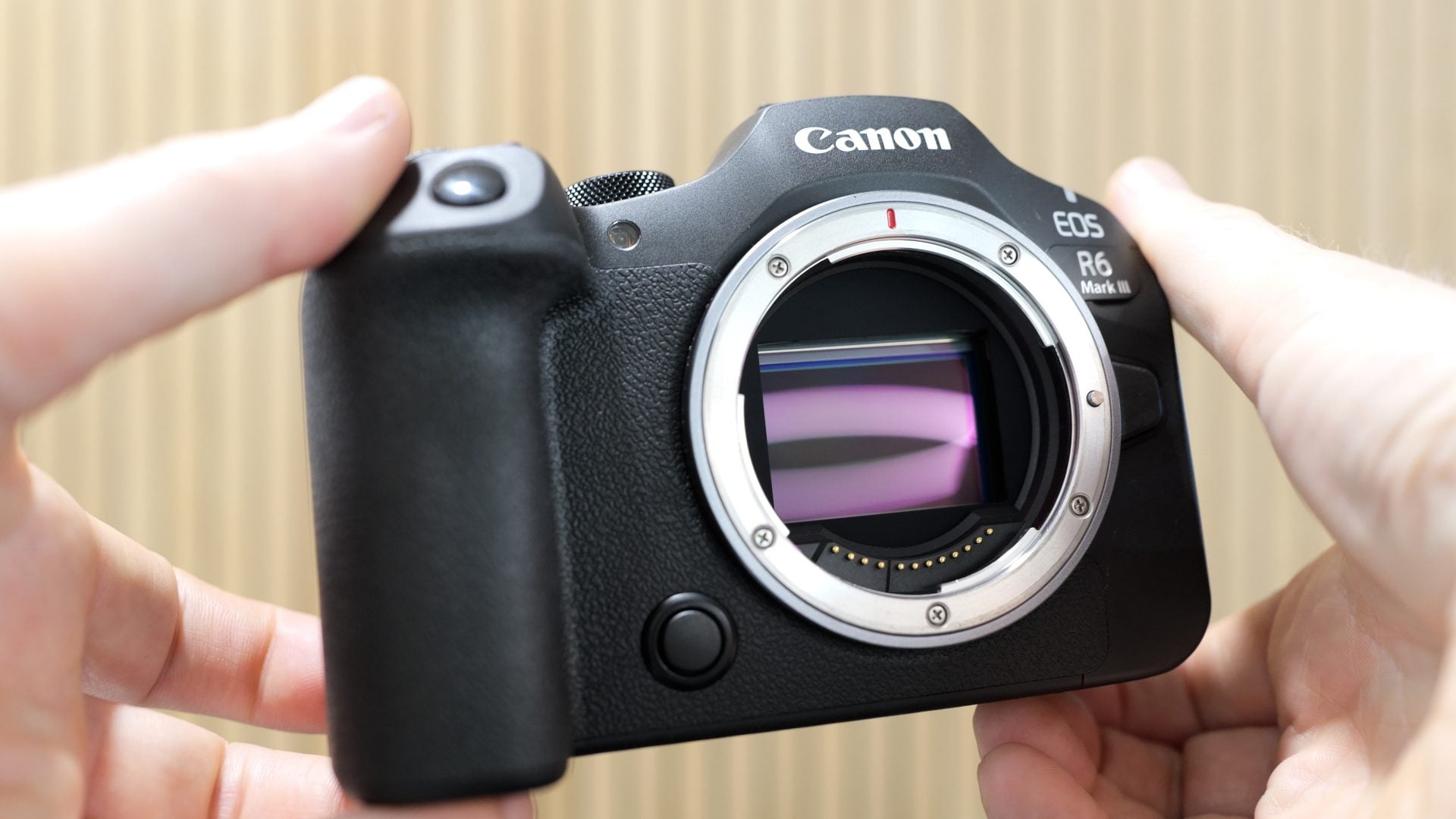
Ok now for a physical tour around the body. As I alternate between the Mark III and the older Mark II, notice the subtle change of the upper shape, and the inclusion of a tally lamp above the EOS logo. The dimensions are the same as the Mark II, and while it is fractionally heavier, you’re only looking at 29g extra when both are fitted with their batteries, so it feels essentially the same in your hands.
From the top, the Mark III also looks almost unchanged from the Mark II. So the top thumb dial has a chunky power collar with a locking position, and there’s also front finger and rear wheel controls.
The mode dial is subtly different, dropping the Auto Movie and Effects positions, but adding one devoted to video Slow and Quick modes, or S&Q for short. Meanwhile on the left side is the same switch to select between photo and video modes, while atop the viewfinder head is one of Canon’s Multi Function shoes.
Turning to the rear, the controls appear exactly the same, including that flat thumb wheel and a joystick. Note the Rate button in the upper left can now access colour options.
Composition appears to be the same spec as the R6 II before it, so you’re getting an OLED viewfinder with 3.69 million dots and a refresh up to 120fps. Remember the C50 does not have a viewfinder or an accessory for one. In my video, you can see People subject detection using the new RF 45mm f1.2 launched alongside it, and I have a separate preview of that lens if you’re interested.
Alternatively you can compose with the 3in touchscreen which has 1.6 million dots and a side-hinged mechanism that allows it to flip out and twist around to face you or back on itself for protection.
So far so similar, but open the door on the grip side and you’ll see the R6 III inheriting the twin card formats of the C50 and R5 II, so rather than a pair of SD cards, you’re getting one SD and one Type-B CF Express. There’s pros and cons to this, as while CF Express cards are quicker and allow faster flushing of the buffer, some will prefer both slots being SD and gravitate towards the older R6 II.
On the opposite side behind a series of rubber flaps you’ll find the ports. The main left flap is home to the 3.5mm microphone and headphone jacks, while below it is a 2.5mm remote terminal.
Open the main flap on the right and you’ll find USB C and HDMI, but in an important upgrade, Canon’s ditched the Micro connector of the previous Mark II for a full-sized port here – just like the C50 and R5 II, and about time too. Oh and the USB C port allows it to work as a standard UVC webcamp up to 4k 60.
Note there’s no vents for passive or active cooling here, so that remains a difference with the C50 and R5 II, so I look forward to seeing how long the camera can record in practice. Canon suggests two hours of 4k 30p in the oversampled Fine mode should be possible, but higher frame rates and RAW will almost certainly be limited.
Meanwhile the camera’s powered by the same LP-E6P as the C50 with Canon claiming 620 shots under CIPA conditions. Note using older battery types may limit compatibility with the most demanding burst or video modes, so be warned. For longer life or more to hold onto, the R6 III is compatible with two of the three grips designed for the R5 II: the BG-R20 or BG-R20EP, although on the latter the ethernet port is disabled.
With no vents, it’s no surprise the R6 III can’t use the cooling grip accessory of the R5 II, so that’s another differentiator with the higher-end model. Right, that’s everything I know so far, so time to wrap-up with my initial thoughts about the new camera.
Canon EOS R6 Mark III verdict so far
The Canon EOS R6 Mark III is a powerful camera that slots between the existing R6 Mark II and R5 Mark II. The major upgrade over its predecessor is a higher resolution sensor, roughly matching the photo resolution of Sony’s A7 IV and V while supporting higher resolution video than either the Sony or the R6 II.
The top burst speeds may remain 12 or 40fps with the mechanical or electronic shutters, but there’s now a much more practical pre-burst mode and the chance to clear the buffer faster with a CF Express card. Event, wedding and sports photographers will also love the ability to register key faces to give them priority over others in group compositions. This was one of the most useful features on the R5 II, and it’s now available at a lower price.
Videographers now get uncropped 4k 120p, albeit not over-sampled, a full-size HDMI port, and the chance to internally record 7k RAW up to 60p or Open Gate video up to 30p that uses the full sensor height.
Arguably the biggest downsides are an unstacked sensor and a lack of vents or cooling options, so you’ll need to watch out for potential skewing and limited recording times in the more demanding video modes. I say potential as until I test a final sample, I can’t say for sure how it’ll look or how long it’ll record.
In Canon’s World, they’d direct you towards the C50 or the R5 II if you need cooling for longer recording times. The R5 II also sports a higher resolution stacked sensor and more detailed viewfinder with eye control, although it’s also important to note the Lumix S1 II gives you a built-in fan and partially stacked 24 Megapixel sensor for much the same price as an R6 III.
It’s also interesting to compare the R6 III against the C50, sharing the same sensor but coming in cheaper while including a viewfinder, IBIS and mechanical shutter, although the C50 does have active cooling, dual-base ISO and more rigging options; it is after all a video model first.
If you’re a photographer or hybrid shooter, the R6 III looks competitive against the C50, but I’m pleased to see the older R6 II continuing as a more affordable option that offers the same burst speeds, excellent subject detection, and uncropped 4k 60.
Indeed for those happy with 24 Megapixel photos and 4k video, the R6 II remains a very capable and tempting option at increasingly discounted prices, and at those prices you should compare it closely against the Sony A7 IV.
As for the latest Sony A7 V, it shares essentially the same resolution, but from a new partially-stacked sensor that has potentially less skewing than the latest Canon, although as always I’ll wait to test them side-by-side before making any judgment. Like the R6 III, the A7 V also now offers uncropped and oversampled 4k video up to 60p, although on the Sony 4k 120 is cropped versus full-frame on the Canon. Plus the Canon R6 III also boasts internal and external RAW video, Open Gate options and wider DCI shapes, all lacking from the A7 V.
Check back soon for my in-depth reviews and comparisons!
Check prices on the Canon EOS R6 Mark III at B&H, Adorama, WEX UK or Calumet.de. Buy used gear from MPB. Sell your used gear to MPB. Alternatively get yourself a copy of my In Camera book, an official Cameralabs T-shirt or mug, or treat me to a coffee! Thanks!