Support Cameralabs by shopping at our partner stores or donating via Paypal
 

Follow me!
Camera Labs RSS Feed
Gordon Laing and Cameralabs on Google+
Camera Labs on Facebook
Camera Labs on Twitter

 
  Latest camera reviews

Olympus E-PM1
Nikon V1
Sony NEX-5N
Canon 100HS / 115HS
Canon 300HS / 220HS
Canon S100
GoPro HD Hero 2
Canon 510HS / 1100HS
Canon 310HS / 230HS
Canon SX150 IS
Olympus E-PL3
Canon SX40 HS
Sony NEX-C3
Panasonic GF3
Fujifilm HS20 EXR
Panasonic FZ150
Olympus E-P3
Panasonic FZ47 / FZ48
Nikon COOLPIX S9100
Sony Cyber-shot HX100V
Sony Cyber-shot HX9V
Panasonic FX77 / FX78
Canon SX230 HS
Canon EOS T3 / 1100D
Panasonic Lumix G3
Sony Cyber-shot TX10
Canon 500HS / 310HS
Nikon D5100
Sony Cyber-shot W510
Nikon COOLPIX L24
Canon PowerShot A1200
Panasonic FS18 / FH5
Canon PowerShot A800
Panasonic TZ18 / ZS8
Canon PowerShot A3300IS
Canon EOS 600D / T3i
Panasonic TZ20 / ZS10
Canon IXUS 1000/SD4500
Sony Alpha SLT-A33
Panasonic Lumix GH2
Nikon D7000
Canon PowerShot G12
Canon PowerShot S95
Panasonic Lumix LX5
Nikon D3100
Canon EOS 60D
Canon EOS 550D / T2i
Canon EOS 7D
Nikon D300s
Canon EOS 5D Mark II
Nikon D90

All reviews ....


  Best Buys: our top models
   
  Best Canon lens
Best Nikkor lens
Best Sony lens
Best budget DSLR
Best mid-range DSLR
Best semi-pro DSLR
Best point and shoot
Best superzoom
Best camera accessories


Camera Labs Forum

Any questions, comments or a great tip to share? Join our Forum and let everyone know.
   
 
  DSLR Tips


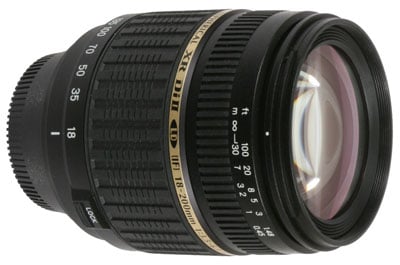
Tamron AF 18-200mm F3.5-6.3 XR Di-II LD IF Gordon Laing, August 2006


Tamron 18-200mm verdict


Delivering a focal range equivalent to 27-300mm on most DSLRs, the Tamron 18-200mm is a highly versatile lens. Its massive 11.1x zoom range allows you to capture both wide landscape shots and decent close-ups of distant subjects such as wildlife without worrying about carrying additional lenses.

Unsurprisingly a lens with this kind of focal range is rarely going to perform as well as one with a shorter range, but we were impressed overall by the results possible. Certainly unless you’re into extreme wide or telephoto work, or demand the ultimate quality, you could really be very happy with one of these lenses. Indeed many photographers could fit one and never take it off again – and that’s not only highly convenient but also greatly reduces the potential for dust to enter the camera body.

So an 18-200mm could be the ideal lens for you, but since the Tamron and Sigma models essentially cost the same, which one should you go for? Or is it really worth spending double on the Nikkor version?

Looking at the Tamron and Sigma results first, both lenses scored similarly in many respects: their macro, fringing, geometric distortion and vignetting results were essentially the same with only slight variations. Where they differed were in our outdoor and corner sharpness results.

As can be seen on our corner sharpness results page, the Sigma clearly doesn’t perform as well as the Tamron in the extreme corners at both their 18 and 200mm focal lengths. Switch to the outside test taken at a focal length of 35mm though, and the Tamron crops are noticeably less sharp than its rival. Comparing their physical characteristics, the Tamron’s a little larger and heavier than the Sigma, while its focusing is slightly louder. They’re subtle differences though.

Ultimately there’s not a great deal to choose between the Tamron and Sigma 18-200mm lenses. A handful of our results favoured one over the other, but neither took a decisive lead overall. Since the prices are essentially the same, we therefore have to call it a draw, and leave the final decision between which personally looks and feels better in your hand.

Which brings us to the Nikkor. It may offer the same focal range, but sports three key differences. Most importantly, there’s the inclusion of Vibration Reduction which as we illustrated in our review, effectively combats camera shake. Secondly there’s the slightly optically faster focal ratio of f5.6 at the telephoto end. Third, the Nikkor model boasts noticeably superior build quality which extends to the smoothness of the mechanics and silence of its focusing. In terms of our results, it also took the lead in corner sharpness and vignetting at wide angle, although the macro reproduction was less impressive.

The Nikkor 18-200mm is clearly a superior lens in many respects, but only you can decide if its benefits justify paying twice the price of the Tamron or Sigma. While we at Cameralabs believe its worth spending the extra on the Nikkor if you can afford it, anyone on a tighter budget can’t fail but be impressed by the sheer value of the Tamron and Sigma lenses. They both offer a very impressive deal for the money and come recommended.


Good points
Highly versatile 11.1x zoom range
Great value
Relatively small and light - great travel lens
Polariser-friendly internal focusing

Bad points
Sigma version very similar
Pricier Nikkor version has anti-shake
Pricier Nikkor version is optically faster
Pricier Nikkor version has better build quality


Scores
(relative to other zooms)
 

Build quality:
Optical quality:
Specification:
Value:

Overall:

17 / 25
19 / 25
20 / 25
22 / 25

78%
 

Support this site by checking prices below or shopping via our affiliate stores

USA readers


UK readers
Jessops discount voucher


All words, images, videos and layout, copyright 2005-2012 Gordon Laing. May not be used without permission.

/ How we test / Best Cameras / Advertising / Camera reviews / Supporting Camera Labs