Sony SAL-1118 DT 11-18mm f4.5-5.6 lens review
-
-
Written by Gordon Laing
In depth
The DT 11-18mm is the widest angle Sony zoom for Alpha DSLRs. Offering an equivalent range of 16.5-27mm, it delivers ultra-wide to standard wide-angle coverage and is compatible with both cropped-frame Alpha DSLRs and the earlier Konica Minolta Dynax / Maxxum 5D and 7D bodies.
Indeed despite being announced as a new Sony product during the Alpha launch of July 2006, the DT 11-18mm, like many Sony lenses, is actually a rebranded and slightly modified version of an existing Konica Minolta model. In this case, it’s based on the Konica Minolta DT 11-18mm, which was one of three digital-only DT models announced with the Konica Minolta Dynax / Maxxum 5D back in July 2005.
The DT 11-18mm offers a range which is ideal for capturing big landscape views and large buildings both inside and out. It’s also ideal for situations when you literally can’t step back any further, and can be used for very dramatic effects. And since the Alpha bodies feature built-in stabilisation, you’ll also enjoy anti-shake facilities with the DT 11-18mm. This allows you to use relatively long exposures to blur subjects in motion while still in a handheld environment.
The DT 11-18mm may only offer a relatively modest 1.63x optical zoom ratio, but its range perfectly complements the kit 18-70mm zoom, while only having a small amount of overlap with lenses which start at 16mm.
In this review we’ll put the Sony DT 11-18mm zoom through its paces and see how it complements the standard DT 18-70mm kit lens. Along with full tests across its focal range, we’ve directly compared results of the DT 11-18mm against the DT 18-70mm when both are set to 18mm to reveal which is the preferred choice at this popular focal length. As always we’ll also demonstrate the build quality, coverage and features in our Sony DT 11-18mm video tour. So read on to find out if this is the ideal ultra-wide solution for Alpha DSLRs.
Testing notes
The DT 11-18mm was tested using an Alpha A100 body using its factory default settings – unless otherwise stated. The lens had a serial number of 1804026.
Sony DT 11-18mm design and build quality
The Sony 50mm f1.4 prime lens, DT 18-70mm f3.5-5.6 kit zoom and the DT 11-18mm f4.5-5.6 are pictured below from left to right. The DT 11-18mm is zoomed to its shortest focal length and the DT 18-70mm zoomed to its mid-way 35mm focal length at which point the barrel is physically shortest. So these are the three lenses in their physically most compact configurations.
Measuring 83mm in diameter by 81mm in length when zoomed-out, the DT 11-18mm is noticeably wider but not a great deal longer than the kit zoom’s 66x77mm dimensions. Zoom the DT 11-18mm into its longest focal length and it extends by a mere 4mm or so – see photo below.
Its filter thread measures 77mm compared to 55mm on the kit zoom, and Sony generously includes a lens hood as a free accessory – this makes Canon look very mean in comparison, not including lens hoods with anything other than its premium L models.
In terms of weight, the DT 11-18mm weighs 360g to the kit zoom’s 235g, so while it’s obviously heavier, it can hardly be described as a burden to carry around. The build quality is superior to the kit lens and there’s also a tougher metal lens mounting, but in your hands they don’t feel miles apart. Before you take that the wrong way though, the DT 18-70mm feels good for a kit lens – it’s just that the DT 11-18mm isn’t a massive step ahead.
As you can see on the photos, the DT 11-18mm features decent-sized zoom and manual focusing rings, and both turn smoothly without catching. The general standard of construction and assembly is decent with no wobbles or creaks to mention. The fine-grooved rubber grips on the zoom and focusing rings do have a habit of collecting dust though, but as this is part of the Alpha styling, it’s something which affects all Sony lenses.
Sony DT 11-18mm optical design
The Sony DT 11-18mm employs 11 elements in nine groups and features a seven-blade aperture diaphragm. The maximum aperture of f4.5-5.6 is a little slower than some ultra-zoom rivals at the wide end, such as Canon’s EF-S 10-22mm f3.5-5.6, but matches most when zoomed-in. As we’ll see in the results, the DT 11-18mm performs better than the Sony kit zoom when both are set to 18mm, but if you opt for the ultra-zoom, you’ll obviously be losing more than a stop of light gathering power.
Sony DT 11-18mm focusing
The DT 11-18mm, like the vast majority of Sony lenses, employs the AF motor built-into Alpha DSLR bodies – and like the other Sony lenses which employ this resource, the auto-focusing can be relatively slow and noisy. Sony may think its quick and quiet SSM technology is only necessary on high end telephoto lenses, but anyone who’s used a Canon USM or Nikkor SWF lens will know these lens-based focusing motors are desirable at any focal range.
While the filter mounting doesn’t rotate during focusing though, the actual manual focusing ring does – so if you’re holding the lens near the end of the barrel, be prepared for a nudge. And if you want to manually focus the lens, you’ll need to disengage the AF motor using a switch on the Alpha body. On the upside, the lens does at least feed distance information back to the camera for ADI flash support.
The whole focusing experience with the DT 11-18mm is a world apart from the full-time manual focusing options and quick and quiet AF of the competition though. Sony may argue it’s normal on its own range, but anyone who compares it against, say, the Canon EF-S 10-22mm or Nikkor DX 12-24mm, may wonder why they have to put up with such an old-fashioned system. You can see (and hear) an example of this in our Sony DT 11-18mm video tour.
Deja-vu
And finally if the photos and specifications look familiar, that’s because the Sony DT 11-18mm shares many similarities with the existing Tamron 11-18mm lens. They share the same optical construction, virtually identical dimensions, similar exterior design, and about the only differences we’re aware of are the direction of the focusing ring and confirmed support for ADI flash on the Sony model.
The Tamron version is available in the Sony / Konica Minolta fit, and comes in slightly cheaper, so it’s something you may wish to consider. It’s also available in Canon and Nikon fits for owners of these systems. Note: Tamron and Sony assured us they didn’t manufacture lenses for each other, but anyone can see the likeness is uncanny.
Sony DT 11-18mm coverage
The Sony DT 11-18mm offers ultra-wide angle to standard wide angle coverage. Mounted on an Alpha DSLR, it delivers a field of view equivalent to 16.5-27mm. At the wide-end, this gives you an enormous 104 degree field of view, which is fantastic for capturing big landscapes, large buildings, or small interiors. It’s invaluable when you literally can’t step back any further. Zoom in and you have a more typical 27mm wide angle coverage.
To demonstrate the coverage of the DT 11-18mm in practice, we mounted a Sony Alpha DSLR-A100 on a tripod and photographed our standard test scene with the lens zoomed-out, then zoomed-in. The results are below.
Sony DT 11-18mm with Alpha A100 | ||
 |  | |
| 11-18mm at 11mm, f8 (16.5mm equivalent) | 11-18mm at 18mm, f8 (27mm equivalent) | |
The coverage examples clearly illustrate the massive field of view you can capture with the DT 11-18mm, and our sample images page shows the kind of situations where you might exploit it. Compared to other ultra-wide angle zooms though, the DT 11-18mm’s optical range is a relatively modest 1.63x. Canon’s EF-S 10-22mm and the Nikkor 12-24mm offer 2.2 and 2x ranges respectively, and in comparison the Sony certainly doesn’t feel like offering a broad range in practice.
To be fair though the DT 11-18mm is designed to fit in with lens collections which also probably include a general purpose lens which starts at either 18 or 16mm, so it either takes over perfectly or with the minimum overlap. To illustrate how the DT 11-18mm complements the standard DT 18-70mm kit lens, we shot the same scene with the latter, again zoomed-out, then zoomed all the way in. The results are below.
Sony DT 18-70mm with Alpha A100 | ||
 |  | |
| 18-70mm at 18mm, f8 (27mm equivalent) | 18-70mm at 70mm, f8 (105mm equivalent) | |
The coverage examples above show how the DT 11-18mm and DT 18-70mm perfectly complement each other, although we’d still have preferred a longer optical range. On the upside though, at least there’s no gap in-between their ranges and you could always argue there’s a little overlap when using a general purpose lens which starts at 16mm.
Outdoor scene: Sony DT 11-18mm vs 18-70mm with Alpha A100
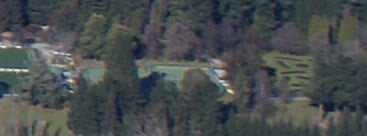
| To compare real-life performance we shot the same scene with the Sony DT 11-18mm and DT 18-70mm using the Sony Alpha A100 within a few moments of each other using the camera’s best quality JPEG and lowest ISO settings. Anti-shake was turned off.Both lenses were set to a focal length of 18mm for this test. We acknowledge we’re comparing the wide-end of one lens against the long end of another, but it still illustrates any optical differences when switching from one range to the next. |
| With both the DT 11-18mm and DT 18-70mm zoomed to a focal length of 18mm, the former delivers a slightly sharper and higher contrast result. This is apparent across the three cropped areas, although it’s quite subtle at times. And while subjects like the trees in the bottom crop are a little better-defined on the DT 11-18mm, the ultra-wide lens also exhibits slightly higher coloured fringing on the mountain range. Ultimately if you owned both lenses though and were shooting at 18mm, you’d be better-off overall using the DT 11-18mm rather than the kit zoom. Now let’s compare their resolution in a studio environment. |
Sony DT 11-18mm f/4.5-5.6 | Sony DT 18-70mm f/3.5-5.6 | |
 |  | |
1/250, f8, 100 ISO | 1/250, f8, 100 ISO | |
 |  | |
1/250, f8, 100 ISO | 1/250, f8, 100 ISO | |
 |  | |
1/250, f8, 100 ISO | 1/250, f8, 100 ISO |