Sony Cyber-shot RX1
-
-
Written by Gordon Laing
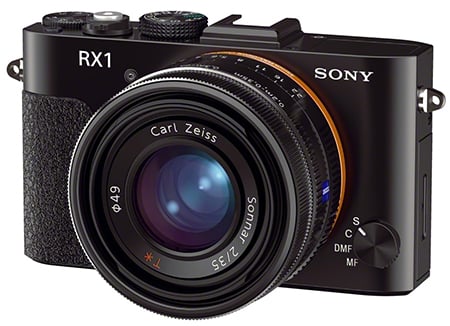
The Sony Cyber-shot RX1 is the world’s first compact camera with a fixed lens and full-frame sensor. Announced in September 2012, it brings the low light, high dynamic range and shallow depth of field benefits of a full-frame camera to a much smaller form factor than DSLRs like the Canon 5D Mark III and Nikon D800. And while Leica has long offered its relatively compact full-frame M9 system with removable lenses to boot, the Sony RX1 is smaller and more affordable.
The RX1’s 35mm sized sensor sports 24.3 Megapixels and is coupled with a 35mm f2.0 lens from Carl Zeiss. This lens is fixed in focal length and physically to the camera, so there’s no chance of fitting anything else. While this may seem restrictive to owners of interchangeable lens cameras and zoom lenses, the 35mm focal length is a classic general-purpose option and Fujifilm’s X100 has already proven there’s a market for a fixed lens camera with the same equivalent coverage.
As you’d expect there’s a wealth of manual control with mode and exposure compensation dials on the top surface, and an aperture ring around the lens. The RX1 also packs in both a popup flash and a standard hotshoe. By default composition is entirely with the screen, although option opticalal and electronic viewfinders can be slotted onto the hotshoe. It’s a very exciting proposition and I’m pleased to share a great selection of Sony RX1 sample images taken by professional photographer and friend Peter Adams.
 |
SAN DIEGO, Sept 12, 2012 –
For the first time, all the benefits of full-frame digital photography are available in a palm-sized compact camera.
The extraordinary new Sony Cyber-shot DSC-RX1 digital camera packs an advanced 35mm full-frame 24.3 MP Exmor® CMOS sensor and exceptionally Carl Zeiss T*t 35mm f/2.0 fixed lens into a highly portable, lightweight camera body. Measuring approximately 4.5 inches wide by 3 inches tall and weighing just over a pound, it-s significantly smaller and lighter than any full-frame DSLR yet sacrifices nothing in terms of image quality, HD video quality or manual control.
“The new Cyber-shot RX1 is truly ‘one of a kind’, offering a unique combination of size and performance that’s never before been realized in the world of digital cameras,” said Yosuke Tomoda, director of the Cyber-shot camera business at Sony Electronics. “With its highly advanced sensor and fast 35mm f/2.0 lens packed into a small, portable camera body, professionals, enthusiasts and advanced hobbyists can experience the world of full-frame imaging in new and different ways than they ever thought possible.”
The new camera’s unified lens and body design allows performance that few interchangeable lenses can match. The Carl Zeiss lens not only delivers spectacular image quality all the way to the edges of each frame, it incorporates a near-silent in-lens shutter and is far more compact than comparable lenses of interchangeable design. The camera also features full manual control options and an intuitive user interface, making it easy for photographers to adjust all settings quickly and easily.
The 35mm full-frame sensor inside the RX1 camera more than doubles the area of APS-C sensors commonly found in much bulkier DSLR cameras, allowing it to take in significantly more light while capturing content. With an effective resolution of 24.3 megapixels, it’s capable of resolving the finest image details and most subtle textures for rich color reproduction and an impressively broad dynamic range.
The large sensor size also boosts the camera’s sensitivity range to a generous ISO 100 – 25600, with the option to shoot as low as ISO 50 in expanded sensitivity mode. Similarly, ISO settings as high as 102400 can be achieved using Multi Frame Noise Reduction. This allows the camera to capture natural, low noise handheld images in near-dark conditions without needing flash.
The fast, bright Carl Zeiss Sonnar T* 35mm lens is a versatile choice for portraits, street photography and everyday shooting. This premium lens features newly designed optics including an Advanced Aspherical (AA) glass element, which contributes to the camera’s extremely compact dimensions without sacrificing optical performance.
The lens’ wide F2 maximum, 9-bladed circular aperture enable beautiful background defocus (‘bokeh’) effects to rival or exceed professional-class DSLR camera lenses. Additionally, it features a macro switching ring on the lens barrel which instantly shortens the minimum focusing distance to approximately 20cm (from image plane), allowing the camera to capture small, close-up subjects with exquisite detail.
The Cyber-shot RX1 camera also features an enhanced BIONZ processing engine that rapidly handles data from the Exmor CMOS sensor and also powers full-resolution burst shooting at up to five frames per second. The powerful processor can output image data in 14-bit RAW format, giving advanced users total freedom to express their creative vision throughout the shooting and post-production processes.
Despite the camera’s extraordinarily compact dimensions, the new Cyber-shot RX1 model offers a full range of manual control modes on par with typical high-end full-frame DSLR cameras. Dedicated lens rings allow for fingertip control of focus and aperture, while a DSLR-style Focus mode dial on the front of the camera enables easy switching between focus modes. Top-mounted exposure compensation and mode dials are strategically placed for simple access and operation, while custom function and AEL buttons on the back panel are also easily accessible.
The new camera features a Quick Navi mode that allows fast, intuitive adjustment of camera settings. This is especially useful when using the camera with an optional viewfinder (sold separately). A memory recall (MR) mode is accessible via the mode dial so photographers can store and instantly recall up to three sets of camera settings.
Other refinements include a MF Assist function that magnifies a portion of the image while framing to simplify fine focus adjustments, as well as a Peaking function that highlights sharply-focused areas of the image on screen.
Additionally, the RX1 camera features By Pixel Super Resolution digital zoom technology, which allows for magnification of image size without sacrificing pixel count. This results in far higher quality results than are achievable with conventional digital zoom.
A Smart Teleconverter function crops a central portion of the image sensor, boosting effective magnification by 1.4x or 2x realizing an effective 49mm or 70mm focal length. With the extremely high pixel count of the full-frame image sensor, even zoomed and cropped images maintain generous amounts of fine detail when blown up for large print sizes.
In addition to beautiful still images, the Cyber-shot RX1 compact camera can capture high-quality, low-noise Full HD movie footage in all lighting conditions at a choice of 60p or 24p (progressive) frame rates. There’s a full complement of P/A/S/M exposure modes during video shooting for creative flexibility.
The new camera also features 13 different Creative Styles for fine-tuning images, plus a wide range of Picture Effect treatments. Further, it has Auto HDR and D-Range Optimizer, bracket shooting (Exposure, DRO or White Balance) and Auto HDR shooting modes, and there’s a Digital Level Gauge that indicates camera pitch and camera roll on the LCD screen for straight, even landscape and architectural shots.
New Accessories for Cyber-shot RX1
Shooting possibilities for stills and video are broadened by the camera’s Multi Interface Shoe that accepts a growing range of accessories. Options include a high-quality OLED XGA OLED Tru-Finder EVF (model FDA-EV1MK) which allows for even greater manual focusing precision as well as an external optical viewfinder featuring Carl Zeiss optics (model FDA-V1K).
Also available are a thumb grip (model TGA-1) for sure, comfortable handling as well as a lens hood (model LHP-1) and jacket case (model LCJ-RXB).
Sony PlayMemories Services
The Cyber-shot RX1 comes preinstalled with PlayMemories Home (Lite Edition) software, allowing easy image transfers to a PC for managing, editing and printing. Available for free download, a full version of PlayMemories Home software adds movie editing and disc burning.
Also available for download, PlayMemories Studio allows game-like editing of photos and videos on PlayStation 3 systems. Images can be shared easily via PlayMemories Online service, the cloud-based sharing service from Sony that simplifies ‘any time, any place’ viewing on a wide range of connected devices.
Pricing and Availability
The Cyber-shot RX1 compact, fixed lens camera will be available this November for about $2800.
The FDA-EV1K electric viewfinder and FDA-V1K optical viewfinder will each be available at launch for about $600 and $450, respectively.
The thumb grip, lens hood and jacket case will also be available at launch for about $250, $180 and $250, respectively.
See our selection of Sony RX1 sample images!