Sony Vario-Sonnar T* DT 16-80mm f3.5-4.5 ZA
-
-
Written by Gordon Laing
In depth
The Sony DT 16-80mm (SAL-1680Z) is the first zoom lens for the Alpha DSLR system designed by highly respected optical company Carl Zeiss. It offers a general-purpose 16-80mm range, equivalent to 24-120mm when mounted on an Alpha DSLR, delivering decent wide angle to telephoto capabilities. It is designed for use with cropped-frame bodies like the A100, and is not corrected for full-frame.
The Sony DT 16-80mm lens was announced at the same time as the DSLR-A100 body itself, and was an undoubted highlight of the system’s launch. Most of the first Alpha lenses were rebadged versions of existing Konica Minolta models, but here was a brand new zoom for the system which promised a quality general-purpose option for discerning photographers. Sony also announced two further fixed focal length lenses from Carl Zeiss at the Alpha launch.
Unfortunately none of the Zeiss lenses were actually ready for sale at the A100’s Summer 2006 launch and a few months later the release date of the DT 16-80mm had been delayed even further. This was a big disappointment for those who believed until the brand new lenses (and bodies) arrived, the Alpha system was little more than a rebadged project. Thankfully any issues concerning the delay have now been resolved and the DT 16-80mm finally went on sale in Spring 2007.
As one of the most exciting and highly anticipated lenses for the Alpha system, we’re pleased to present our new full review of the Sony DT 16-80mm. It represents an upgrade for existing Alpha kit lens owners, or of course a quality general-purpose option for those buying into the Alpha system from scratch.
As such we’ll be comparing it here against the standard Sony DT 18-70mm kit lens. The range of the DT 16-80mm is clearly both slightly wider and longer, and the f4.5 aperture at the telephoto end a little brighter, but how does the build quality, focusing speed and crucially the optical quality measure-up?
Does the Sony DT 16-80mm justify its higher price tag, or is the standard kit lens still the best choice for new buyers wanting a general-purpose zoom? Find out in our Sony DT 16-80mm full review and for a demonstration of its design, features and coverage, check out our Sony DT 16-80mm video tour.
Testing notes
We tested the Sony DT 16-80mm and DT 18-70mm lenses using an Alpha A100 body. The A100 was set to its best quality Large Fine JPEG mode, and unless otherwise stated, all sample images were taken with Auto White Balance, 100 ISO sensitivity, Vivid colour mode and with the D-Range Optimiser switched off. The serial numbers of the 16-80mm and 18-70mm lenses tested were 3800651 and 1805672 respectively.
Sony DT 16-80mm design and build quality
The Sony DT 18-70mm and DT 16-80mm lenses are pictured below, left and right, in their physically shortest positions. This occurs when the DT 16-80mm is zoomed-out to its widest 16mm focal length, and when the DT 18-70mm is positioned approximately mid-way through its range.
In terms of physical dimensions, the two lenses are actually quite similar. The DT 16-80mm and DT 18-70mm measure 72x83mm and 66x77mm respectively (diameter x shortest length), so while the Carl Zeiss model is certainly bigger, it’s not by a great deal.
Zoom both lenses to their longest focal lengths though and the DT 16-80mm extends further by 42mm compared to the modest 17mm of the DT 18-70mm. Both lenses are pictured below zoomed-into their longest focal lengths, again with the DT 18-70mm on the left and the DT 16-80mm on the right.
The Carl Zeiss zoom may be only slightly larger than the standard kit lens when both are in their shortest positions, but the former is much heavier, weighing 445g to the 235g of the DT 18-70mm. The extra weight gives the DT 16-80mm a greater air of confidence, but it’s still relatively light compared to other premium zooms of a similar specification and feels well-balanced mounted on the A100 body.
Much of the extra weight is down to a greater number of optical elements (14 compared to 11) and a brighter focal ratio when zoomed-in: f4.5 compared to f5.6 on the kit lens. The DT 16-80mm also employs a metal lens mount compared to the plastic mount on the kit lens and the overall build quality feels better, although not by a significant degree – it’s certainly not like upgrading, say, a Canon or Nikkor kit lens to one of their premium models. So while the Sony DT 16-80mm may be sturdier and more substantial than the kit lens, in terms of general look and feel, the difference is not as great as you may hope.
The Sony DT 16-80mm has a 62mm filter thread and comes supplied with a carrying pouch and a petal-style lens hood which can be reversed over the end of the barrel for transportation.
Sony DT 16-80mm focusing
The Sony DT 16-80mm features internal focusing and a front element which (unlike the kit lens) doesn’t rotate or extend. The AF motor remains within the Alpha body though, and in terms of focusing speed and noise, the DT 16-80mm is roughly similar to the kit lens. So it’s not especially quick, and you’ll also hear it in action.
This is a disappointment for anyone hoping for significantly faster or quieter auto-focusing from this premium lens – and we have a demonstration of this in our Sony DT 16-80mm video tour where it’s clear the focusing is nowhere near as quick or quiet as lens-based AF motors like Canon’s USM, Nikkor’s SWM, or indeed Sony’s own SSM systems.
On the upside there is a proper manual focusing ring, and a window showing distance, although there’s no full-time manual focus option – you’ll need to switch the Alpha body to manual focus. As you turn the manual focusing ring you can also feel the gearing behind it – again this is not as smooth or step-less as rival systems.
Sony DT 16-80mm wide angle coverage
The Sony DT 16-80mm is designed as a high quality general purpose lens for Alpha DSLR owners. Sporting an equivalent range of 24-120mm, it zooms both wider and longer than the 27-105mm equivalent range of the kit lens. This may not sound like a great difference when written down, but provides significantly greater flexibility in practice.
To illustrate the coverage of the DT 16-80mm compared to the DT 18-70mm, we fitted each to an Alpha A100 body mounted on a tripod and shot exactly the same scene from the same position, first zoomed all the way out, then zoomed all the way in. Below are coverage shots taken with each lens zoomed-out to their widest angle.
By looking around the edges of the frames below, it’s clear the DT 16-80mm’s wide angle coverage is comfortably greater than the kit lens. This equivalent focal length of 24mm not only captures a bigger field of view when you can’t step back any further, but can be used for more dramatic wide angle photography at close range – it’s a really useful focal length to have at your disposal whether you’re shooting indoors or out.
Sony DT 16-80mm with Alpha A100 | Sony DT 18-70mm with Alpha A100 | |
 |  | |
| 16-80mm at 16mm, f8 (24mm equivalent) | 18-70mm at 18mm, f8 (27mm equivalent) |
Sony DT 16-80mm telephoto coverage
Next up are examples of each lens zoomed-in to their maximum focal lengths, pictured below, and again it’s clear the DT 16-80mm has a much longer reach, giving it greater flexibility when shooting portraits or tighter crops of distant or small subjects.
The 24-120mm equivalent focal length of the DT 16-80mm is one of the most useful to have in a general purpose lens and one of our own favourite ranges. Of course personal preferences vary, but if you’re into wide angle, you’d be happy to sacrifice a longer telephoto for a 24mm equivalent. The good news if you’re upgrading from the kit lens though is you win at both ends of the range.
Sony DT 16-80mm with Alpha A100 | Sony DT 18-70mm with Alpha A100 | |
 |  | |
| 16-80mm at 80mm, f8 (120mm equivalent) | 18-70mm at 70mm, f8 (105mm equivalent) |
Outdoor scene: Sony DT 16-80mm vs Sony 18-70mm with Alpha A100
|


 | To compare real-life performance we shot the same scene with the Sony DT 16-80mm and Sony 18-70mm using the Sony Alpha A100 within a few moments of each other using the camera’s best quality JPEG and lowest ISO settings.The A100 was set to Large Fine JPEG mode and its Vivid colour mode. The crops are taken from the originals and presented here at 100%. The image left was taken with the Sony Alpha A100 using the DT 16-80 mm at 22mm f8; the original JPEG measured 3.84MB. |
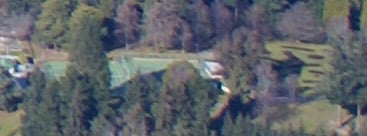
| Sometimes we have to examine crops very closely to spot differences between products, but each of the examples below clearly illustrate the optical superiority of the Sony DT 16-80mm over the standard kit lens. Starting with the first row of crops taken from the upper left corner and showing the mountain ridge, the DT 16-80mm sample is sharper, better-corrected, suffers from noticeably less coloured fringing and also exhibits higher contrast, revealing subtle tonal details which are washed-out on the kit lens sample. The second row of crops taken from the middle of the image again show greater contrast and a punchier-looking result from the DT 16-80mm than the kit lens. The third row of crops, taken from the lower right corner of the image, tells a similar story to the first row: namely the DT 16-80mm being much better corrected compared to the somewhat soft edge performance of the kit lens, coupled with higher contrast for good measure. Normally we’d stop with these three crops, but have included a fourth set of samples taken from halfway up the far left side of the image. These brightly illuminated buildings particularly reveal coloured fringing on the kit lens and again illustrate the optical superiority of the DT 16-80mm. So while the build quality and focusing aren’t amazing, the DT 16-80mm redeems itself with its optical performance under real-life conditions. Now let’s see how it measures-up in the studio: next up, the Sony DT 16-80mm resolution. |
Sony DT 16-80mm f/3.5-4.5 | Sony DT 18-70mm f/3.5-5.6 | |
 |  | |
1/200, f8, 100 ISO | 1/200, f8, 100 ISO | |
 |  | |
1/200, f8, 100 ISO | 1/200, f8, 100 ISO | |
 |  | |
1/200, f8, 100 ISO | 1/200, f8, 100 ISO | |
 |  | |
1/200, f8, 100 ISO | 1/200, f8, 100 ISO |