Sony Alpha DSLR-A380
-
-
Written by Gordon Laing
Intro
Sony’s Alpha DSLR-A380 is the company’s latest upper-entry-level DSLR. Announced in May 2009, it’s the successor to the Alpha A350, and inherits many features from this earlier model including the same 14.2 Megapixel CCD sensor, built-in image stabilisation which works with any lens you attach, quick Live View system and vertically-tilting screen. Indeed the internal specification is almost identical.
The major changes to the A380 involve a new body shape that’s smaller and lighter than its predecessor and an easier control system designed for DSLR beginners upgrading from a point-and-shoot camera. With the new body, Sony’s also taken the opportunity to relocate the memory card door to the left side of the camera, and switch from Compact Flash to SD media, alongside and additional slot for Memory Stick Pro Duo. These card slots are hidden behind a sliding door which also reveals a new HDMI port for connection to High Definition TVs, although at the cost of the standard composite TV output.
Sony has also introduced four new lenses with a built-in ‘Smooth Autofocus Motor’ or SAM for short, including two kit models: the DT 18-55mm f3.5-5.6 SAM and DT 55-200mm f4-5.6 SAM.
Like its predecessor, the A380 is the top model in a range of three consumer DSLRs which share a great deal in common with each other. As before the main differences are the sensor and the presence of Live View and the tilting screen.
The cheapest A230 model (replacing the A200), features 10.2 Megapixels and a fixed 2.7in / 230k screen without Live View. The A330 (replacing the A300) employs the same 10.2 Megapixel sensor, but adds Live View and mounts the screen on a vertically-tilting platform for greater compositional flexibility. Then the A380 completes the line-up by taking the A330 with its Live View and tilting screen, but switching its 10.2 Megapixel sensor for one with 14.2 Megapixels. By doing this, Sony’s effectively created three versions of the same DSLR, allowing you to choose the model which best suits your budget and requirements. This strategy also maximises exposure for the Alpha range in stores.
|

Like the earlier A300 and A350, it’s not the main sensor which provides the Live View facilities on the A380, but a secondary sensor built-into the viewfinder. Sony’s broken from most other Live View systems by fitting this extra sensor, along with a tilting mechanism in the viewfinder which directs the light to either it or through the traditional eyepiece. The benefit is not having to bypass the conventional phase-change AF system during Live View, thereby allowing the A380 to autofocus as quickly as it would do normally, while avoiding interruption or noise. It also means you can switch in and out of Live View very quickly without any fuss.
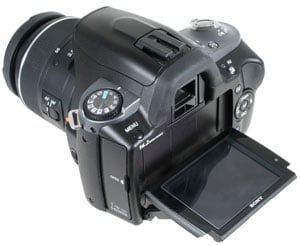 |
Making Live View all the more useful is the flip-out screen which can be tilted vertically to allow comfortable shooting at high or low angles. The A380’s screen may not twist sideways nor flip to face the subject, but it’s still a very flexible feature.
Like all Alpha DSLRs, the main sensor is mounted on an adjustable platform which shifts to counteract camera-shake. You won’t see the effect through the viewfinder – or in Live View as this uses a different sensor – but it will work with any lens you attach. This not only has cost-savings, but means you get to enjoy stabilisation on lenses which most manufacturers wouldn’t fit anti-shake facilities too, like standard 50mm models.
Responding to customer feedback, Sony’s revamped the controls and user-interface for a more beginner-friendly experience. The default screen presentation graphically indicates how the aperture can be used to control depth-of-field, and the shutter used to freeze action. Buttons and switches on the previous models have also been either relocated or minimised to avoid potential confusion. Many newcomers to DSLRs are also put-off by larger and heavy bodies, so Sony has additionally shrunk the camera and reduced its weight compared to the previous range.
So while the internals of the A380 remain pretty much the same as its predecessor, Sony’s concentrated on making the camera smaller, lighter and much easier to use by DSLR beginners. And while there’s still no movie mode, the A380 manages to still tick most boxes of new buyers by featuring high resolution, quick and quiet Live View, built-in stabilisation and a tilting screen.
In our full review we’ll put the new Alpha A380 through its paces, comparing its features, handling and quality against both its predecessor and today’s key rivals, including the Canon EOS 500D / Rebel T1i, Nikon D5000 and Olympus E-620. There’s a growing number of choices in the upper-entry-level DSLR market and over the following pages we’ll ensure you buy the right one for your requirements.
Testing notes
We tested a final production Alpha A350 running firmware version 1.0. Following our convention of using default factory and best quality JPEG settings to test cameras unless otherwise stated, the A380 was set to L:14 Fine JPEG quality, Auto White Balance, Multi-segment metering and the Standard Creative Style. High ISO NR and the D-Range Optimiser were set to their default On and Standard settings respectively, except from our High ISO Noise results where the latter was disabled as it can introduce noise. SteadyShot stabilisation was enabled for all handheld shots and disabled for tripod-based tests.