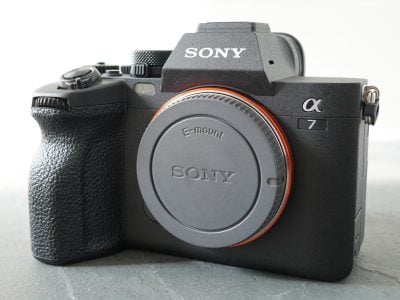
Sony Alpha DSLR-A350
-
-
Written by Gordon Laing
Intro
The Alpha DSLR-A300 and Alpha DSLR-A350 are Sony’s fourth and fifth DSLRs, launched together at the annual PMA show in late January 2008. Since the original A100 was replaced by the A200 in early January, Sony now has four models in the Alpha range: the entry-level A200, the semi-pro A700, and positioned in-between, the new A300 and A350 models.
The A200, A300 and A350 have a lot in common. They all share essentially the same body, controls, features and accessories, but the higher-end models add something new to the mix. The A200 is the base model with a 10.2 Megapixel sensor and a fixed screen. The A300 keeps the same sensor, but adds Live View and a tilting screen. Finally, the A350 takes the A300 and simply swaps its 10.2 Megapixel sensor for one with 14.2 Megapixels.
So the A300 and A350 are identical other than the resolution of their sensors and a small difference in the continuous shooting rates: the A300 is a 10.2 Megapixel model, shooting at 3fps, while the A350 is a 14.2 Megapixel model, shooting at 2.5fps. In this preview we’ll be looking at the most powerful model of the threesome, the Alpha A350.
The Alpha DSLR-A350 features a 14.2 Megapixel CCD sensor, Live View, a vertically-tilting monitor, and like all Alpha DSLRs, sports built-in sensor-shift anti shake facilities which work with any lens you attach. It’s available body alone, or in a kit with the Sony DT 18-70mm lens.
Interestingly, it’s not the main sensor which provides the Live View facilities, but a secondary sensor built-into the viewfinder. Sony’s broken from traditional Live View systems by fitting this extra sensor, along with a tilting mechanism in the viewfinder which directs the light to either it or through the traditional eyepiece. The benefit is not having to bypass the conventional AF system during Live View, thereby allowing the A350 to autofocus as quickly as it would do normally, and without interruption or noise.
Making Live View all the more useful is a flip-out screen which can be tilted vertically to allow comfortable shooting at high or low angles. The A350’s screen may not twist sideways nor flip to face the subject, but it’s still a very flexible feature.
Like all Alpha DSLRs, the main sensor is mounted on an adjustable platform which shifts to counteract camera-shake. You won’t see the effect through the viewfinder – or in Live View – but it will work with any lens you attach. This not only has cost-savings, but means you get to enjoy stabilisation on lenses which most manufacturers wouldn’t fit anti-shake facilities too, like standard 50mm models.
The new A350 also shares many aspects with the entry-level A200. Apart from the flip-out screen and Live View switch, the bodies and controls are essentially identical. So the A350 inherits the A200’s Function system which gives quick on-screen access to popular settings including AF, White Balance and the Dynamic Range Optimiser. Like the A200 the battery life is also displayed as an accurate percentage remaining on-screen. Finally, by sharing the same basic body shape, the new A350 can also use the portrait battery grip launched for the A200.
With high resolution, quick and quiet Live View, built-in stabilisation and a tilting screen, the Sony Alpha A350 looks very strong against the competition, especially priced head-to-head against Canon’s new EOS 450D / Rebel XSi.
 |
Sony has asked us to describe the unit supplied as a pre-production model, but running Firmware version 1.0, we’re confident the output is close or even identical to what you’ll get with retail units when they’re released. As such, we’re describing this article as a full review, although we’ll update the sample images and publish our full suite of results once we have a confirmed retail unit. So to find out if Sony has a potential winner on its hands, read on…
Note: since the basic body, controls, features and accessories are identical to the A200, portions of the following article are taken from our earlier Alpha A200 review. If you’re interested in Sony’s entry-level DSLR, check out our Alpha A200 review.
Testing notes
We tested what Sony asked us to describe as a pre-production A350, but running Firmware 1.0, we’re confident the output is close or identical to what we can expect from final production models. As mentioned above though, we will retest a final retail unit when available and update our sample images and results as required.
Following our convention of using default factory and best quality JPEG settings to test cameras unless otherwise stated, the A350 was set to Large Fine JPEG quality, Auto White Balance, Multi-segment metering and Standard Colour mode. High ISO NR and the D-Range Optimiser were set to their default On and Standard settings respectively. Super SteadyShot was enabled for all handheld shots and disabled for tripod-based tests.