Support Cameralabs by shopping at our partner stores or donating via Paypal
 

Follow me!
Camera Labs RSS Feed
Gordon Laing and Cameralabs on Google+
Camera Labs on Facebook
Camera Labs on Twitter

 
  Latest camera reviews

Olympus E-PM1
Nikon V1
Sony NEX-5N
Canon 100HS / 115HS
Canon 300HS / 220HS
Canon S100
GoPro HD Hero 2
Canon 510HS / 1100HS
Canon 310HS / 230HS
Canon SX150 IS
Olympus E-PL3
Canon SX40 HS
Sony NEX-C3
Panasonic GF3
Fujifilm HS20 EXR
Panasonic FZ150
Olympus E-P3
Panasonic FZ47 / FZ48
Nikon COOLPIX S9100
Sony Cyber-shot HX100V
Sony Cyber-shot HX9V
Panasonic FX77 / FX78
Canon SX230 HS
Canon EOS T3 / 1100D
Panasonic Lumix G3
Sony Cyber-shot TX10
Canon 500HS / 310HS
Nikon D5100
Sony Cyber-shot W510
Nikon COOLPIX L24
Canon PowerShot A1200
Panasonic FS18 / FH5
Canon PowerShot A800
Panasonic TZ18 / ZS8
Canon PowerShot A3300IS
Canon EOS 600D / T3i
Panasonic TZ20 / ZS10
Canon IXUS 1000/SD4500
Sony Alpha SLT-A33
Panasonic Lumix GH2
Nikon D7000
Canon PowerShot G12
Canon PowerShot S95
Panasonic Lumix LX5
Nikon D3100
Canon EOS 60D
Canon EOS 550D / T2i
Canon EOS 7D
Nikon D300s
Canon EOS 5D Mark II
Nikon D90

All reviews ....


  Best Buys: our top models
   
  Best Canon lens
Best Nikkor lens
Best Sony lens
Best budget DSLR
Best mid-range DSLR
Best semi-pro DSLR
Best point and shoot
Best superzoom
Best camera accessories


Camera Labs Forum

Any questions, comments or a great tip to share? Join our Forum and let everyone know.
   
 
  DSLR Tips


Support me by shopping at Amazon!
Sony Cyber-shot DSC-H9 Gordon Laing, May 2007

Lenses and SteadyShot / Screen and menus / Sensor and processing


Sony Cyber-shot DSC-H9 lens coverage

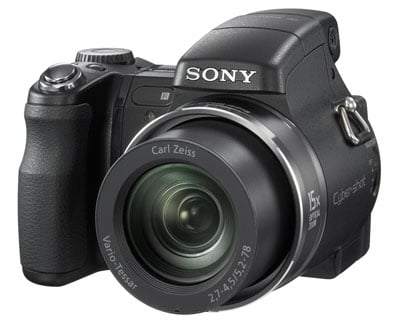
The Sony Cyber-shot DSC-H9’s big selling point is of course its 15x optically stabilised zoom lens. Sporting an equivalent range of 31-465mm, it’s both a little wider and a little longer than the 12x optical ranges offered by Panasonic’s super-zooms, and beaten only by the considerable 18x optical zoom range of the Olympus SP-550UZ. The Sony H9’s actual optical specification is 5.2-78mm f2.7-4.5, and it can focus as close as 1cm in macro mode.

When the H9 is powered-up, the lens barrel extends by 22mm and prods its lens cap off if you’d not already removed it; the camera’s ready for action in just under two seconds. Zoom the H9 into its maximum focal length and the barrel extends to 38mm. You can see these two positions along with the camera powered-off in the photo below.


Sony Cyber-shot DSC-H9 lens extension


Like its predecessor the H9 actually offers two different motorised zoom speeds. Press the zoom rocker gently and it’ll take about five seconds to fully zoom-in. Press the rocker harder and it’ll take just two seconds. It’s a really nice touch to have the different zoom speeds, allowing you to fine tune, or quickly get close as required. You can even zoom at either speed during video recording and the slower option is much quieter.

To illustrate the H9’s 31-465mm range in practice we mounted it on a tripod and shot the same scene fully zoomed-out, then fully zoomed-in. We then shot the same scene from exactly the same position moments later using the Panasonic Lumix DMC-FZ8 which is equipped with a 12x range equivalent to 36-432mm. To see examples of the Olympus SP-550UZ taken from exactly the same spot, albeit on a different day, see our Olympus SP-550UZ review.


Support this site by shopping via these links


Sony Cyber-shot DSC-H9 coverage wide
Panasonic Lumix FZ8 coverage wide
Sony Cyber-shot DSC-H9 coverage wide
Panasonic Lumix FZ8 coverage wide
5.2-78mm at 5.2mm (31mm equivalent)
 
6-72mm at 6mm (36mm equivalent)

The examples above clearly illustrate while the H9 isn’t as wide as the Olympus SP-550UZ’s 28mm equivalent, it still captures a comfortably wider field than the Panasonic FZ8. This gives the H9 greater flexibility whether you’re shooting large subjects or in cramped conditions where you can’t step back any further.

Zoom both cameras into their longest focal lengths as seen below and the difference is much closer, although again the Sony H9 enjoys the edge. Our Olympus samples taken on a different day show the view slightly shifted to the right, but again it’s still clear it has a slight edge over the Sony when zoomed-in.

Sony Cyber-shot DSC-H9 coverage tele
Panasonic Lumix FZ8 coverage tele
Sony Cyber-shot DSC-H9 coverage tele
Panasonic Lumix FZ8 coverage tele
5.2-78mm at 78mm (465mm equivalent)
 
6-72mm at 72mm (432mm equivalent)

In use the big difference between the three cameras though is not how much they can zoom-in, but how far they can zoom-out. Wide angle capabilities make a big difference in a wide variety of situations, and with an equivalent of 28mm, the Olympus SP-550UZ is most flexible. The Sony H9’s not far behind though at 31mm and both models offer noticeably wider coverage than either the Panasonic FZ8 or FZ50 at 36 and 35mm respectively. (Note the Panasonic TZ3 compact has a 10x optical range which starts at an equivalent of 28mm – see our Panasonic TZ3 review for more details).

If you love the H9 but wished it had a longer range still, you can fit one of two lens converters. The VCL-DH0774 multiplies the range by 0.7x to deliver 21.7mm wide angle capabilities, while the VCL-DH1774 will multiply the range by 1.7x, delivering a maximum equivalent focal length of 734mm. Both mount onto the supplied accessory ring, which is also used to fit the considerable lens hood – again supplied. See our Sony H9 video to witness this lens hood in practice!

Sony Cyber-shot DSC-H9 image stabilisation

Sony Cyber-shot DSC-H9 SteadyShot menu
 

Pressing the Menu button and scrolling down to the SteadyShot options presents three settings: Shooting, Always On and Off. The first mode only activates the SteadyShot system when the shutter release button is pressed halfway (to save battery power) and we have a demonstration in our Sony H9 video tour.

To illustrate its effectiveness here we took two photos of the same scene with the H9 fully zoomed-in to an equivalent of 465mm and at a shutter speed of just 1/20. We’ve taken crops of each measuring 564x272 pixels (thereby representing about one sixth of the total image width), and reduced them in size to 288x136 pixels for reproduction below. Therefore the images you see below are effectively like viewing the originals at 50%.

Sony Cyber-shot DSC-H9
Super SteadyShot off
Sony Cyber-shot DSC-H9
Super SteadyShot on
Sony Cyber-shot DSC-H9 Super SteadyShot off
Sony Cyber-shot DSC-H9 Super SteadyShot on
5.2-78mm at 78mm (465mm equiv), 1/20, 80 ISO
 
6-72mm at 72mm (465mm equiv), 1/20, 80 ISO


You can clearly see from the examples above that the H9’s Super SteadyShot has eliminated camera-shake on the relatively slow exposure of 1/20. We found this was about the slowest shutter speed we could handhold with the lens fully zoomed-in, but it’s still impressive considering we needed an exposure several times faster to capture a sharp result without stabilisation.

Sony Cyber-shot DSC-H9 focusing

   
Sony Cyber-shot DSC-H9 face detection Sony Cyber-shot DSC-H9 manual focus
   

The Sony H9 offers four focusing modes: Multi-AF evaluates the entire frame, Center AF focuses only on the middle area, Flexible Spot AF lets you choose the area you’d like to use for focusing, and finally there’s a manual focusing option which can enlarge the centre portion. Face detection is also offered, but only in Auto and Portrait modes.

Focusing is one of the H9’s highlights. Pressing the shutter button halfway zips the camera through its focusing range and quickly locks onto the subject. You can set a menu to continuously auto-focus for even faster response, although this will drain the battery quicker.

When you first read about super-zoom ranges, it’s hard not to think about the possibilities for photographing wildlife or sporting events, but the reality is normally very different. With most non-DSLR cameras, the focusing can be so slow the subject has long gone before you’ve had a chance to focus on them, let alone attempt to fire off a shot.

While the Sony H9 isn’t as quick as a DSLR equipped with a decent lens, it’s still noticeably quicker than any other super-zoom we’ve tested, and we successfully used it fully zoomed-in to photograph several birds which were in almost constant motion. It’s very impressive in operation and you can see an example in our H9 Gallery along with a demonstration in our H9 video tour.


Sony Cyber-shot DSC-H9 features continued...

Lenses and SteadyShot / Screen and menus / Sensor and processing

If you found this review useful, please support us by shopping below!
All words, images, videos and layout, copyright 2005-2012 Gordon Laing. May not be used without permission.

/ How we test / Best Cameras / Advertising / Camera reviews / Supporting Camera Labs