Support Cameralabs by shopping at our partner stores or donating via Paypal
 

Follow me!
Camera Labs RSS Feed
Gordon Laing and Cameralabs on Google+
Camera Labs on Facebook
Camera Labs on Twitter

 
  Latest camera reviews

Olympus E-PM1
Nikon V1
Sony NEX-5N
Canon 100HS / 115HS
Canon 300HS / 220HS
Canon S100
GoPro HD Hero 2
Canon 510HS / 1100HS
Canon 310HS / 230HS
Canon SX150 IS
Olympus E-PL3
Canon SX40 HS
Sony NEX-C3
Panasonic GF3
Fujifilm HS20 EXR
Panasonic FZ150
Olympus E-P3
Panasonic FZ47 / FZ48
Nikon COOLPIX S9100
Sony Cyber-shot HX100V
Sony Cyber-shot HX9V
Panasonic FX77 / FX78
Canon SX230 HS
Canon EOS T3 / 1100D
Panasonic Lumix G3
Sony Cyber-shot TX10
Canon 500HS / 310HS
Nikon D5100
Sony Cyber-shot W510
Nikon COOLPIX L24
Canon PowerShot A1200
Panasonic FS18 / FH5
Canon PowerShot A800
Panasonic TZ18 / ZS8
Canon PowerShot A3300IS
Canon EOS 600D / T3i
Panasonic TZ20 / ZS10
Canon IXUS 1000/SD4500
Sony Alpha SLT-A33
Panasonic Lumix GH2
Nikon D7000
Canon PowerShot G12
Canon PowerShot S95
Panasonic Lumix LX5
Nikon D3100
Canon EOS 60D
Canon EOS 550D / T2i
Canon EOS 7D
Nikon D300s
Canon EOS 5D Mark II
Nikon D90

All reviews ....


  Best Buys: our top models
   
  Best Canon lens
Best Nikkor lens
Best Sony lens
Best budget DSLR
Best mid-range DSLR
Best semi-pro DSLR
Best point and shoot
Best superzoom
Best camera accessories


Camera Labs Forum

Any questions, comments or a great tip to share? Join our Forum and let everyone know.
   
 
  DSLR Tips


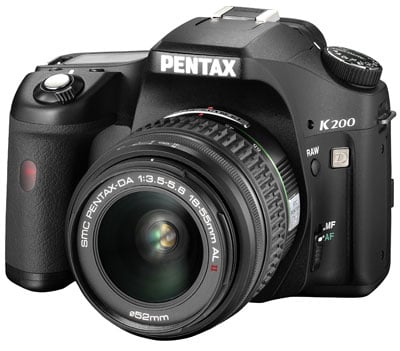
Pentax K200D Gordon Laing, July 2008
 

Pentax K200D Gallery

The following images were taken with a final production Pentax K200D fitted with a Pentax DA 18-250mm lens; note this was the only lens Pentax had available for our review.

The K200D was set to 10M *** JPEG quality, Auto White Balance, Multi-Segment metering, High ISO NR off, and the Custom Image setting at the default Bright option with +1 for Contrast and Sharpness. Shake Reduction was enabled for all these handheld shots.

The individual exposure mode, file sizes, shutter speeds, aperture, ISO and lens focal length are listed for each image.

The crops are taken from the original files, reproduced at 100% and saved in Adobe Photoshop CS2 as JPEGs with the default Very High quality preset, while the resized images were made in Photoshop CS2 and saved with the default High quality preset. The three crops are typically taken from far left, central and far right portions of each image.

Note: you may wish to open our Sony Alpha DSLR A350 Gallery and Canon EOS 450D / XSi Gallery for a direct comparison of detail and noise.

Support this site by price checking below


Pentax D-BG3 GRIP


Support this site by shopping via these links


Landscape: 3.91MB, Program, 1/350, f8, ISO 100, 18-250mm at 22mm (equivalent to 33mm)

  This first shot was taken with the K200D at 100 ISO under bright conditions.

Pentax has clearly gone for a consumer-friendly approach with its default image processing. The saturation, contrast and sharpness are set relatively high, which has produced a slightly unreal result. Of course you may personally like this approach but it's also possible to reduce the settings if preferred.

Either way, close examination at 100% reveals lots of clean detail and sharp performance from the 18-250mm.


Landscape: 3.73MB, Program, 1/180, f6.3, ISO 100, 18-250mm at 18mm (equivalent to 27mm)

    Our second shot was again taken at 100 ISO with direct sunlight on the background, although a low Sun mean the foreground was in shadow, so we forced the flash to fire as a fill-in.

There's a small amount of coloured fringing visible along the mountain ridge in this shot, but otherwise the 18-250mm performs very well with sharp details across the frame.

Once again the K200D has delivered a vibrant image with its default settings.


Landscape: 4.11MB, Program, 1/400, f10, ISO 200, 18-250mm at 55mm (equivalent to 83mm)


    Our next shot was taken with the K200D increased to 200 ISO and the lens zoomed to an equivalent of 83mm.

The steamship was taking its annual break, so we don't have a shot in motion for you.

The K200D often underexposes, so faced with this bright white hull in direct sunlight we applied +1EV of compensation.

There's no detriment to the higher sensitivity and the crops are packed with sharp, clean details.


Portrait: 3.99MB, Aperture Priority, 1/800, f4.5, ISO 200, 18-250mm at 65mm (equivalent to 98mm)


  For this portrait shot we kept the sensitivity at 200 ISO, but increased the focal length to an equivalent of 98mm and opened the aperture to its maximum f4.5 in Aperture Priority mode. Note: we didn't fire the flash here.

The DA 18-250mm has delivered a nicely blurred background at its maximum aperture and you can increase this effect at longer focal lengths.

The crops of the subject are again very sharp and detailed.


Macro: 3.92MB, Program, 1/400, f10, ISO 400, 18-250mm at 92mm (equivalent to 138mm)

  For this macro shot we increased the sensitivity to 400 ISO and positioned the camera as close at it would focus with the lens zoomed to an equivalent of 138mm.

We shot this in Program mode, but a larger depth of field could have been achieved in Aperture Priority.

The increase to 400 ISO hasn't had any detrimental effect on this particular composition, with the crops again showing lots of detail and no undesirable artefacts.


Indoor: 3.92MB, Program, 1/50, f4, ISO 400, 18-250mm at 18mm (equivalent to 27mm)


  Our first indoor shot was taken with the K200D at 400 ISO.

The K200D, like other Pentax DSLRs, has a tendency to underexpose. Here we applied +0.3EV compensation and it's still arguably too dark.

On the upside, the crops are still showing a decent amount of detail and the default disabling of noise reduction ensures there's no smearing to worry about.

The slightly soft crop of the eye is due to it being slightly out of the plane of focus in this shot.


Indoor: 4.02MB, Program, 1/6, f3.5, ISO 800, 18-250mm at 18mm (equivalent to 27mm)

  Our second indoor shot was taken with the K200D's sensitivity increased to 800 ISO. Again we've applied compensation (+0.5EV), and despite not performing that well in other tests, the Shake Reduction has eliminated any wobbles at the relatively slow shutter speed of 1/6.

Here you can see Pentax's noise reduction strategy in action. It's off by default, so you'll see noise speckles at high sensitivities. But by eliminating any smearing, you'll also retain plenty of detail. An impressive 800 ISO result here.


Indoor: 4.00MB, Program, 1/30, f3.5, ISO 1600, 18-250mm at 18mm (equivalent to 27mm)

  Our final indoor shot was taken with the K200D's sensitivity increased to 1600 ISO.

The default metering rendered shadow areas into solid darkness, so we applied +1EV of compensation, although this in turn has blown some highlights. See the Features page for a version with the K200D's Expanded Dynamic Range.

The crops reveal a significant increase in noise speckles, but again the lack of noise reduction means any detail is held onto. It's an unusual strategy in the current noise-averse climate, but one which serves the K200D well.


All words, images, videos and layout, copyright 2005-2012 Gordon Laing. May not be used without permission.

/ How we test / Best Cameras / Advertising / Camera reviews / Supporting Camera Labs