Panasonic Lumix DMC-TZ8 / ZS5
-
-
Written by Gordon Laing
Intro
The Panasonic Lumix TZ8 / ZS5 is a 12 Megapixel compact with a 12x optical zoom and 2.7 inch screen. It was released in January 2010 alongside the higher-end Lumix TZ10 / ZS7, with which it shares the same body, lens, sensor, 720p HD video and manual controls. The TZ10 / ZS7 additionally boasts a larger 3 inch screen, built-in GPS, an HDMI connector and can alternatively encode HD video in the AVCHD format for longer recording times. If those are features you can’t live without then check out our Lumix TZ10 / ZS7 review, otherwise, the cheaper TZ8 / ZS5 could be right for you.
Panasonic is credited with creating the travel zoom category with the TZ1 back in 2006. Since then, models have become smaller, lighter and cheaper, zoom ranges have expanded and, of course, sensor resolution has increased.
Following Panasonic’s lead, other companies were quick to follow and these developments have been spurred on by the presence of competing models from other manufacturers. Is Panasonic still a leader in the market it created? To find out we tested the TZ8 / ZS5 alongside two similarly-priced models with similar specifications – the Nikon COOLPIX S8000 and the Sony Cyber-shot H55. Read our full review to find out how it fared.
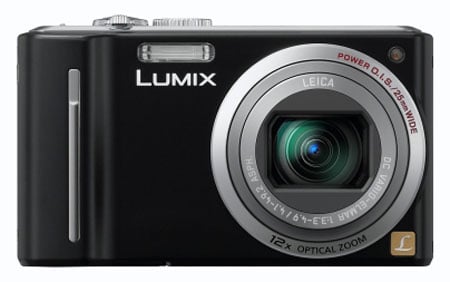 |
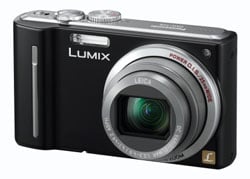
Though it’s marginally larger and heavier than the Nikon COOLPIX S8000 and Sony Cyber-shot H55, looking at, or indeed holding the Lumix TZ8 / ZS5, you’d never guess. This isn’t a camera that will fit comfortably into your trouser pocket, but pop it in your jacket or coat pocket and you’ll hardly know it’s there.
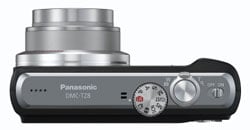
The camera is available in silver or black and with it’s large off-centre silver lens bezel looks like a stylish, yet serious compact camera. Like the Sony Cyber-shot H55, it has a cigar tube-sized bulge at the right end which, in combination with a vertical raised strip helps you grip the camera one-handed.
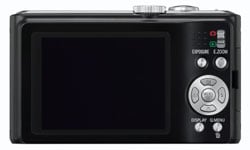
Though at 2.7 inches the TZ8 / ZS5’s screen is smaller than the TZ10 / ZS7, the COOLPIX S8000 and the Cyber-shot H55, Panasonic hasn’t really made the most of the extra space and the back panel layout looks a little crowded. There’s a (too) small dimpled grid for your thumb squeezed in alongside the capture / playback mode switch. Below that and next to a button for activating manual exposure control, the dedicated Movie button of the higher-end TZ10 / ZS7 is replaced with an E.Zoom button that automatically zooms the lens in or out to its full extent. At the bottom, below a standard four-way control pad with a Menu/Set button at its centre are buttons for toggling display overlays and activating the Q.Menu.
 |
On the right side of the camera body there’s a large hinged flap that opens to reveal a much smaller USB/AV port but, unlike the TZ10 / ZS7, there’s no HDMI connector. On the base there’s a sturdy-looking centrally-mounted metal tripod bush and on the right a spring-loaded door pops open to reveal the battery and card compartment. The TZ8 / ZS5 takes SD cards as well as the newer high-speed, high-capacity SDXC format cards.
Panasonic’s preference for switches is one of the things that sets it apart from most of its competitors. Aside from looking a little dated, providing a switch to change from shooting to playback mode means there’s only one way to get back into shooting mode – moving the switch back to the shooting position. Rival models that use a button to switch modes allow you to switch from playback to shooting mode on half-press of the shutter release and we think that the lack of this feature on the TZ8 / ZS5 is a real drawback. In its absence you just have to make sure you always put the switch back to shooting mode when you’re done reviewing shots or you might miss a spontaneous photo opportunity.
 |
|

There’s one other switch on the TZ8 / ZS5 which turns the camera on and off. Aside from looks, we don’t have a problem with this one, which is located on the right end of the top panel next to the shutter button which itself has a collar-type zoom control. To the right of that is the 10-position mode dial. We’ll cover exposure modes in more detail later in the review, for now let’s just say that the TZ8 / ZS5 has an exposure mode for everyone, from intelligent Auto exposure with Face detection and Scene recognition to fully manual with both Aperture and Shutter priority semi-automatic modes. There’s also a Program auto mode, two Scene mode positions, a Custom mode which uses your own stored settings, a Clipboard mode which records timetables, maps and the like to the built in memory, and Motion picture mode.
Though the new positioning of the mode dial, virtually in the middle of the top panel may seem a little unconventional, with the knurled ring extending out beyond the back of the camera it’s easy to operate, yet difficult to move accidentally. If you do manage to nudge it to a point between two adjacent modes you’ll get an on-screen warning.
The Lumix TZ8 / ZS5 has a built-in flash unit with a quoted maximum range of 5.8 metres at the maximum wide angle lens setting. For any compact zoom, that’s a pretty impressive number but, as we’ve said before, based as it is on an automatic ISO sensitivity setting it doesn’t mean a great deal. What we can say is that in practice the TZ8 / ZS5 flash provided a good level of overall illumination will little fall-off at the edges and that the results were broadly similar to those from the Nikon COOLPIX S8000 and Sony Cyber-shot H55. The flash takes around three seconds to recharge between shots, but if you want to take flash shots in quick succession there’s a Flash Burst scene mode that shoots up to five frames at 3 Megapixel resolution.
In Auto mode the flash fires when ambient light levels are too low for a good exposure without it. In modes that support it, the flash can be forced on or off and used in Slow sync mode to provide fill-in illumination at slow shutter speeds. Red-eye reduction, which fires a pre-flash to contract the subject’s pupils, can be selected for both Auto and Slow sync modes.
The Lumix TZ8 / ZS5 uses a Lithium-Ion battery pack that on a full charge provides enough power for 340 shots using the CIPA (Camera Imaging Products Association) standards. This is pretty good going, outreaching the impressive performance of the Sony Cyber-shot H55 by 30 shots and outperforming the COOLPIX S8000 by more than a third.
Panasonic Lumix TZ8 / ZS5 coverage wide |
Panasonic Lumix TZ8 / ZS5 coverage tele | |
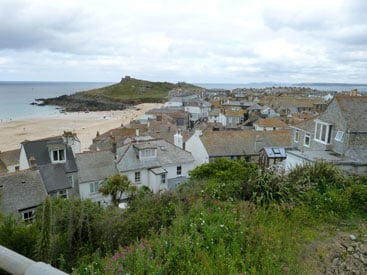 | 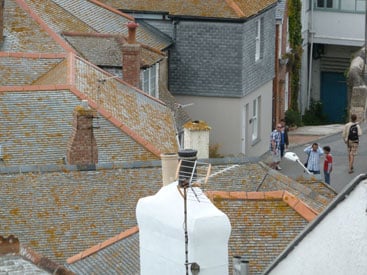 | |
| 4.1-49.2mm at 4.1mm (25mm equivalent) | 4.1-49.2mm at 49.2mm (300 mm equivalent) |
The 12x optical zoom lens is undoubtedly the Panasonic TZ8 / ZS5’s biggest selling point. This is the same 25-300mm equivalent lens as on the TZ10 / ZS7 and its predecessor. It’s difficult to overstate the capability of this lens. At both ends of the focal length spectrum it outperforms most other compact zooms on the market. Compared with close rivals it provides the best of both worlds, matching the wide angle performance of the Sony Cyber-shot H55 and the telephoto performance of the Nikon COOLPIX S8000. Or, to look at it from the other direction, bettering the telephoto performance of the Cyber-shot H55 and the wide-angle performance of the COOLPIX S8000.
If you like to shoot panoramic landscapes, interiors or large groups, you’ll appreciate that a few millimetres at the wide angle end of the zoom range makes a big difference in terms of the extra field of view it provides. Verging on super-wide angle territory, the Lumix TZ8 / ZS5’s lens fully justifies the travel zoom label as there isn’t a landscape, street scene or interior that won’t benefit from the distinctive perspective it provides. At the telephoto end of the range it will get you as close as you need to go for all but the most distant subjects.
Like the Sony Cyber-shot H55, the Lumix TZ8 / ZS5 has a two-speed zoom that’s operated by a collar around the shutter release. At the fastest speed it covers the range smoothly and in near silence in around two and a half seconds. The Lumix TZ8 / ZS5 provides very fine motor control – we were able to nudge the zoom through 36 discrete steps in both directions. Most of this control is concentrated at the wide angle end of the range, at the telephoto end a single flick of the collar is enough to increase the magnification by a factor of 1 – from 9x to 10x, likewise to 11x and 12x. The TZ8 / ZS5 keeps a tight grip on focus during zooming – an important consideration for an optical zoom that can be used during video shooting.
Panasonic Lumix TZ8 / ZS5 Power O.I.S: off / continuous | ||
 |  | |
100% crop, 4.1-49.2mm at 49.2mm, 1/20, 200 ISO, Program mode, Power O.I.S.off. |
100% crop, 4.1-49.2mm at 49.2mm, 1/20, 200 ISO, Program mode, Power O.I.S.on. | |
Even in reasonably good light, it can be difficult to hold a compact steady enough to get a sharp shot at long focal lengths. All Panasonic compacts employ optical image stabilization and the TZ8 / ZS5 is no exception. In fact Panasonic has updated the stabilization from the Mega O.I.S system to Power O.I.S which it claims is twice as effective.
Power O.I.S is automatically enabled in many of the auto and scene modes, while in manual modes you can turn it off or set one of two modes; mode 1 is continuous and mode 2 activates on first press of the shutter release. Mode 2 uses less power, but the image can wobble around quite a bit while you’re composing the shot at longer focal lengths. There’s also an auto mode which decides on either Mode 1 or Mode 2 depending on the situation. When shooting movies Mode 1 is automatically selected.
To test the image stabilization on the Lumix TZ8 / ZS5 we took two shots in the same location with the lens zoomed to its maximum 300mm telephoto length, one with Power O.I.S. Turned off and another with it set to Mode 1 (continuous). The two crops above are taken from the central area of those shots. The Lumix TZ8 / ZS5 was set to Program mode with the ISO sensitivity manually set to 200 ISO where the metering selected an exposure of 1/20th of a second at f4.9. According to conventional photographic wisdom, the minimum shutter speed required to eliminate camera shake with a 300mm lens is 1/300th of a second. The crop on the right is taken from the shot with Power O.I.S. Enabled, the one on the left with it turned off. Pretty clear evidence that the Lumix TZ8 / ZS5 is capable of producing sharp images a full four stops slower than convention suggest would be possible without it.
 |
The Lumix TZ8 / ZS5 has a broad range of focusing options including face detection and recognition. Face recognition has become more or less standard on compacts that provide assisted fully auto modes, though some work better than others. The Lumix TZ8 / ZS5 performs quite well in real-life conditions, it’s quick to lock onto to faces in the frame, tracks well and is quite sticky – it doesn’t lose faces the second they turn to profile. Like all such systems when the light begins to fade, and when subjects are more than a few metres from the camera, things get a little less clear-cut.
The Lumix TZ8 / ZS5 goes a step further with this feature, allowing registration of up to six faces on which focus is prioritized should they appear in the frame. Faces can be registered manually or you can let the camera automatically register faces that it sees a lot of. This is a useful addition to the Face detection AF feature and it’s also good fun to see people’s names appear when they’re being tracked and during playback. If there’s one criticism we’d make of these it’s the meagre nine-character limit on the name field. It would also be a lot more useful if the name was written as a caption into the IPTC EXIF data. We’ll look at Face recognition in more detail a little later.
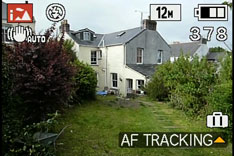
If it can’t find any faces the Lumix TZ8 / ZS5 defaults to the nine-area Auto focus system and this can be manually selected in the manual shooting modes along with AF tracking, centre AF and Spot AF. In other words about every AF mode ever devised, but no manual focussing option.
The Lumix TZ8 / ZS5 has a 2.7in LCD screen with 230 thousand pixels. Though it’s a step down from the 3in screens of the TZ10 / ZS7, the Cyber-shot H55 and the COOLPIX S8000, it’s a good quality screen that provides a bright contrasty image. Like all LCD screens, the one on the Lumix TZ8 / ZS5 is difficult to see in bright sunlight, but Panasonic has at least attempted to address this issue by providing alternative screen modes. Power LCD makes the screen brighter for outdoor use and Auto Power LCD automatically adjusts the brightness levels to suit the ambient conditions. In bright sunlight it doesn’t make a huge amount of difference, but every little helps.
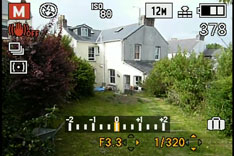
The TZ8 / ZS5’s menu system is activated by pressing the central button on the four-way control pad. What’s displayed is dependent on the selected shooting mode, but the options are always arranged on three tabs – Rec, Travel Mode and Setup, with a fourth tab added for scene selection when either of the two scene selection options are set on the mode dial.
 |
 |
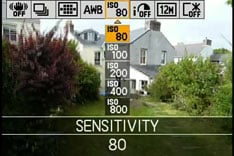 |
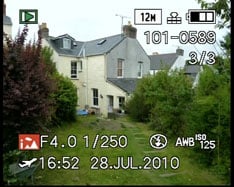
The Rec menu holds all the camera settings, the full set being available in manual modes including Picture size and Quality, ISO sensitivity, White balance, Face recognition, Metering modes, Burst mode, Digital zoom, Stabilizer and |Red-eye removal. In intelligent Auto mode these are limited to Picture size, Burst mode, Colour rendering and Face recognition.
 |
 |
 |
|

The setup menu has four pages of settings including Date and time, Custom preset selection, LCD mode, Economy (power saving), Language and Formatting. There’s an option to display menu text and you can also display a live histogram during shooting.
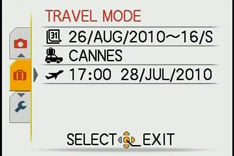
In between the Rec and Setup tabs is a Travel mode tab that you can use to select a travel date and destination so that the clock is reset to local time during your stay. For a minor feature, the travel mode settings are very prominent – the tab appears on the playback menu as well – and add a layer of, possibly unnecessary complexity to the menus. But if you travel a lot, and this is, after all, a travel zoom, you’ll undoubtedly find it very helpful.
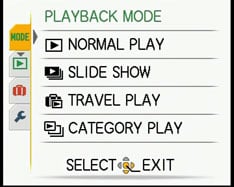
In playback mode the menu is also divided onto four tabs. The Mode tab provides selective playback options and a slideshow feature which replays images with ‘Ken Burns’ style panning effects and a music backing. If you’ve used the Travel mode tab to set destinations you can selectively playback shots or movies from specific locations. This is something that many people will prefer to leave until they’ve transferred their photos to a computer, but full marks to Panasonic for including genuinely useful travel features for those who want them.
The Playback tab offers calendar-based date filtering, basic resizing and retouching tools and printing options. There’s also a text stamp and title editing tool, but using the four-way control pad to enter characters is a fiddly business and, once again, something that’s probably best done on a computer. The remaining two tabs – Travel Mode and Setup are essentially the same as in shooting modes.
The Lumix TZ8 / ZS5’s menus are lengthy, but commonly used settings like Stabilization, Burst mode, AF mode, White balance, ISO sensitivity, Intelligent exposure, Picture size and LCD mode, can be accessed directly using the Q.Menu button on the bottom right corner of the rear panel. This displays settings on an overlay strip at the top of the screen with options appearing on a drop-down button list. As with the Rec Mode menu, these options are dependent on the chosen shooting mode.
The TZ10 / ZS7 and the TZ8 / ZS5 are the first models in the TZ series to offer full manual control. The mode dial now offers Program, Aperture Priority, Shutter Priority and full Manual options; Program is essentially the same as the ‘Normal’ mode on earlier models, but the other new additions really do give you much more control than before.
The TZ8 / ZS5 has seven aperture settings (when zoomed-out) which you can adjust yourself in Aperture Priority or Manual modes. Switch to Shutter Priority and you can choose from exposures between 1/2000 and 8 seconds, with Manual further extending the maximum to an impressive 60 seconds. To make changes to the aperture or shutter, just press the new Exposure button on the back of the camera, and then use the control pad to adjust the setting highlighted in yellow at the bottom of the screen.
Like most compacts, there are some restrictions. The quickest shutter speed of 1/2000 is only available with an aperture range of f4-6.3. Drop to 1/1600 and you can open the aperture to f3.6, but for the full aperture range, the maximum shutter speed is limited to 1/1000. Again like most compacts there are also caveats involving the usefulness of manual exposure control. Most notably, the inherently large depth-of-field in most compacts, including this one, means it’s hard to achieve a blurred background on portraits even with the aperture wide open.
On a more positive note though, Aperture Priority does allow you to select the optimum f-number to avoid diffraction. Shutter Priority also lets you choose deliberately slower-than-normal exposures to blur moving action, such as waterfalls or racing vehicles. You can find out how to achieve these effects in our Blurring Action and Photographing Water tutorials. Meanwhile, full Manual lets you choose combinations of aperture and shutter which go way beyond normal metering or compensation ranges, allowing you to achieve massive under or over-exposures. You can also choose very long exposures with ease.
The PASM modes are joined by Intelligent Auto, a pair of MyScene modes, SCN, Clipboard and Custom options on the dial, plus Motion picture mode. The TZ8 / ZS5 lacks the TZ10 / ZS7’s dedicated movie button, which is a bit of shame, but in its place you’ll find a less useful E.ZOOM button which automatically zooms the lens to its maximum telephoto setting or back to the wide angle setting.
Intelligent Auto on the Lumix TZ8 / ZS75 combines Panasonic’s latest technologies to deliver a pretty foolproof experience. Like earlier models, these include Intelligent ISO and Scene Detection which both do a good job of figuring out what you’re trying to take and whether the subject’s in motion. In practice this works very well, with the camera setting itself to its Landscape preset when we pointed it at a mountain, into Macro when directed towards a close subject, then onto its Portrait preset with Face Detection when turned to people. The camera’s also good at detecting motion and increasing the sensitivity if necessary to maintain a quick shutter to avoid blurring – great when photographing unpredictable children, although obviously the quality reduces quickly at higher ISOs. These tricks may now be several years old for Panasonic, but remain some of the most effective on the market. Rather than rest on its laurels though the Lumix TZ8 / ZS5 enhances the Face Recognition technology first-seen on the TZ7 / ZS3, while also introducing Intelligent Resolution.
As before, Face Recognition can memorise up to six people along with their names and birthdays if desired, but in a feature inherited from the FZ35 / FZ38, the TZ8 / ZS5 can now store up to three poses for each person in order to better recognise them under different situations. Once registered, these faces can have focusing priority over ‘strangers’, and it’s also fun to see their name pop-up under the tracking frame. If the subject’s age is less than three years old, the camera will also automatically switch to its Baby scene preset. In practice it really works too, and is fairly tolerant of accessories like hats, although sunglasses can fool the system.
Turning the dial to SCN lets you choose from 29 Scene Presets which now include the High Dynamic option first seen on the FZ35 / FZ38. The High Dynamic scene preset simulates the effect of HDR photography with a single frame, digitally boosting shadow areas while attempting to retain bright highlights; it in fact employs the same technique as Intelligent Exposure but with two or three times the effect. This approach is however far from ideal, as significant brightness adjustments to a single exposure normally incurs loss of quality, such as increased noise in those shadow regions. This is further accentuated by the preset operating at a fixed sensitivity of 400 ISO. In use the High Dynamic preset can noticeably boost the shadow areas, albeit with increased noise artefacts when viewed at 100%. As such it’s best-reserved for small prints or emailed photos. Finally, the two MyScene positions can be used to store and quickly access your favourite pair of presets, while Clipboard is used to record documents or memos. In PASM, MyScene or SCN modes, you can also record a five second audio memo.
New to the TZ8 / ZS5 is Intelligent Resolution, which applies greater sharpening to images, and if i.ZOOM is also enabled, allows the camera to digitally extend its zoom from 12x to 16x. Technically speaking the i.ZOOM extension inevitably doesn’t record any greater detail, but does a fair job of scaling in-camera and providing a little extra reach when ultimate image quality isn’t paramount. You can see some examples of i.resolution and i.ZOOM in our TZ10 / ZS7 review.
Pushing the upper cross-key lets you adjust exposure compensation in a +/-2EV range, while pushing up a second time in certain shooting modes presents the bracketing options. The Auto Bracket option lets you take three images up to 1EV apart, while pressing Display allows you to choose the Multi Aspect feature which takes images in 4:3, 3:2 and 16:9 aspect ratios in succession.
Though it lacks the TZ10 / ZS7’s ability to alternatively encode HD video in the AVCHD format, the TZ8 ZS5 can still shoot 720p HD video in the Motion JPEG format. Lower resolution modes include a 16:9 WVGA format measuring 848×480, VGA (640 x 480 / 4:3) and QVGA (320 x 240 / 4:3). All four video formats are recorded at 30fps on a fixed quality setting. What you lose by not having the TZ10 / ZS7’s AVCHD option is the ability to record high quality HD video with smaller file sizes and longer times per clip – in our tests with the TZ10 / ZS7 the AVCHD codec compressed clips of the same duration to around half the size of those encoded using Motion JPEG. The other drawback is the 2GB file size restriction of the Motion JPEG mode means that continuous video recording is limited to eight minutes here.
On the plus side, you can use the TZ8 / ZS5’s optical zoom during shooting, though it’s a shame the E.ZOOM button is disabled as an automatic wide-to-tele, or vice-versa zoom would be ideal for movies. Having said that, the single- (slow) speed zoom works equally well, is virtually silent in operation and manages to hold the focus very well throughout the full zoom range.
If we were to make one criticism it would be that the microphone, situated in the middle of the top panel next to the mode dial, was quite susceptible to wind noise. Registered members of Vimeo can download the original Motion JPEG clip shown here for evaluation on their own computers.
The Lumix TZ8 / ZS5 offers a variety of continuous shooting modes. Burst mode, available from the Q.Menu shoots 3 fine resolution or 5 standard resolution images at a quoted frame rate of 2.3fps. We confirmed this in testing, however, the Lumix TZ8 / ZS5 can only achieve this rate at the 80 and 100 ISO sensitivity settings. If you increase the ISO to 200 the rate drops significantly – to around 1.5fps.
Like other recent Lumix compacts, the TZ8 / ZS5 is also equipped with a High Speed Burst Scene preset which reduces the resolution to 3, 2.5 or 2 Megapixels (at 4:3, 3:2 and 16:9 aspect ratios respectively) and the compression to Standard, but allows you to shoot up to 100 images at around 6fps in Image Priority, or up to 10fps in Speed Priority. Note both modes employ high sensitivities with 800 ISO not uncommon even under bright conditions. The Normal Burst and High Speed Burst Preset modes both involve compromises, either in total frames or resolution respectively, but are arguably more useful alternatives to the infinite, but very slow continuous rate of most rival models.
The Lumix TZ8 / ZS5 is equipped with the same 14.5 Megapixel CCD sensor measuring 1 /2.33in, as the TZ10 / ZS7, though like that model, it actually captures images with a maximum effective resolution of 12.1 Megapixels. The extra pixels around the edge are used to maintain the angle of view and avoid cropping at different aspect ratios. So with the camera zoomed-out, you’ll enjoy 25mm coverage whether you’re shooting in 4:3, 3:2 or 16:9 aspect ratios. This innovative approach is unique to Panasonic and in contrast to most compacts which simply crop strips from the top and bottom at wider aspect ratios, thereby losing resolution and coverage.
The best quality setting produces images with a 4:3 aspect ratio measuring 4000 x 3000 pixels. There’s a choice of two compression settings – Standard and Fine and Full resolution images files compressed using the Fine setting typically measure around 5MB. With 40MB of built-in memory you’ll need to pick up an SD card if you want to shoot video or more than a handful of images. The sensitivity ranges from 80 to 1600 ISO at full resolution, with a High Sensitivity Scene Preset automatically choosing between 1600 and 6400 ISO depending on conditions – albeit operating at a greatly reduced resolution of 3 Megapixels (in 4:3 mode).
To see how the quality of the Lumix TZ8 / ZS5 measures-up in practice, take a look at our real-life resolution and high ISO noise results pages, browse the sample images gallery, or skip to the chase and head straight for our verdict.