Panasonic Lumix DMC-GH1
-
-
Written by Gordon Laing
Intro
Panasonic’s Lumix DMC-GH1 is the second model in the Lumix G range, following the original G1. Announced in March 2009 at the PMA trade show, the GH1 becomes the second camera to be based on the recent Micro Four Thirds standard, and the first to boast HD movie recording, unusually in the choice of either the 720 or 1080 formats.
Micro Four Thirds was jointly developed by Olympus and Panasonic to target those who want the flexibility and quality of camera with a large sensor and interchangeable lenses, but who’ve been put-off by the size and weight of traditional DSLRs along with their perception of difficult operation.
Micro Four Thirds addresses this by taking the sensor dimensions of the existing Four Thirds DSLR standard, but dispensing with the traditional SLR mirror and optical viewfinder to allow a much shorter lens to sensor distance; this in turn enables smaller and lighter cameras (and lenses) to be built. Micro Four Thirds employs a new lens mount, but can accommodate existing Four Thirds lenses via an adapter, albeit with some AF restrictions we’ll describe in our review.
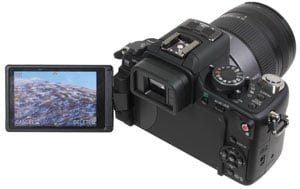
The new Lumix GH1 is strongly based on the original Lumix G1, announced in September 2008: it shares the same body and controls, with the only external differences being a new record button on the rear and a slightly taller popup flash section to accommodate stereo microphones. Like the G1 (and other Micro Four Thirds cameras), the GH1 operates 100% in Live View, exclusively employing electronic composition with either the excellent quality Live View Finder, LVF, or a fully-articulated 3in / 460k screen. The quick and broad 23-area contrast-based AF system also remains here.
At first glance, the resolution appears to be the same 12.1 Megapixels, but look a little closer and you’ll discover the Lumix GH1 actually employs a new sensor – not just to equip it with the ability to record video, but to also support multiple aspect ratios with the same angle of view. The Lumix GH1’s sensor actually sports 14 Megapixels in total with a slightly larger surface area, allowing it to switch between 4:3, 3:2 and 16:9 aspect ratios without cropping the image or compromising the field of view. So the 4:3 aspect ratio uses the full height of the sensor, while the 16:9 aspect ratio uses the full width.
The headline new feature is of course movie recording, something which arguably should have been in the original Lumix G1 from day-one. Panasonic has at least pulled-out all the stops though to offer an unrivalled choice of formats. Unlike most cameras which only offer either 720 or 1080 recording, the GH1 gives you the choice of both, encoded using the AVCHD compression system. Interestingly, like its most recent compacts, Panasonic alternatively offers a variety of movie modes in the older Motion JPEG format, including a 720p option.
 |
Unlike many rival models with movie modes, the GH1 supports autofocus while you film and the choice of full manual control over the aperture and shutter. And rather than using a tiny built-in mono microphone, the GH1 features a pair of respectable stereo microphones, along with a 2.5mm jack for connecting an external model.
It’s not just the body that’s designed for video either: Panasonic has developed a new super-zoom kit lens for the GH1 specifically with video recording in mind. The new G VARIO 14-140mm lens boasts a 10x optical range that’s equivalent to 28-280mm, and Panasonic’s HD labelling which means it can adjust its focus and aperture quietly, along with supporting autofocus in the top quality 1080 mode. At the time of writing, the GH1 was only available in a kit with this lens, although you can still film video with other lenses, only with some AF restrictions and audible adjustments.
All-in-all it’s one of the most rounded and complete camera specifications to date and one which has understandably generated a great deal of excitement and anticipation. In our full review we’ll put the GH1 to the test and find out whether it can deliver the goods in practice and live up to expectations. The critical question for a camera of its class is how the video and stills capabilities compare to both DSLRs and the best compacts around, so we’ll pitch the GH1 against the Nikon D90 and Canon PowerShot SX1 IS to see how it measures-up. Will the Lumix GH1 be the hybrid camera you’ve been waiting for with uncompromised stills and movie capabilities? Find out right here!
Testing notes
We tested a final production Lumix GH1 running the latest 1.1 firmware released in June 2009. Following our practice of testing cameras with their default settings and best quality JPEG options, the GH1 was set to Program mode with Large Fine JPEG quality (4:3 aspect ratio), Auto White Balance, Multiple Metering, and the Standard Film Mode (the default setting for contrast, saturation and sharpening). Image Stabilisation was enabled for all handheld images and disabled for all tripod-based tests. Note: due to the similarity with the earlier G1, some portions of our previous review have been re-used here.