| |
Panasonic Lumix DMC-GF1 preview
NEW! See how the GF1's noise compares against the Olympus E-P1 and Canon PowerShot G11 here!
Panasonic’s Lumix DMC-GF1 is a compact camera with a DSLR-sized sensor and removeable lenses. Announced in September 2009, it’s the third Lumix G model from Panasonic, following the G1 and GH1, with all three based on the recent Micro Four Thirds standard.
Micro Four Thirds was jointly developed by Olympus and Panasonic to target people who want the flexibility and quality of camera with a large sensor and interchangeable lenses, but who’ve been put-off by the size and weight of traditional DSLRs along with their perception of difficult operation.
Micro Four Thirds addresses this by taking the sensor size of the existing Four Thirds DSLR standard, but dispensing with the traditional SLR mirror and optical viewfinder to allow a much shorter lens to sensor distance; this in turn enables smaller and lighter cameras to be built. Micro Four Thirds employs a new lens mount, but can accommodate existing Four Thirds lenses with an adapter.
The new Lumix GF1 departs from the mini-DSLR-styling of the earlier G1 and GH1, instead adopting a relatively compact form factor. Like the Olympus E-P1 before it, the GF1 therefore delivers the combination of large sensor, interchangeable lenses and portability which enthusiasts have been requesting for years.
Size is everything in such a model, so we’ll start with the vital statistics: measuring 119x71x36mm for the body alone, the Lumix GF1 is almost exactly the same size as its major rival, the Olympus E-P1. The Olympus is 2mm wider, 1mm shorter and 1mm thinner. The Panasonic is slightly lighter though at 341g including battery, compared to 380g for the E-P1 with its battery.
| |

|
 |
| |
| |
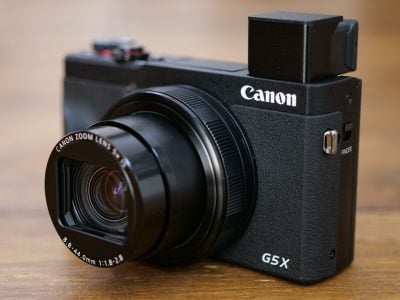
Both compare favourably with a typical enthusiast’s compact like the Canon PowerShot G11, which at 112x76x48mm may be 7mm less wide, but 5mm taller and a considerable 12mm thicker; the G11 is also slightly heavier at 402g. Of course the G11’s dimensions and weight include a 5x 28-140mm equivalent zoom lens, while the GF1 and E-P1 stats above are for their body and batteries alone. The smallest lens option for the GF1 is Panasonic’s new 20mm pancake, a fixed f1.7 prime adding 100g to the weight and 25mm to its thickness, while the standard 14-45mm 3x zoom adds 195g to the weight and 60mm to its thickness. So like the E-P1 before it, the Lumix GF1 is clearly thicker and heavier than most compacts when fitted with a lens, and more suited to a small bag or large coat pocket, but both are still impressively small considering their interchangeable lens capability and DSLR-sized sensors.
Sticking with the sensor, the Lumix GF1 is equipped with the same 12.1 Megapixel Live MOS sensor as the Lumix G1 before it. As such, the maximum resolution is 4000x3000 pixels in the 4:3 aspect ratio, and if you switch to wider 3:2 or 16:9 modes, the image will be vertically-cropped; this is unlike the Lumix GH1 which employed a slightly larger sensor, allowing it to maintain the same angle of view across multiple aspect ratios. The sensitivity is in the same 100-3200 ISO range and you can record images in the JPEG or RAW formats. As a standard Four Thirds sensor, it measures 17.3x13mm, which may be smaller than the APS-C sized chips in most DSLRs, but is huge compared to a typical compact.
| Support this site by shopping at Amazon |
|
|
|
|
Interestingly though, despite having the G1’s sensor, the GF1 does have HD video recording capabilities. It may not boast the Full HD 1920x1080 capabilities of the GH1, but you can record at 1280x720 pixels. Like recent Panasonic models, the GF1 offers the choice of encoding formats too: Motion JPEG for ease of editing, or AVCHD for greater efficiency. Set to Motion JPEG, the frame rate is 30fps, and lower resolutions including 848x480, 640x480 and 320x240 pixels are also available. Set to AVCHD, the resolution is fixed at 1280x720 and the frame rate recorded at progressive 50fps for PAL models or 60fps for NTSC models (the native sensor output in each case is 25 or 30fps respectively).
Autofocus while filming is possible, but like the GH1 before it, there’s a wealth of caveats depending on the lens in question, and Panasonic explained the AF speed while filming is also slower than the GH1. As before, keep an eye on Panasonic’s lens compatibility web page to learn the full details. And again European models are limited to individual file lengths of 29 minutes and 59 seconds to comply with tax regulations.
In terms of auto-focusing for still images, the GF1 is equipped with the same 23-area contrast-based system as the GH1 and G1 before it. Panasonic describes the speed as being almost the same, which would be good as those models were very quick, and if born out in practice, this could give the GF1 a critical advantage over the Olympus E-P1.
Both the GF1 and E-P1 are equipped with 3in colour screens as their only means of composition in their standard packages, although Panasonic’s sports double the resolution: 460k pixels compared to the somewhat pedestrian 230k of the Olympus. The GF1’s screen may not have VGA resolution, but it’s still much more detailed than the Olympus and this gives it a key advantage.
Both cameras also offer optional viewfinders which mount on their respective hotshoes, but they’re significantly different. While Olympus offers a fairly simple optical viewfinder, Panasonic has gone for an electronic ‘Live View Finder’. Before you get too excited though, this is a lower specification than the one in the Lumix G1 and GH1. Those cameras employed an LCOS finder with 1.4x magnification and 1,440,000 dots, delivering a large and very detailed image.
In contrast, the GF1’s optional finder has a smaller 1.04 magnification and much lower 202,000 dot resolution. We’re confirming with Panasonic about the technology, but its size and resolution are much closer to that of typical super-zoom cameras. The LVF does of course still deliver 100% coverage and overlaid graphics which match those on the main screen though, and the lower spec should keep the price affordable.
Another aspect where both cameras differ is their flash capability: the Olympus E-P1 does not have a built-in flash, instead requiring you to buy an optional accessory, whereas the Panasonic GF1 has a built-in option. It’s fairly modest with a guide number of 6, but it’s certainly useful to have, and if necessary, you can alternatively mount a flashgun on the hotshoe.
A major difference between the GF1 and EP-1 concerns image stabilisation: Olympus has gone for a body-based solution which shifts the sensor to provide stabilisation with any lens you attach, whereas Panasonic has gone for an optical solution which requires the lens to provide stabilisation. So for stabilisation on the GF1, you’ll need to couple it with, say, the Panasonic 14-45mm standard zoom or the new 45mm f2.8 macro prime; sadly the new Panasonic 20mm f1.7 pancake won’t be stabilised on the GF1, although of course it would be if fitted on the Olympus E-P1.
Completing the GF1’s specifications are a wealth of shooting modes from Intelligent Auto to full manual control, and an HDMI port which also allows slideshows to be remote controlled when connected to a compatible Panasonic TV set. The Lumix GF1 will be available in black, red, silver or white.
The Lumix GF1 will launch at a price of $899 USD with either the 20mm pancake lens (pictured in these images of the camera) or the 14-45mm stabilised zoom. Now let's see how it compares to its arch rival, the Olympus E-P1...
Compared to Olympus E-P1
The closest rival to the Lumix GF1 is of course the Olympus E-P1. Both are compact cameras based on the Micro Four Thirds standard and share much in common. They’re essentially the same size, they both sport 12 Megapixel sensors, 3fps continuous shooting, 3in screens with optional viewfinders, flash hotshoes, 720p HD video recording capabilities, HDMI ports, and as Micro Four Thirds cameras, they can also use the same lenses. At first glance then, you could be mistaken for thinking the choice boils down to preferences in styling and minor difference in pricing, but look a little deeper and significant differences emerge.
In its favour, the Lumix GF1 has a screen with double the resolution (460k pixels vs 230k), it features a popup flash (unforgivably missing on the E-P1), what we believe to be faster autofocusing, has a more sophisticated auto mode, the choice of Motion JPEG or AVCHD for movie encoding, and it’s 39g lighter when both are fitted with their respective batteries. The GF1’s optional viewfinder is also electronic, as oppose to the E-P1’s optional model, which is optical and also fixed at one focal length. Some may still prefer the E-P1’s optical solution, but many will prefer the GF1 viewfinder’s ability to deliver 100% coverage with any lens along with showing the same graphics as the screen; it’ll also tilt vertically.
Sounds like a slam-dunk for the Panasonic, but the Olympus E-P1 has some key advantages of its own, most notably built-in image stabilisation which works with any lens you attach. This is a major advantage for the E-P1 since the Panasonic relies on lenses with optical stabilisation, and already there’s several compelling options – including Panasonic’s own 7-14mm and 20mm pancake models – which aren’t stabilised. Pop them on the E-P1 though, and you’ll enjoy up to four stops of compensation. Not bad considering the camera is about the same size as the GF1 and only 39g heavier. The Olympus also has twin control dials, an electronic levelling gauge, boasts greater compatibility with legacy lenses and includes the company’s Art Filters for in-camera special effects.
A lot will also still boil down to which model you prefer the look of, with many enthusiasts falling for the retro styling of the E-P1 over the modern look of the GF1. And if you buy them in their respective zoom kits, the Olympus lens features a cunning design which allows it to fold down to just 44mm thick, compared to 60mm for the standard Panasonic 14-45mm in its shortest position. At the time of writing, the E-P1 also cost slightly less than the GF1, but these prices could become closer over time.
For more details, see our Olympus E-P1 review!
Panasonic Lumix DMC-GF1 final thoughts
Until we test a final production sample, that’s about all we can say about the Lumix GF1 for now – but certainly in terms of specification it looks pretty compelling, offering the key combination of a large sensor and interchangeable lenses in a portable form factor, while also addressing some of the disappointments with the Olympus E-P1, such as the low-res screen and lack of popup flash. Is it the compact you’ve been waiting for? Tell us what you think in the Cameralabs forums!
|