Panasonic Lumix DMC-FZ45 / FZ40
-
-
Written by Gordon Laing
Intro
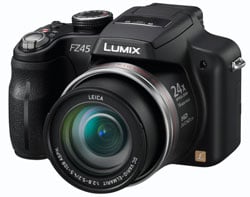
The Panasonic Lumix DMC-FZ45, or FZ40 as it’s known in North America, is a 14 Megapixel super-zoom camera with a 24x stabilised range, HD video and a 3 inch screen. Launched in July 2010 it replaces the very popular Lumix FZ38, or FZ35 as that model was called in North America. From here on we’ll refer to the old model as the FZ38 / FZ35 and the new one as the FZ45 / FZ40.
The FZ45 / FZ40 extends the zoom range of its predecessor from 18x to 24x, widening the equivalent coverage from 27 to 25mm and greatly extending it from 486 to 600mm. The maximum resolution is increased by 2 Megapixels and, at 3 inches, the fixed main screen is a little larger, but retains the 230k pixel resolution of its predecessor.
There’s big rivalry in this segment of the market, which is nowhere more closely contested than between Panasonic and Canon. Within a few weeks of Panasonic releasing the Lumix FZ45 / FZ40, Canon announced the PowerShot SX30 IS, a more expensive camera that outperforms the Lumix FZ45 / FZ40 in some key areas, most notably with its incredible 35x optical zoom. But Panasonic also has a new ‘premium’ version of the Lumix FZ45 / FZ40 – the FZ100. By offering two choices at two different price points has Panasonic out-manoeuvred Canon, or is the SX30 IS a just a better all-round choice for those who want the ultimate zoom range? Read our full review to find out.
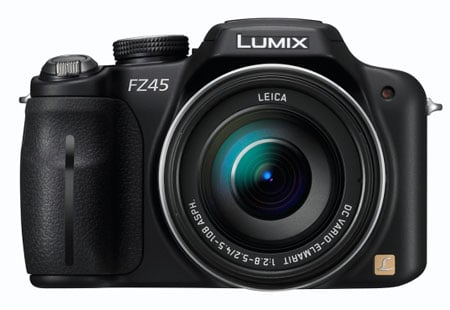 |
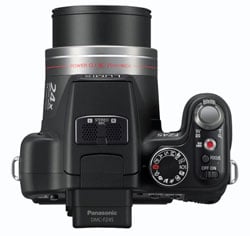
There’s been no radical restyling of the Lumix FZ45 / FZ40 body and side-by-side it doesn’t look all that different to the FZ38 / FZ35 that it replaces. At 498g the Lumix FZ45 / FZ40 is however 84g heavier when both are fitted with their respective batteries and cards, but in your hands it’s less of a difference than it sounds. The Lumix FZ45 / FZ40 is also couple of millimetres bigger all round than its predecessor, but, again, you’d be hard pressed to tell in use. More importantly there’s been some rearrangement of the controls which, as we’ll see, has much more of an impact on function than appearance.
Before moving-on, it’s important to note the Lumix FZ45 / FZ40 is considerably lighter and more compact than than the PowerShot SX30 IS. Its arch rival from Canon weighs a not inconsiderable 601g including battery and card, while measuring 12mm taller and 16mm thicker. The Lumix may lack the Canon’s sexy curviness, but it’s very comfortable to hold and operate, and its smaller size and lower weight will be seen as a real advantage by some. Note the FZ100 falls between the FZ45 / FZ40 and SX30 IS in weight, at 540g including battery and card.
 |
 |
The Lumix FZ45 / FZ40 has quite a lot of buttons, dials and wheels. This isn’t necessarily a bad thing, particularly if you like to have dedicated controls for things rather than, as is more the case on the PowerShot SX30 IS, fewer multi-function controls.
On the the top panel the shutter release occupies the far end of the hand grip and immediately behind it is the dedicated movie recording button, moved from its previous position on the rear of the FZ38 / FZ35. Behind that is a smaller button for activating some of the AF options and lastly there’s the on/off switch. The mode dial sits between the top of the hand grip and the flash housing with 14 positions for the manual PASM exposure modes, Intelligent Auto, a choice of scene modes, a SCN position with further menu-selectable scene modes and a final position used to select one of three custom settings.
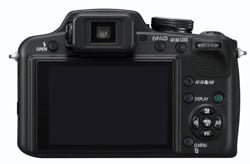
On the back the electronic viewfinder, or EVF, is flanked by a button on the left to release the pop-up flash and two on the right – one to switch the display between the EVF and main screen and another which has a double function as an AF/AE lock.To the right of those a new ‘rear dial’ control, used to adjust exposure and focus settings, has been added.
To the right of the main screen is a conventional four-way control pad with a Menu/Set button at its centre. The four positions on the pad are used to navigate menus and as one-touch buttons for exposure compensation, ISO sensitivity and self timer, the bottom of the four having a custom function.
|
Four buttons occupy the remaining rear panel space. One toggles between the various focus modes and another toggles display overlays. A third activates the Q.menu – a shortcut menu containing frequently used functions. This replacement button also doubles up as a delete button in playback mode, but burst shooting no longer has a dedicated button and the FZ38 / FZ35’s Q.menu ‘nipple’ is no more.
The fourth button, which activates playback mode, marks a bit of a shift in Panasonic’s design philosophy. What’s different about it is that it’s not a switch. The FZ38 / FZ35 and most other Panasonic compacts to date have used a switch to move between capture and playback modes. The problem with that way of doing things is that the only way to get from playback mode to shooting mode is to use the switch which means that you can often lose a shot by pressing the shutter and wondering why nothing is happening before belatedly realising you’ve got the switch in the playback position.
The substitution of a button for a switch means that if you half-press the shutter release while in playback mode the camera automatically switches to shooting mode. So-called ‘shooting priority’, means you can take the shot with only a slight delay. The continued use of an on/off switch, rather than a button means that you can’t use the playback button to turn the camera on, but we can live with that.
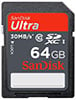
On the left side of the body a small plastic cover opens to reveal a combined USB / A/V port and an HDMI mini-port. A hinged door on the base below the hand grip pops open to reveal the combined battery and card compartment. The Lumix FZ45 / FZ40 takes SD, SDHC and the new SDXC high speed, high capacity cards.
The Lumix FZ45 / FZ40’s flash is mounted above the lens and flips up when you press a small button to the left of the viewfinder. In this position it works in auto mode and fires should the ambient lighting conditions require it. In supported exposure modes it can be forced on or off, used in slow sync mode for fill-in illumination at slow shutter speeds and you can synch the flash with the first or second shutter curtain. A red-eye reduction mode both pre-fires the flash and illuminates the LED AF assist lamp. The quoted range of the flash at the wide angle lens setting is an impressive 9.5 metres.
Panasonic has continued to resist fitting a flash hotshoe to the FZ45 / FZ40, giving Canon’s PowerShot SX30 IS an advantage in this respect. But as explained earlier, the new premium Lumix FZ100 features a flash hotshoe in addition to several other key benefits.
The Lumix FZ45 / FZ40 uses a Panasonic Lithium Ion battery which is charged outside of the camera. A fully charged battery provides enough power for 580 shots using the CIPA (Camera Imaging Products Association) standard. In the absence of any information to the contrary, we’re assuming that’s using the EVF rather than the main screen, but it’s nonetheless pretty impressive and should enable most people to do a day’s shooting without the need for a spare.
The Lumix FZ45 / FZ40 has a 24x optical zoom lens with a range of 4.5 to 108mm which is 25 – 600mm in 35mm terms. That’s a big jump from the 18x optical zoom of the FZ38 / FZ35, providing a slightly more useable wide angle as well as a much longer maximum telephoto – it’s a very welcome upgrade over its predecessor.
Panasonic Lumix FZ45 / FZ40 coverage wide | Panasonic Lumix FZ45 / FZ40 coverage tele | |
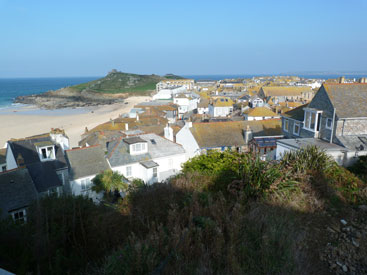 | 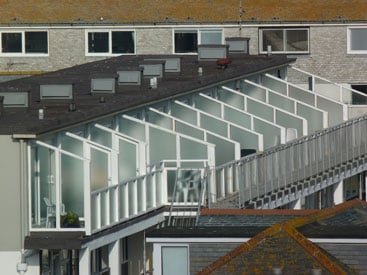 | |
| 4.5-108mm at 4.5mm (25mm equivalent) | 4.5-108mm at 108mm (600mm equivalent) |
The maximum aperture at the wide angle setting is f2.8, but as soon as you begin to extend the zoom this immediately drops to f2.9. Unlike the PowerShot SX30 IS, which closes the aperture in larger fractions of stops at discrete points in the zoom range, the Lumix FZ45 / FZ40 maximum aperture closes in 0.1 increments with small zoom increments. It hits f3.2 at around 40mm, at 100mm it reaches f3.5 and the f4.0 mark is reached at 290mm. At 540mm it reaches f4.8 and f5.2 isn’t reached until you hit the end point at 600mm.
One small, but significant improvement is the lens cap which now fits to the extending barrel of the lens, rather than the outer housing as was the case with the FZ38 / FZ35, so you can now power up the camera with the lens cap in place. The camera is also supplied with a bayonet-fitting lens hood which is much easier to attach than the older-style lens hood, with little danger (though it is possible if you don’t pay attention to the instructions) of causing vignetting by incorrect mounting. You can also reverse-mount the lens hood for compact storage when it’s not in use.
On power-up the lens extends by 19mm and the camera is ready to shoot in about one and a half seconds. The zoom travels smoothly in both directions and is almost silent in the slower of its two speeds. It’s possible to make very fine adjustments to the zoom – by flicking the zoom collar it’s possible to set 80 discrete positions in both directions. Fully extended the barrel protrudes by 58mm from the housing. Unlike the PowerShot SX30 IS there are no lens markings to indicate approximate focal length, though the screen does show the zoom magnification which you can multiply by 25 to make a rough calculation.
Panasonic Lumix FZ45 / FZ40: off / continuous | ||
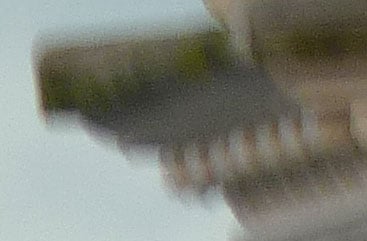 | 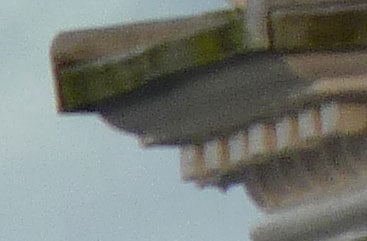 | |
100% crop, 4.5-108mm at 108mm, 1/25, 100 ISO, Power O.I.S off. | 100% crop, 4.5-108mm at 108mm, 1/25, 100 ISO, Power O.I.S on. | |
Like its predecessor, the Lumix FZ45 / FZ40 uses Panasonic’s image stabilisation to reduce the effect of camera shake and the blur that results at slower shutter speeds, although the earlier OIS has been updated to the company’s latest Power OIS. There are four settings, Off, Auto, Mode 1, which applies stabilisation continuously and Mode 2, which activates it when the shutter release is pressed half-way.
The crops above are from shots taken with the Lumix FZ 45 / FZ40 with the lens set to its maximum focal length of 108mm – the equivalent of 600mm on a full-frame 35mm camera. At this focal length you’d ordinarily expect to be using a shutter speed of 1/600 to avoid camera shake. Both of these crops are from shots taken with a shutter speed of 1/25th of a second, for the one on the left Power O.I.S was turned of, for the one on the right it was set to Continuous. As you can see the FZ45 / FZ40 has coped impressively with the low light conditions managing to produce a crisp image more than 4 stops slower than you would expect – this confirms the claims of Panasonic’s Power OIS system.
 |
The Lumix FZ45 / FZ40 has a variety of AF options as well as the ability to set focusing manually. There is, of course Face detection which can detect up to 15 faces and lock focus on one of them. Multiple AF uses 23 areas to determine the best focus and there’s a single area AF option with a default central AF area that can be moved around the screen.
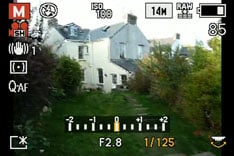
Manual focusing is selected by pressing the AF/AF Macro/MF button on the rear panel and then using the rear dial to adjust the focus referencing a scale on the screen, remembering first to press the dial in to switch from exposure adjustment. The scale uses the width of the screen to represent distances from a few centimetres to infinity, so it’s difficult, if not impossible to focus precisely without invoking the MF assist function which magnifies a portion of the screen. It takes several turns of the rear dial to move the focus point by a significant amount, but the left and right buttons on the mode dial provide a quicker alternative. The scale graphically represents the depth of field, which gives you an indication of how successful your manual focussing efforts are likely to be.
|
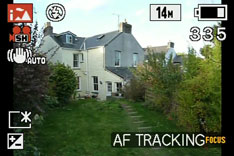
In AF tracking mode pressing the AF/AE lock on the rear panel locks and tracks the object within the central target area. Like Face detection, AF tracking holds onto subjects well in good light, but in poor lighting conditions and when subjects move quickly, it can slip off the target.
The pre AF mode, which is set from the main menu, helps speed up the focusing process by pre-focusing before you press the shutter release. There are two options Q-AF and C-AF for Quick and Continuous respectively. C-AF works the same way as continuous AF on most cameras, including the PowerShot SX30 IS, with all the implications for battery life that continual adjustment of the focus motor carries. Q-AF rather cleverly uses the image stabilization system to detect when the degree of jitter becomes minimal, interprets this as you framing up your shot, and only then activates AF.
We should also mention here that the Lumix FZ45 / FZ40 supports face recognition. Up to six faces can be stored along with name, D.O.B. and a custom AF icon. Focus and exposure are prioritised on recognised faces which can be registered manually, or you can set things up so that the camera automatically registers frequently shot faces. It’s a feature that’s popular on Panasonic’s compact range and undeniably great fun to see the names of people appear below their faces when they’re recognised. What would make it truly useful is to have the name recorded as a keyword in the image’s EXIF data.
The screen on the Lumix FZ45 / FZ40 has been increased to 3 inches diagonally from the 2.7 inch screen of the FZ38 / FZ35. Most of the extra space has been added to the horizontal dimension, so the greatest benefit will be felt when shooting 16:9 aspect ratio HD movies which fill the screen horizontally with a narrow black strip above and below.
Where 4:3 aspect ratio stills (and VGA video) filled the screen of the FZ38 / FZ35, there are now narrow vertical black bars either side. Though the screen is bigger, the number of pixels remains at 230 thousand and this provides a sharp and detailed image, the only evidence of pixellation occurring when viewing magnified portions using the MF assist feature.
The screen is fixed, putting it at a distinct disadvantage compared to the articulated screen of the PowerShot SX30 IS and the Lumix FZ100, you can’t, for example tilt it to keep it out of the sun, or to get a better view with the camera held up high or down low. This is less of an issue than it might be, though as the Lumix FZ45 / FZ40 has a electronic viewfinder. This is activated by a small button to the right of it which simultaneously turns off the main screen. Unlike the main screen, there’s little to differentiate between the Lumix FZ45 / FZ40, FZ100 and PowerShot SX30 IS where the viewfinder is concerned.
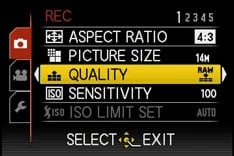
The Lumix FZ45 / FZ40’s menu system is accessed by pressing the Menu/Set button at the centre of the control pad and is arranged on three tabs, Rec – for shooting stills, Motion Picture and Setup. The Rec tab is pretty extensive – in the PASM exposure modes it contains 25 options ranged over five pages. This in itself isn’t a problem but it would be a help if the Lumix FZ45 / FZ40 had something like the PowerShot SX30’s hint feature to tell you what some of the options are for. The ‘Mode 1’ and ‘Mode 2’ stabiliser options, for example, would benefit by being renamed ‘continuous’ and ‘partial’ or something else that better describes what they actually do. The Setup menu has seven pages of options, though many of these, like the time and date settings, power saving options, USB and HDMI port modes and display options, are things you’ll most likely set only rarely.
 | 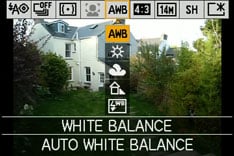 |  |
The menus are tailored to display only those options available in the selected exposure mode. In Intelligent auto mode, for example, the Rec menu is replaced with an iA menu with just five options. The full list includes Picture size, picture quality, sensitivity, white balance, AF mode, Burst, Stabilisation and colour rendering.
 |  |  |
The Motion picture menu allows you to set movie recording options including recording quality, Pre AF mode and to activate the wind filter and zoom mic feature.
The Q. Menu button activates a shortcut menu overlay with frequently used functions. As with the main menu these are dependant on the selected exposure mode. In Program mode the full list is flash, burst shooting, metering mode, AF mode, white balance, aspect ratio, picture size, movie recording quality, and LCD mode. As with the PowerShot SX30 IS, there’s no ISO setting here because that has it’s own dedicated button on the control pad.
|

In Playback mode the Setup menu tab is joined by Mode and Playback tabs. The first of these is used to select between normal playback, slideshow, mode playback, from which you can chose to play just movies or stills, and category-based filtered playback. The Playback menu provides some basic editing tools including a tool which splits movie clips and one that allows you to edit Face recognition information.
The Lumix FZ45 / FZ40 has a wide range of exposure options ranging from the fully automatic Intelligent Auto mode to fully manual exposure control. In between there are semi auto aperture and shutter speed priority modes providing the PASM quartet familiar to SLR users as well as a wide range of scene modes. No fewer than six of these have their own setting on the mode dial, the remainder being chosen from a screen menu having selected the SCN position on the mode dial.
Intelligent Auto mode employs scene detection and, where appropriate, selects the Portrait, Scenery, Macro, Night Portrait, Night Scenery, Sunset or Baby scene modes, otherwise, it uses the standard auto exposure settings. Intelligent auto also employs intelligent ISO which detects motion in the frame and selects an appropriately high sensitivity setting to enable a suitably fast shutter speed. Lastly, Intelligent exposure sets different ISO levels for individual scene areas to produce an exposure that captures a wider range of tonal detail than would otherwise be possible. Intelligent ISO and Intelligent Exposure are also available in other modes.
Panasonic’s scene detection works pretty flawlessly, identifying scene types swiftly and accurately. Though it’s a less sophisticated system than the PowerShot SX30 IS’s, with fewer scene types, it was more often able to make an identification in situations where the SX30 IS defaulted to the ‘generic’ auto exposure setting.
In Semi auto and manual modes aperture and shutter speed are set using the rear dial. In Manual, a push on the dial toggles between aperture and shutter speed and rotating the dial changes the setting which is displayed at the bottom of the screen. In semi-auto modes pushing the real dial switches between exposure settings and exposure compensation. Shutter speeds range from 60 seconds to 1/2000, with a one second lower limit in Program mode.
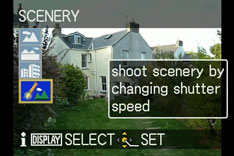
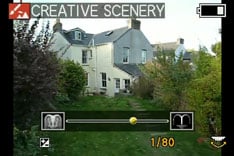
The scene modes allocated pride of place on the mode dial are My colours, Portrait, Scenery, Sports, Close-up and Night portrait. Selecting any of these provides further options on a screen overlay. For example, My colours provides a choice of colour rendering options, Portrait offers normal, soft skin outdoor, indoor and creative options and the Scenery scene mode offers normal, nature, architecture and creative.
The creative element in these modes provides an additional level of control appropriate to the scene – in portrait you can adjust the aperture and hence the depth of field, in Scenery mode you can adjust the shutter speed to produce more interesting water effects. A further 17 scene modes are available from the SCN position on the mode dial, These include Panorama Assist, two baby modes, Pet, Sunset, High Sens, High Supped Burst, Flash Burst, Aerial Photo and Frame.
Panasonic Lumix FZ45 / FZ40 Movie Mode
Like its predecessor, the FZ45 / FZ40 can record movies in 720p HD mode with a choice of encoding formats as well as offering three standard resolution video recording formats. The Lumix FZ45 / FZ40 has twin stereo mics mounted on top of the flash housing, a dedicated video recording button and you can use the 24x optical zoom and stabilizer during recording. You can’t shoot still images while video recording is in progress, though that option is available on the Lumix FZ100.
|
In contrast to Canon, which has switched from Motion JPEG to the better quality, more efficient H.264 codec, Panasonic continues to offer both Motion JPEG and AVCHD Lite formats on the Lumix FZ45 / FZ40. When set to AVCHD Lite you have the choice of three 720p quality settings, SH, H and L which encode footage at 17, 13 and 9Mbps respectively. If you have a ‘PAL’ model (Europe / Aus / NZ), the sensor outputs 25fps and the AVCHD files are recorded at 50p. If you have an ‘NTSC’ model (North America), the sensor outputs 30fps and the AVCHD files are recorded at 60p.
Switch to Motion JPEG and the 720p HD option is joined by WVGA (848 x 480), VGA (640 x 480), and QVGA (320 x 240) size options, all recorded at a fixed quality setting and at a frame rate of 30fps regardless of geographic region. Note to support AVCHD Lite, you’ll need to use a memory card rated as Class 4 or quicker, while to support Motion JPEG, you’ll need Class 6 or faster. For the record, AVCHD Lite is the same as AVCHD, but only operating at 720p.
So which mode should you use? Motion JPEG may be older, but has the advantage of easier editing and greater compatibility, but AVCHD enjoys longer recording times. To put them in perspective, the FZ45 / FZ40’s AVCHD Lite mode (even in its best quality SH setting) consumes almost half as much memory as Motion JPEG, allowing you to squeeze around double the footage into the same space, while delivering roughly the same image quality. Given an 8GB card, you’re looking at around half an hour of footage in Motion JPEG as opposed to one hour with AVCHD, again even when the latter is set to its best quality SH mode.
Beyond more efficient compression though, the really important feature of AVCHD is potentially longer recording times per file. Motion JPEG files on the FZ45 / FZ40 are restricted to 2GB in size, which limits the HD mode to clips lasting about 8 minutes and 20 seconds each. In contrast, switching to the AVCHD Lite mode allows you to keep recording uninterrupted until you run out of memory or battery life. Fit an 8GB card and you could record for an hour in the best quality setting.
There is however one important caveat for the European Lumix FZ45 version, which has a maximum recording time of 29 minutes and 59 seconds per file to comply with tax regulations. But that’s still much longer than the 8 minute maximum of Motion JPEG.
Another difference worth noting between the two formats is their location on the card itself. Motion JPEG ‘MOV’ files may be found alongside your still photos in the DCIM folder, but the AVCHD ‘MTS’ files are buried away in various nested folders which start with one unhelpfully labelled PRIVATE on your card. This is to ensure compatibility with Panasonic’s TVs, and to play them on your computer, simply point your software at this folder and it’ll work out the rest; we had no issues playing back in Cyberlink’s PowerDVD 8 which ‘saw’ them as a Blu-Ray disc, or opening them directly into VLC Player. Either way, just remember to copy the MTS files out of this folder before reformatting your card.
Movie recording can be started regardless of the mode dial position by pressing the dedicated record button immediately behind the shutter release. Switch the mode dial to the Creative movie mode position, though, an you have the option to select one of the PASM exposure modes for manual control over the aperture and shutter speed – a welcome facility for video-philes.
| |
|---|---|
|
This hand held shot shows the full extent of the Lumix FZ45 / FZ40 zoom. The AF holds the focus reasonably well, though it does wander a little near the end of the range.
| |
|---|---|
|
In this tripod-mounted panning shot, the Lumix FZ45 / FZ40 does a better job of holding the focus. It loses it momentarily a couple of times, but regains it very quickly.
| |
|---|---|
|
And in this indoor low light example, the Lumix FZ45 / FZ40 does a good job of coping with changes in the light level.
Panasonic Lumix FZ45 / FZ40 Continuous shooting and sensor
In Burst mode with a quoted continuous shooting speed of 1.8 frames per second the Lumix FZ45 / FZ40 does a little better than the Canon PowerShot SX30 IS. In our tests it actually did significantly better, managing around 2.5fps, however, the FZ45 / FZ40 is limited to a 3-frame burst with the picture quality set to fine, or five frames with it set to standard quality.
The High Speed Burst scene mode shoots 3 Megapixel images at speeds of 5fps in image priority mode and 10fps in speed priority mode, both at relatively high sensitivities. In practice we got better than quoted performance, in image priority mode we managed just over 8fps. The number of images you can record, up to a maximum of 100 is mostly dependent on the speed of your card, so if continuous shooting is important to you it’s worth investing in a card with high write speeds.
The Lumix FZ45 / FZ40 has a 1 / 2.3 inch CCD sensor with 14 Megapixels producing images with a maximum size of 4320 x 3240. Still image files can be saved in JPEG format at one of two compression settings, Fine and Standard. In a continued advantage over Canon’s super-zoom, the FZ45 / FZ40 can record RAW files, and now you can accompany them with JPEGs at either of the quality settings. Maximum resolution images shot using the Fine quality setting are around 5Mb in size and RAW files 16Mb.
The ISO range is 80 to 1600 ISO with a High Sens scene mode that operates between 1600 and 6400 ISO. To see how the quality of the FZ45 / FZ40 measures-up in practice, take a look at our real-life resolution and high ISO noise results pages, browse the sample images gallery, or skip to the chase and head straight for our verdict.