Support Camera Labs by price checking using the flags below


or by shopping via our affiliate stores
- thanks!

RSS Feed Camera Labs RSS Feed


Latest camera reviews

Nikon D90
Panasonic Lumix LX3
Canon EOS 1000D / XS
Nikon D700

Pentax K200D
Olympus E-520
Panasonic Lumix FX500

Olympus E-420
Pentax K20D
Canon EOS 450D / XSi
Sony Alpha A350

Panasonic Lumix TZ5

Nikon D60
Sony Alpha A200
Nikon D300
Canon EOS 40D

All reviews ....
   
 
  Latest DSLRs


Canon
Olympus
Pentax
Nikon
Panasonic
Sony
     
 
  Best Buys: our top models


Compacts / Super-zooms
Budget DSLRs / Semi-pro / Lenses


Camera Labs Forum

Any questions, comments or a great tip to share? Join our Forum and let everyone know.
   
 
  DSLR Tips


Panasonic Lumix DMC-TZ3 Gordon Laing, May 2007

More Features : Lenses and OIS / Screen and menus / Sensor and processing

Panasonic Lumix DMC-TZ3 lens coverage

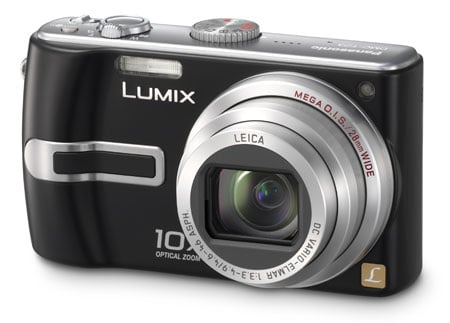
The Panasonic Lumix TZ3 is equipped with a Leica DC Vario-Elmar 10x optical zoom delivering an equivalent range of 28-280mm and a focal ratio of f3.3-4.9; the actual focal length is 4.6-46mm and we counted 36 discrete steps when zooming from wide angle to telephoto. The closest focusing distance is 5cm in Macro mode with the lens zoomed all the way out.


The TZ3 may come almost one year after the TZ1, but it’s still remarkable to find a powerful 10x optical zoom lens squeezed into such a compact body. There are several key differences between the TZ3’s optics and those of its predecessor though.

Most notably the TZ3 has a wider equivalent range of 28-280mm compared to the TZ1’s 35-350mm, and as discussed earlier, the former range is more preferable to most photographers. The TZ3 may not zoom-in quite as far as the TZ1, but 280mm is still very powerful and the wider angle coverage when zoomed-out makes a huge difference in practice.

To illustrate this range we mounted the Lumix TZ3 on a tripod and shot the same scene fully zoomed-out, then fully zoomed-in. We then shot the same scene from exactly the same position moments later using the Fujifilm FinePix F30 which is equipped with a more typical 3x range equivalent to 36-108mm.


Support this site by shopping via these links


Panasonic Lumix TZ3 coverage wide
Fujifilm FinePix F30 coverage wide
4.6-46mm at 4.6mm (28mm equivalent)
 
8-24mm at 8mm (36mm equivalent)

The examples above clearly illustrate while 28 and 36mm sound quite close when written down, they deliver considerably different results in practice. 28mm is much wider and offers far greater flexibility whether you’re photographing broad landscapes, large buildings, cramped interiors or big group shots.

The examples below also illustrate the reach offered by the TZ3 when fully zoomed-in. It may not get quite as close as the TZ1, but an equivalent of 280mm remains seriously powerful for a compact.

Panasonic Lumix TZ3 coverage tele
Fujifilm FinePix F30 coverage tele
4.6-46mm at 46mm (280mm equivalent)
 
8-24mm at 24mm (108mm equivalent)

Interestingly the TZ3’s sensor size also allows the same lens coverage to be enjoyed at any aspect ratio, whether the squarish 4:3 or wide 16:9 – see our third features page for details.

It’s not all progress though. The TZ3’s lens has a slightly slower focal ratio of f3.3-4.9 compared to f2.8-4.2 on the TZ1. More significantly the earlier TZ1 employed an internal prism and folded optics which allowed the lens to zoom horizontally within the camera. Amazingly when fully zoomed-in, the TZ1’s lens barrel extended by a mere 14mm. According to Panasonic, it was the world’s first integration of a retractive lens with folding optics.

With the new TZ3 though, Panasonic’s returned to a more conventional optical system which zooms externally. Consequently when first powered-up, the TZ3’s lens barrel extends by 19mm, then on to 33mm when fully zoomed-in. This extension at power-up means the TZ3 is slightly slower to start than its predecessor, although in its favour the TZ1’s clip-on lens cap has been switched for a much more convenient integrated lens covering, in line with most compacts. Unlike the TZ1 though you can no longer optically zoom while filming video clips.

Panasonic Lumix TZ3 image stabilisation


Like all of Panasonic’s current range, the Lumix TZ3 is equipped with Optical Image Stabilisation (OIS) to counteract camera shake – and while the maximum focal length has reduced slightly from its predecessor, you’ll still welcome its benefits with an equivalent range which extends to a hefty 280mm.

As with other Panasonic models, the TZ3 features three different OIS options, accessed by pressing and holding the button on the top surface with an icon of a shaky hand. Mode 1 applies stabilisation constantly which can greatly aid composition, especially at longer focal lengths. Mode 2 only applies the stabilisation as you take the picture, which has the potential to be more effective since the system always starts from a central position, although you won’t see the effect as you compose the image. Finally, the third option switches the OIS off altogether for use with tripods. Note OIS is also available when recording movies, but only with Mode 1.

Panasonic Lumix DMC-TZ3
Mega OIS off
Panasonic Lumix DMC-TZ3
Mega OIS Mode 1
Panasonic Lumix DMC-TZ3
Mega OIS Mode 2
4.6-46mm at 46mm, 1/200, 100 ISO   4.6-46mm at 46mm, 1/200, 100 ISO   4.6-46mm at 46mm, 1/200, 100 ISO


Above are crops from three examples of a boat taken with OIS disabled, followed by the two OIS modes. The crops are taken directly from the original images and reproduced here at 1:1.

The images taken with OIS clearly show camera shake has been greatly reduced, and interestingly Mode 2 does seem slightly more effective than Mode 1 confirming Panasonic's claims. In use though, Mode 1 is preferred as stabilisation applied during composition certainly helps at longer focal lengths. But if upon playback you're finding camera shake creeping in, it's nice to have the option to reshoot with the slightly more effective Mode 2.


Panasonic Lumix TZ3 features continued...

Lenses and OIS / Screen and menus / Sensor and processing


Support this site by checking prices below or shopping via our affiliate stores


USA readers


UK readers
Jessops discount voucher
All words, images, videos and layout, copyright 2005-2008 Gordon Laing. May not be used without permission.

About Us / How we test / Best Buys / Home