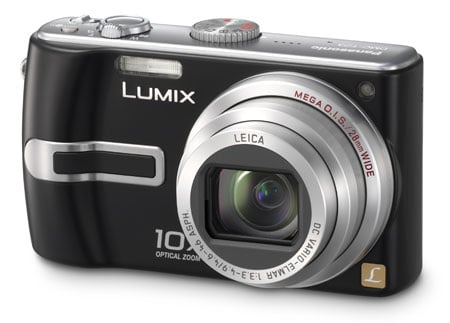
Panasonic Lumix DMC-TZ3
-
-
Written by Gordon Laing
Intro
The Panasonic Lumix DMC-TZ3 is a 7.2 Megapixel compact which houses a huge 10x optical zoom with image stabilisation. Announced in January 2007, the TZ3 is the successor to last year’s 5 Megapixel Lumix TZ1, which also sported a 10x optical zoom.
An extra two Megapixels aside, the biggest difference with the new TZ3 is its equivalent optical range of 28-280mm compared to 35-350mm on the TZ1. What the TZ3 loses out in telephoto though is more than made up for at the other end.
Interestingly while the TZ3 records 7.2 Megapixel images, it’s actually equipped with an 8.5 Megapixel sensor. This larger sensor allows the TZ3 to capture images with the full lens coverage regardless of the aspect ratio. Normally if you’re using a camera with a 4:3 shaped sensor and switch to a wider aspect ratio, the camera would simply crop strips from the top and bottom, thereby both reducing the resolution and the angle of view. Not so with the TZ3 which maintains its 7.2 Megapixel resolution on both the 4:3 and 3:2 aspect images and its angle of view on 4:3, 3:2 and wide 16:9 images. So you’ll still enjoy 28mm wide angle coverage regardless of the aspect ratio and we’ve got examples to illustrate this in our review. Panasonic has also equipped the TZ3 with a generous 3in screen, three new recording modes, and taken the excellent Function control from the higher-end LX and FZ series which overlays a menu providing quick access to many settings.
So with a wider angle lens, higher resolution sensor, bigger screen and easier access to settings, it sounds like one of 2006’s best compacts has just got a whole lot better – in theory anyway. Read on to discover if the Lumix TZ3 genuinely succeeds the excellent TZ1 to become one of the best all-round compacts in practice, and check out our video tour for a demonstration of its headline features. Note: Panasonic launched the Lumix TZ3 alongside the slightly lower-end TZ2 for certain markets. The TZ2 has a smaller 2.5in screen and lower 6 Megapixel resolution, but is otherwise identical to the TZ3, sporting the same 28-280mm stabilised lens range and full coverage across multiple-aspect ratios.
Testing notesThe model tested was a final production unit. Following our convention of using default factory and best quality JPEG settings to test camera bodies unless otherwise stated, the TZ3 was set to 7M Fine JPEG mode with Auto White Balance, Multiple metering and the Standard Colour mode. |