 The ability to continue to use their DX lenses in a cropped-frame 10.5 Megapixel mode until they can afford to replace them only sweetens the deal. As does the opportunity to use older non-AF-S lenses with the ability to autofocus. It all looks like great news for Nikon users. We'll reserve judgement on the EOS 6D until we're able to fully test one, but, for now at least, it looks like Canon has got some catching up to do in order to compete with Nikon in this market. In the meantime the D600 is a class act and a tough one to beat and it will come as no surprise that it gets the Cameralabs' Highly Recommended award.
Nikon D600 review
-
-
Written by Gordon Laing
Intro
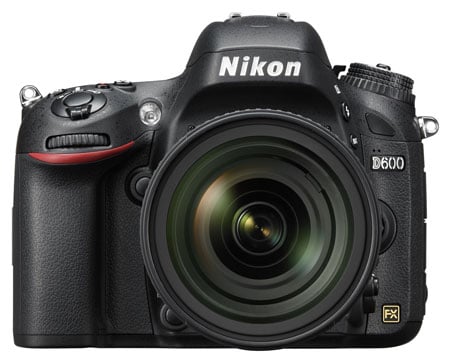
The Nikon D600 is a ‘budget’ full-frame DSLR aimed at enthusiasts upgrading from mid-range models or pros looking for an affordable backup for a higher-end body. Announced in September 2012, it’s positioned roughly between the full-frame D800 and crop-format D7000 and combines many aspects of both models. Along with a new 24 Megapixel full-frame FX-format sensor, you get the 100% viewfinder coverage and 3.2in screen of the D800 in addition to most of its movie features, along with the build and twin SD card slots of the D7000.
The D600 features a new 39-point AF system that’s compatible with lenses down to f8, a built-in AF motor which will drive older non AF-S lenses, 5.5fps continuous shooting, an expanded sensitivity range of 50-25600 ISO, Nikon’s 2016 pixel metering sensor and a built-in flash. The movie mode offers 1080p at 24, 25 and 30p, or 720p at 25, 30, 50 or 60p. Impressively there’s also the mic input, headphone jack, DX-crop mode and uncompressed HDMI output of the D800, albeit not the silent aperture controls. The D600 also works with the WU-1b wireless adapter which allows remote control with compatible Android and iOS devices.
Most important is the price: it’s the joint-cheapest new full-frame DSLR and brings this cropless factor to a wider audience than before. It’s also worth noting that while the D600 is 12 Megapixels shy of the D800, its resolution matches or beats any other full-frame camera around including the Canon EOS 5D Mark III and its ‘budget’ rival, the new EOS 6D. It’s also Nikon’s smallest and lightest full-frame DSLR.
The D600’s specifications make impressive viewing and you have to take your hat off to Nikon not just for its technical prowess, but canny marketing too. Obviously the D600 is going to have massive appeal to anyone currently using an APS-C DSLR who’s previously steered clear of full-frame bodies on the grounds of price. Many of those will be existing Nikon DX body owners and the D600’s similarity to the D7000 combined with its ability to use DX lenses (albeit at a reduced resolution) makes it a very attractive option to upgraders. Its price and the fact that it retains so many features of the higher end D800 also makes it a logical choice for owners of that model looking for a second ‘back up’ body. That’s why in this review we’ve decided to compare it to both lower and higher-end models, along with, of course, Canon’s ‘budget’ full-framer, the EOS 6D. We’ll also update the review with EOS 6D quality comparisons once that model is available.
 |
Nikon D600 design and controls
The D600 looks and feels like a solid semi-pro DSLR. It’s a little smaller than the D800 and also a little bit lighter, enough of a difference to make you feel better about carrying it around all day, but not to raise doubts about the quality of construction. Let’s take a look at the dimensions and how they compare with other models. The D600 measures 141 x 113 x 82mm and weighs 850g with the battery and cards fitted. The D800 is 146 x 123 x 81.5 and weighs a Kilo – just over two pounds. So the heavier camera is a centimetre taller and a little wider, but side-by-side the difference isn’t striking.
Compared with the D7000 which measures 132 x 105 x 77 and weighs 780g including cards and battery the D600 is a little larger and heavier. Don’t forget we’re comparing the full-frame D600 to a mid-range DX body here, the D7000 features the equivalent Magnesium alloy top and rear covers and weather sealing so the build quality is similar.
 |
For the record, the Canon EOS 5D Mark III is 152 x 116 x 76.4 and weighs 950g, a little broader and, like the D800, a little tougher and heavier than the D600. Meanwhile the Canon EOS 6D (the biggest rival for the D600) measures 145 x 111 x 71mm and weighs 755g, so comes in a little smaller and noticeably lighter.
Of course a lot of the size weight and feel of these bodies is largely dependant on the lens that’s attached. The D600 is available as a body only or with the AF-S Nikkor 24-85mm f3.5-4.5G ED VR as a kit. I’l talk about this lens a little more later the review or you can read our in-depth Nikon 24-85mm review. For now I’ll confine my comments to saying that with the 24-85mm kit lens attached the D600 feels nicely balanced and a very comfortable fit, though that’s a subjective judgement, if you like Nikon bodies there’s nothing about the D600 that will upset you.
The D600 has a slightly smaller grip than the D800, but retains the slight indentation on the inside that makes for a very secure hold. With my thumb on the back thumb rest and index finger on the shutter release, the remaining three fingers of my right hand fit comfortably around the grip with room to spare at the bottom. At the top of the grip is one of two command dials; like the main command dial on the rear panel, the sub-command dial can be customised, but its main function is aperture control.
Just inside the grip, neatly positioned for the second finger of your right hand is the depth of field preview button and above that, near the top plate the large LED AF-assist illuminator. At the bottom of the front panel on the grip side and reachable with the third finger of your right hand is the first of the programmable function buttons.
Moving round to the other side of the lens, at the bottom is the AF mode button and focus mode selector. Moving up beyond the lens release are buttons for auto bracketing and popping up the flash. So far, so very D7000, and the similarities don’t end there. On the left side of the top panel is the mode dial with the same array of exposure modes as the D7000 – including the two user modes. The new lock release button at the centre of the mode dial is a welcome addition; in order to change the exposure mode you must first depress the centre button, so there’s absolutely no chance of accidental mode switching. The release mode dial, located below the mode dial, is also locked, pressing a small button on the left rear edge of the body releases it allowing you to change the drive mode.
 |
Moving over the pentaprism hump atop which sits the built-in flash and standard hotshoe, the right side of the top panel is occupied by the LCD control panel. At the front of the grip extension the shutter is surrounded by the on/off collar which has a third position to illuminate the control panel. Behind that are the direct movie record button and buttons for exposure compensation and metering mode. Again, this will be very familiar territory to D7000 owners, but D800 owners will have some adjustments to make to accommodate the differing methods of mode selection; on the D800 the Mode button occupies the position of the D600’s metering mode button.
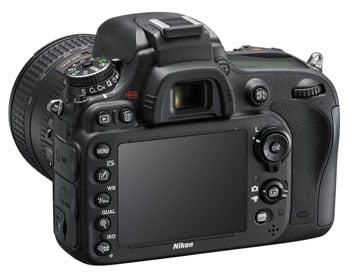
The rear panel control layout is something of a hybrid, combining elements from both the D7000 and D800 so, depending on how you look at it, it will be both familiar to owners of either model, but at the same time require some adjustments to the way you normally do things. The D600’s 3.2 inch LCD screen is the same as the D800’s, I’ll go into more detail about it later in the review. To the left of it is a vertical 5-button array headed by the menu button and followed by four additional buttons that have a dual function depending on whether you’re in a shooting or playback mode.
The first of these is the menu button, the second is a new button that provides direct access to Picture control settings or retouching in playback mode. The remaining three are the white balance/help/protect, quality/zoom in and ISO/zoom out buttons familiar from the D7000. Except they’re not that familiar as Nikon has swapped the position of the zoom in and zoom out buttons. I think the new zoom button layout makes more sense and in any case follows the D800 layout, so it looks like this is the way it will remain in future.
On the top right are the playback and delete buttons now standard on Nikon Pro DSLRs. The D600’s delete and metering mode button can be used in combination to format cards as on the D800 and D4, though on those models it’s the similarly positioned mode button that fulfils this function.
On the other side of the viewfinder is the AE/AF lock button, the D600 lacks the D800’s AF-On button (though it can easily be programmed – see handling section below) but the control layout on the right side of the screen mimics the D800’s in every other respect. First, there’s the four-way controller or multi-selector as Nikon calls it, surrounded by the focus selector lock. Below that is the new dual position Live view switch first seen on the D800 with separate positions for movie and still Live View. I’ll talk in more detail about this and the other controls in the handling section at the end of my review. At the bottom of the right rear panel is the info button which toggles the display and information readouts on the rear LCD display.
The only other rear control I haven’t yet mentioned is the main command dial, which is located at the top right of the rear panel just above the contoured thumb rest. Like the sub-command dial, it’s programmable, but in the default configuration it’s used mainly to control shutter speed.
Like the D800, the D600 features USB, HDMI and two 3.5mm audio jacks, one for external microphones and the other for headphones, the latter a nice update for videographers which the EOS 6D lacks. Unlike the USB port on the D800 which supports the fastest USB 3 standard though, the D600’s is plain old USB 2, just like the EOS 6D. Arguably the faster transfer speed of USB 3 is less of benefit on the D600 with its smaller file sizes. And in a move which will make Canon videographers jealous, the D600’s HDMI port, like the D800’s, will also output a clean uncompressed signal (8 bit, 4:2:2), allowing you to connect a larger and more detailed monitor, or capture the feed with a higher quality external recorder. Interestingly at the time of writing, Canon announced a firmware update for the EOS 5D Mark III which would also equip it with uncompressed HDMI output, but not until April 2013; there was no mention of upgrading the EOS 6D with the same functionality though.
The D600 uses a Nikon EN-EL15 7 volt 1900MAh Lithium Ion battery which supplies sufficient power for 900 shots under CIPA standard conditions. Not surprisingly, that’s the same as for the D800 and in fact the battery and charger are common to all three models, so upgraders can re-use spares and D800 owners thinking of using a D600 as a back-up body can tick another box.
Those who want longer battery life can fit the optional MB-D14 battery grip which also offers portrait controls. The grip works with the standard EN-EL15, but with an adapter can accommodate a set of AA batteries. Remaining battery life is displayed on the control panel or monitor using a five-segment icon or you can get more detailed battery life information from the setup menu.
The D600 includes a built-in pop-up flash as well as a standard hotshoe. While not everyone is a fan of pop-up flashes on DSLR’s the fact remains that they can be very useful for fill-ins and the D600’s built-in flash can also be used for wireless control of external units. Depending on how you look at it, the inclusion of a flash is one of the advantages that Nikon full-frame DSLR bodies enjoy over Canon full-frame EOS models. Every Nikon body with the exception of the D4 has a built-in flash whereas none of the full-frame Canon EOS models do. The D600’s flash has a guide number of 12 metres (39 feet) at 100 ISO and is the same unit that’s fitted to the D800. With the 24 -85mm f3.5 – 4.5 kit lens, that gives it a reach of around three and a half metres or 11 feet.
The flash supports all the modes you’d expect including red-eye reduction, slow sync, rear-curtain sync and it also supports Nikon’s FP high speed sync which pulse fires the flash enabling you to use it for fill-in at faster shutter speeds than the 1/200th slowest flash sync speed. Note that this is slightly slower then the 1/250 sync speed for the D800 and the D600 also lacks the more expensive model’s PC sync socket.
Wifi and GPS capabilities are available for the D600, but only with optional accessories, using the WU-1b and GP-1 respectively. This is the big difference with the Canon EOS 6D which comes with Wifi and GPS built-in as standard.
Nikon D600 Viewfinder and Screen
The D600’s viewfinder combines 100 percent coverage with a magnification of 0.7x. It’s a big, bright viewfinder comparable with that on the D800 and will be a big step up for those upgrading from a crop frame DSLR. An LCD overlay also provides graphics on demand; when the camera is switched off, only the etched AF region in the centre of the frame is visible.
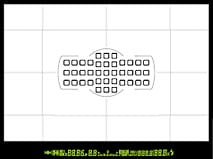 |
Switch the camera on and nothing changes, but a half press on the shutter release brings to life the active AF points. The viewfinder flashes red while focus is acquired and, once locked, it all goes away again. It’s a well-balanced system that provides the information you need only when you need it.
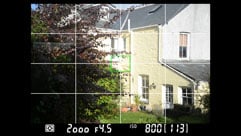
A square alignment grid can be overlayed in the viewfinder and a single-axis level can be assigned to the Fn button. This appears in the information area at the bottom of the viewfinder and looks a little like an exposure compensation scale with short vertical tick marks appearing either side of a central bar if the camera is rotated. It isn’t as visible or sophisticated as the two-axis level on the D800 but, as compromises go, it’s a small one, particularly as there’s a much better 2-axis virtual level in Live view should you need it.
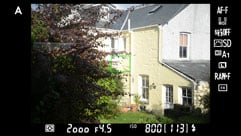
Other information displayed along the bottom of the viewfinder includes metering mode, exposure information and card and buffer capacity. But there’s a wealth of other information that can be displayed here depending on the shooting mode and current operation including AF Area mode, Exposure/Flash compensation, Active D-lighting amount, bracketing indicators and so on. Another minor difference with the D800 is that there’s no built in blind to prevent stray light entering the viewfinder and producing false exposure meter readings, instead a clip-on cap is provided.
The D600 has the same 3.2 inch 921k LCD screen as the D800 and D4. This is a VGA screen with 4:3 proportions and the 3:2 image area sits at the top with a black information strip below. This is the same setup as on the D800 and it means there’s a slightly smaller image area than the 3:2 shaped 3.2in screens on the EOS 5D Mark III and EOS 6D
To enter Live View on the D600 you turn the switch on the rear panel to the camera icon then press the LV button in the middle. Four display overlays are available and pressing the info button cycles through them. The first is a new dual axis levelling gauge which the pilots among you will recognise as looking very similar to an aircraft attitude indicator showing pitch and roll. The next option displays additional shooting information, followed by a clean screen and finally a grid overlay, but, alas, no live histogram.
Like the viewfinder, the screen provides 100 percent coverage in live view and its 170 degree viewing angle means you get a good view even when not looking directly at it. The screen brightness adjusts automatically to the ambient conditions using a small sensor just to the right of it. If you’re worried about scratching and smearing the screen surface, the D600 is supplied with a snap-on clear plastic cover which I kept fitted the whole time. It does little for the screen visibility in bright sunlight however, when you’re better off removing it.
Nikon D600 lens and stabilisation
The D600 is available body only or as a kit with the AF-S 24-85mm f3.5-4.5G ED VR zoom lens. This is an affordable general purpose zoom lens for those starting out with their first full frame body, covering the range from wide angle to short telephoto. The D600 is also compatible with DX lenses, so upgraders won’t have to replace all their lenses, not immediately anyway. Because the DX lenses have a smaller imaging circle than the size of the FX sensor, only the central portion of the sensor is used when a DX lens is fitted and the resolution drops accordingly, in the D600’s case to 10.5 Megapixels. (See the sensor section at the end of my review for more about how this works.)
That’s not a bad compromise though for the ability to continue to use your DX lenses on the D600 until you can afford to replace them. Canon upgraders aren’t similarly blessed, Canon’s EF-S mount isn’t compatible with with EOS full frame bodies so those moving from any APS-C Canon Consumer DSLR to the 6D will be starting again, at least if they’ve invested solely in EF-S lenses. A more likely scenario is that users will have a mixed bag of lenses designed for both full-frame and cropped frame bodies, a scenario in which Nikon upgraders still win out.
Nikon D600 with AF-S Nikkor 24-85mm f3.5-4.5G ED VR at 24mm |
Nikon D600 with AF-S Nikkor 24-85mm f3.5-4.5G ED VR at 85mm | |
 |  | |
| 24-85mm at 24mm | 24-85mm at 85mm |
The AF-S Nikkor 24-85mm brings the overall weight of the 600D to just over 1.3kg or just under 3 pounds. If you’re used to carrying around a DX body with its kit lens you’ll notice the difference, but the combination is nicely balanced and feels comfortable. The lens has two switches on the left side, one to select manual or manually assisted autofocus (you can adjust the focus using the focus ring after the AF has done its job) and another to activate the Vibration Reduction optical stabilisation system.
Nikon claims the VR on the 24-85mm f3.5-4.5 has four stops of stabilisation.To test this claim I zoomed the lens to its maximum 85mm telephoto focal length and took a series of shots in shutter priority mode at progressively slower speeds. As you can see from the 100 percent crops below I managed to get sharp shots with the D600 and 24-85mm lens at speeds as slow as 1/5 – an impressive result that confirms Nikon’s claim.
Nikon D600 with AF-S Nikkor 24-85mm f3.5-4.5G ED VR Vibration Reduction off/on | ||||
 |  | |||
100% crop, 24-85mm 400 ISO 1/5th VR off. | 100% crop, 24-85mm 400 ISO 1/5th VR on. | |||
Nikon D600 shooting modes
The D600 has a new metering system which uses a 2016 pixel sensor and scene recognition to help determine the correct exposure. Scene recognition isn’t used in the same way as on compacts – to set an appropriate scene mode, but merely to help determine the optimal exposure, AF and white balance settings. In practice it works very well, everything I shot with the D600 over the course of a week was, almost without exception, well exposed. The new system also seems to have cured the long standing issue that both myself and Gordon Laing have experienced with Nikon DSLRs whereby bright scenes are over-exposed by about a stop.
The shutter speed range runs between 1/4000 and 30 seconds, the same as the EOS 6D, but both are lacking the 1/8000 shutter speed of the top models. The 1/4000 fastest shutter and 1/200 fastest flash sync may not affect many shooters, but those involved with daylight portraits or professional lighting will find them less flexible than the pricier models.
Like the D800, the D600 includes a dedicated bracketing button on the upper left side of the body which controls exposure, flash, Active D-lighting or white balance bracketing depending on the custom menu setup. The D600 offers 3-frame exposure bracketing in increments from 0.3 to 3 EV. You can also choose a 2-frame option that shoots just the ‘normal’ exposure plus either the over or under-exposed frame. It’s not nearly so versatile as the 2-9 frame bracketing available on the D800, and HDR fans will particularly lament the absence of a 5-frame option. The decision to limit the D600’s bracketing might have been taken to provide another point of differentiation between it and the D800, but Nikon has in this instance also put itself behind its main rival from Canon, the EOS 6D, which sports 2, 3, 5 or 7 shot bracketing options up to 3EV apart at 1/3EV intervals.
There’s also a new Quiet shooting mode and an HDR option lifted from the consumer line where two exposures up to 3EV apart are combined into a single image in an attempt to boost dynamic range. The equivalent HDR Backlight Control feature on the 6D goes one step further by combining three frames, but anyone with more than a passing interest in HDR will do it manually using its excellent bracketing facilities. The D600 has a multiple exposure feature, but like bracketing, it’s a limited version of the same feature on the D800 with a maximum of only 3, rather than 10 composited shots. Like HDR though, anyone serious about producing composite images isn’t likely to do it in camera.
Where the D800 really scores over the 6D in this category though are with its built-in time-lapse and interval timer facilities. The Interval Timer does the job of a separate intervalometer and triggers the camera at pre-set intervals. You can choose the number of shots, the interval between them, and also delay the starting time if desired. I wish all cameras had this built-in. Sure the Canon DSLRs come with the free EOS utility which can do the same job but you’ll need a Windows or MacOS computer to run it which is another thing to carry around and another battery to drain on an overnight shoot.
Meanwhile the Time-lapse photography option also takes photos at pre-set intervals, but then automatically assembles them into a silent video using the currently selected movie settings. Happily, for this feature, the D600 shares the exact same options as the D800 with a maximum shooting time of 7 hours and 59 minutes and intervals from 1 second to 10 minutes. Time-lapse fanatics will ultimately prefer to use Interval Timer shooting and create their video clips using, say, Photoshop, but being able to create in-camera Time-lapse movies remains a fun and useful option, and again takes the D600 beyond what’s possible with the 6D out of the box. And, in recognition of its consumer categorization, Nikon has endowed the D600 both with a Program auto position on the mode dial as well as a full range of scene modes familiar to those who own Nikon consumer DSLRs and compacts.
Nikon D600 movie modes
When Gordon Laing reviewed the Nikon D800 he applauded the fact that it offered the exact same movie options as the D4 flagship pro model at half the price. You’d then be forgiven for expecting Nikon to limit the video modes in its entry level full-frame model, but you’d be wrong. The D600 can film 1080p at 24, 25 or 30fps, 720p at 25, 30, or 50fps, offers full manual control over the exposure, sports an external microphone jack and headphone socket for monitoring and features uncompressed HDMI output (8 bit, 4:2:2), allowing you to connect a larger and more detailed monitor, or capture the feed with a higher quality external recorder. The screen on the rear also remains active when driving an HDMI accessory. The D800 also supports movies with the DX crop, effectively reducing the field of view by 1.5x without any loss of resolution, providing a handy boost in magnification.
This doesn’t of course mean the D600’s movie quality will exactly match that of the D800, but once the video stream is donwnsampled there’s unlikely to be a great deal of difference. The only D800 movie feature the D600 lacks is the ability to control the aperture using buttons on the side of the lens, but since these can only be used with an external recorder, arguably, it’s a minor compromise. Probably more of an issue for most people will be that you can’t alter exposure settings during recording. You can use the PASM modes for movie shooting, but the settings are fixed when you enter movie Live view and the ISO sensitivity is set automatically for all modes other than manual.
The D600 will let you record for a second short of 30 minutes. Files are encoded with the H.264 codec at one of two quality settings, the higher of which encodes at an average bit rate of 24Mbps for the 1080p and higher frame rate 720p modes.
It’s interesting to note that the D600 provides more or less the exact same movie modes as the Canon EOS 6D which also offers 24, 25 and 30 fps recording at 1080p resolutions with 720p at 50 and 60 fps, all encoded using H.264, although the 6D also offers the choice of inter or intra-frame compression. The 6D has an socket for an external microphone, but no headphone socket. On balance I think that with its DX crop mode, uncompressed HDMI output and headphone socket, the D600 is a more capable movie camera then the 6D. At this level at least, Nikon has reversed Canon’s long held dominance in this area.
| |
|---|---|
|
This and all of the video samples here were shot using the D600’s 1080p30 mode. The movie quality was set to High and the autofocus was in AF-S mode. The quality is excellent and the D600 has done a good job with the exposure in demanding conditions. This clip does highlight one problem though and that’s the impossibility of getting a smooth result with a manually operated zoom on a DSLR. When I’m not zooming, though, the Vibration Reduction does a good job of ironing out the wobbles.
| |
|---|---|
|
For this tripod mounted panning shot the stabilisation was disabled. The D600’s CMOS sensor copes well with the bright highlights and again, does a great job handling the exposure. There’s a bit of flare at the beginning of the pan, which is my fault for not fitting the suplied lens hood. It’s easier to zoom with the camera mounted on a tripod, but still not ideal.
| |
|---|---|
|
Once again, the quality on this low-light interior panning shot is very pleasing with little evidence of noise. The white balance is good, but something strange happens with the exposure mid-pan. You’d expect the D600 to stop down passing the windows, but it does the opposite and the image gets slightly brighter. This clip and all the previous ones were shot with the autofocus in single-servo AF mode, next we’ll see how the D600 copes with Full-time servo AF
| |
|---|---|
|
Here’s an example of the D600’s continuous AF, which Nikon calls Full-time servo AF in action. Historically, DSLR’s don’t excel at this, so I had low expectations, but the the D600 actually doesn’t do too badly. It hunts back and forth a little, but eventually finds its target. While it’s not a patch on a mirroless compact system camera, the focus hunting isn’t actually the D600’s biggest problem in AF-F mode. You can’t hear the AF motor for most of this clip because of the noisy coffee machine, but you catch a little of its distracting buzz at the end. For a better idea of just how noisy it is see the next clip.
| |
|---|---|
|
This final clip is a repeat of the tripod pan, this time with Full-time servo AF (AF-F) activated instead of Single-servo AF. It renders the audio virtually unusable. Of course with the D600 you have the option of fitting an external microphone which would overcome this problem.
Nikon D600
handling
I’ve already talked about the size and weight of the D600, for anyone moving up from a cropped frame DSLR this is an important thing to be aware of, conversely, pro users looking for a D4 or D800 backup will be pleasantly surprised at it’s comparatively lightweight, yet robust construction. I’ve also mentioned how the D600’s controls are a kind of D800/D7000 hybrid. The downside of this is that owners of either of those models are going to have to adapt a little, but I think that’s a small price to pay for something that really does combine the best of both worlds.
The Release (drive) mode and mode dials with their respective lock buttons provide just the right balance between security and accessibility, though the former can require a good deal of manual dexterity to operate quickly with one hand. Likewise the combined focus mode selector and AF mode button, sensibly placed Fn button and bracketing button all provide quick access to functions that, on a DSLR you find yourself using very frequently. Opportunities for customisation are there in abundance and should mean that despite physical and handling differences, the D600 can be adapted to work more seamlessly in a two-camera setup with another model. For example, although it lacks the D800’s AF-On button, on the D600 the same function can be assigned to the Fn, Preview, or AE-L/AF-L button. As you’d expect these three buttons are fully programmable and can be assigned separate functions for stills and movie shooting.
Like the D7000, the D600 has U1 and U2 positions on the mode dial providing access to two custom user settings. Among other things you can save exposure mode, metering, AF mode, bracketing and anything on the Shooting settings and Custom settings menus. Two things you can’t store, though are the drive mode and image area, so if you’re a sports photographer and want a custom setup for capturing an action sequence, in addition to turning the mode dial to the U1 or U2 position you’ll still need to turn the release mode dial to the CH position for high speed continuous shooting. Aside from those fairly minor shortcomings, the User settings provide a useful way to quickly access a complete setup from exposure mode to custom buttons.
 |
 |
 |
 |
 |
 |
 |
 |
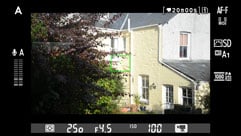 |
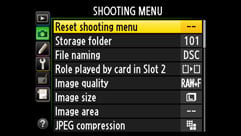
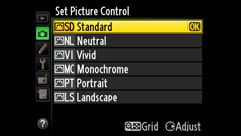
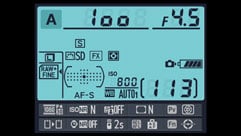
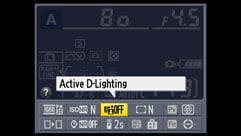
The D600 Menu system will look familiar to anyone upgrading from a D7000, it’s divided over six tabs and pressing the White balance /? button displays a short description of the currently selected menu item. The menus are sensibly organised but, like Sony, Nikon likes to pack as many items onto a single tab as it can resulting in a situation where you have to scroll to look for items that don’t fit on the 3.2 inch screen.
Canon’s menu system adopts a more navigable approach of not fitting more on the screen than you can see without scrolling which makes it much easier to find something if you’re not sure where to look. One way around that problem on the D600 is to use the sixth tab. Labelled ‘My menu’ you can add anything from the other five tabs to this custom menu, making it a simple job to find the things you know you’re going to need.
Nikon D600 Autofocus
The D600 has a 39-point AF system with 9 cross type points, compared to 51 points with 15 cross type points on the D800, or the comparatively paltry 11-point / single cross-type AF system of the EOS 6D. It is however important to point out that the EOS 6D’s AF system can operate under dimmer conditions down to -3EV compared to -1EV on the D600.
The focus point layout is similar to that on the D7000, but the 39 squares are arranged more tightly in the middle third of the frame. The reason for this is so that all the AF points remain in the image area even when the camera is operating in the DX crop mode. It means you have the same AF performance in both modes, but with the disadvantage, in my view a small one, that the FX image area lacks AF points anywhere outside the central portion of the frame. Like the D800, it can autofocus down to f8 using a reduced number of AF points. On the D600 33 points are available slower than f5.6 and faster than f8, while the centre 7 focus points are available at f8.
Like other recent Nikon DSLRs, there’s four AF Area modes to choose from: Single Point, Dynamic Area, Auto Area, and 3D Tracking. In Single and Dynamic Area, you can manually adjust the focusing point using the rocker control, with Dynamic Area also considering 9, 21 or 39 surrounding focus points if the subject moves (you can choose how many it should consider). In Auto Area, the D800 chooses the focus point automatically.
With 3D Tracking, you manually select a focusing point and place it over the desired subject. With the shutter-release half-pressed, the D600 will then attempt to keep this subject in focus even if you recompose the shot. 3D Tracking also exploits colour information to help track a subject, although obviously if it’s the same colour as the background, the system will become confused. Nikon recommends 3D Tracking for quickly composing shots where subjects are moving erratically, such as tennis players. Meanwhile 9-point Dynamic is best for predictable motion, like runners or race cars, 21-point Dynamic is more suited to unpredictable motion like football players, while the 39-point Dynamic option is best for subjects which are moving quickly and can’t easily be framed, like birds in flight.
As with all cameras which offer a variety of AF options, it’s a case of experimenting to see which works best for your particular application. It also pays to be flexible in your choice as the one Nikon thinks is best for a certain activity might not quite fit the one you’re trying to shoot. In use I found the 9-area Dynamic mode was great for tracking steadily approaching action, like jet boats and bikes. Meanwhile the 3D mode did a good job when there was sufficient contrast between the subject and background, like a brightly coloured skier or snowboarder against a white backdrop.
Owners of older lenses will be delighted to discover the D600 includes an integral AF motor that means non-AF-S lenses can be used with autofocus. The D600 can also recognise up to 9 non-cpu manual focus lenses.
Nikon D600 Continuous shooting
The Nikon D600 can shoot at 5.5fps in its full-frame FX mode, or 5fps in the DX mode; significantly faster than the D800 at 4fps due to its lower resolution sensor and also a little faster than the Canon EOS 6D at 4.5fps. The buffer has sufficient capacity for 16 lossless compressed 14 bit RAW files or 100 fine quality JPEGs.
To test the D600’s continuous shooting, I fitted it with a freshly formatted 8GB Sandisk Extreme Pro UHS-1 card in slot 1 and set it to a shutter speed of 1/800, at 400 ISO. I turned off all image enhancements including D-lighting and noise reduction and for the first test set the image quality to 14-bit lossless compressed RAW. The D600 fired a burst of 16 images in 2.8 seconds, slightly bettering the quoted speed with a frame rate of 5.7fps. After the sixteenth frame it didn’t stop, but continued to shoot at a slightly erratic 2fps or so. If I stopped after the sixteenth frame it took ten and a half seconds for the buffer to clear.
Switching to Fine JPEG mode with the default Size priority compression, the D600 fired a burst of exactly 100 images in 20 seconds – exactly 5fps. However, I noticed that after the 80th frame the shooting speed seemed to slow ever so slightly so I timed the first 70 frames in the burst and the result was a more encouraging 5.4fps.
I then switched the D600 to DX image size which produces 10.5 megapixel images using the central portion of the sensor with a crop factor of 1.5x. I used the same RAW settings as for the FX mode test and this time was able to shoot 35 RAW images at just under 5.5fps before the frame rate stuttered and slowed. In Fine JPEG mode at the DX size the limit was still 100 shots and the frame rate remained 5.4fps. So there’s no continuous shooting speed advantage to be gained from shooting in the DX crop mode, however the image buffer does clear a little more quickly – 7 seconds compared with ten and a half in FX mode for RAW files. Switching to a Sandisk Extreme Speed class 10 card made no difference to the continuous shooting speeds, but the buffer write times lengthened, taking 14.5 seconds to clear.
Nikon D600 Sensor
The D600 features a full-frame FX-format sensor with 24 Megapixels which produces images with a maximum size of 6016 x 4016 pixels. Like previous Nikon FX bodies, the D600 also offers a DX-format crop mode which effectively reduces the field of view by 1.5 times. On the higher resolution sensor of the D800, this still leaves enough pixels to generate 15.4 Megapixel images, but on the D600 the DX area images measure 10.5 Megapixels. This may be lower than most modern DX bodies, but if you’re trading up from an older consumer body like the D90 or D5000, you’re only losing out marginally on resolution for the ability to continue using your DX lenses.
DX-format lenses may be officially corrected for a DX imaging circle, but many actually deliver decent performance a few mm beyond. Fit them to an FX body and you’ll enjoy the coverage beyond the DX frame and while none will be sharp to the corners of an FX frame, they could come close. While the D600 lacks the additional 1.2 and 5:4 crop modes of the D800, there’s nothing to stop you shooting with DX lenses in FX area mode and manually cropping yourself, thereby unlocking the potential from many above average DX lenses – another great reason for DX body owners to upgrade.
The D600’s sensitivity runs between 100 and 6400 ISO, expandable to 50 and 25600 ISO, matching the extended option on the D800, but falling short of the EOS 6D’s 102,400 ISO expanded upper limit. The shutter speed range is from 30 seconds to 1/4000, lacking the D800’s fastest 1/8000, but exactly matching the range on the EOS 6D.
To see how the quality of the Nikon D600 measures-up in practice, take a look at my Nikon D600 quality and Nikon D600 noise results pages, browse my Nikon D600 sample images, or skip to the chase and head straight for my verdict.