Support Cameralabs by shopping at our partner stores or donating via Paypal
 

Follow me!
Camera Labs RSS Feed
Gordon Laing and Cameralabs on Google+
Camera Labs on Facebook
Camera Labs on Twitter

 
  Latest camera reviews

Olympus E-PM1
Nikon V1
Sony NEX-5N
Canon 100HS / 115HS
Canon 300HS / 220HS
Canon S100
GoPro HD Hero 2
Canon 510HS / 1100HS
Canon 310HS / 230HS
Canon SX150 IS
Olympus E-PL3
Canon SX40 HS
Sony NEX-C3
Panasonic GF3
Fujifilm HS20 EXR
Panasonic FZ150
Olympus E-P3
Panasonic FZ47 / FZ48
Nikon COOLPIX S9100
Sony Cyber-shot HX100V
Sony Cyber-shot HX9V
Panasonic FX77 / FX78
Canon SX230 HS
Canon EOS T3 / 1100D
Panasonic Lumix G3
Sony Cyber-shot TX10
Canon 500HS / 310HS
Nikon D5100
Sony Cyber-shot W510
Nikon COOLPIX L24
Canon PowerShot A1200
Panasonic FS18 / FH5
Canon PowerShot A800
Panasonic TZ18 / ZS8
Canon PowerShot A3300IS
Canon EOS 600D / T3i
Panasonic TZ20 / ZS10
Canon IXUS 1000/SD4500
Sony Alpha SLT-A33
Panasonic Lumix GH2
Nikon D7000
Canon PowerShot G12
Canon PowerShot S95
Panasonic Lumix LX5
Nikon D3100
Canon EOS 60D
Canon EOS 550D / T2i
Canon EOS 7D
Nikon D300s
Canon EOS 5D Mark II
Nikon D90

All reviews ....


  Best Buys: our top models
   
  Best Canon lens
Best Nikkor lens
Best Sony lens
Best budget DSLR
Best mid-range DSLR
Best semi-pro DSLR
Best point and shoot
Best superzoom
Best camera accessories


Camera Labs Forum

Any questions, comments or a great tip to share? Join our Forum and let everyone know.
   
 
  DSLR Tips


Nikon D300 Gordon Laing, December 2007

Nikon D300 features : Lenses and viewfinder / Screen and menus / Sensor and processing / Anti dust

Nikon D300 lenses, focusing and viewfinder

The Nikon D300 features an F-mount which can accommodate most Nikkor lenses, with the DX-format sensor resulting in their field of view being reduced by 1.5 times. As with all Nikon DSLRs, you’ll need recent lenses to support the full focusing and metering modes. There’s a compatibility chart in the D300 manual or specification sheets, but just briefly you’ll need a Type G or D AF (including AF-S and AF-I) Nikkor to support all functions including the most sophisticated 3D Colour Matrix Metering II system.

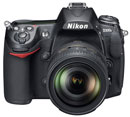
Nikon D300 - body only


The less sophisticated (but still capable) Colour Matrix Metering system is supported on non-CPU lenses if you enter their focal length and maximum aperture into the D300; there’s room to store details of nine different non-CPU lenses with focal lengths from 6 to 4000mm and apertures from f1.2 to f22.

Nikon D300 - Non-CPU data

The D300 is available body alone, or in different lens bundles depending on your region. Two of the more common bundles are with the Nikkor DX 18-135mm or DX 18-200mm VR; we’ve compared both lenses, along with the DX 18-55mm and DX 18-70mm in our Nikkor Kit Lens Group test.


Support this site by shopping below

Nikkor 18-200mm lens
Sigma 18-200mm OS for Nikon

Nikon D300 focusing

The Nikon D300 features a brand new Multi-CAM 3500DX auto-focusing system with not nine or 11, but a whopping 51 focus points, of which 15 are cross-type sensors. A three-way switch on the back of the camera allows you to select between Single Point AF (where you choose the focus point manually using the rocker), Dynamic Area AF (which can track a moving subject) and Auto-area AF (which detects subjects like people against backgrounds, albeit not using face detection). Another switch by the lens mount lets you choose between Manual, Single or Continuous auto focus.

Nikon D300 - custom AF options


The thought of 51 focus points packed into the viewfinder sounds like potential clutter, but like other Nikon DSLRs, each point is indicated by an LCD rectangle which completely disappears from view when not active. So the reality of the system is that only a handful of active focus points are seen, which thankfully makes for a cleaner viewfinder experience. All 51 dots are also shown on the upper LCD info screen, although perhaps sensibly this can’t be used to manually select a focus point – you’ll need to do that through the viewfinder.

Nikon D300 - dynamic AF


To further cement how seriously Nikon is taking AF with the D300, there’s no fewer than ten custom functions devoted to it. One allows you to set the Dynamic AF area so that it uses nine, 21, or all 51 focus points, the latter with a 3D tracking option. You’d think you’d go for the full 51-point system for all moving subjects, but there are benefits to the others.

The nine-point system reacts quickly to predictably-moving subjects which tend to stay in the middle of the frame, such as runners or cars. The 21-point system considers a slightly larger area, allowing you to better track unpredictable motion like football players. If the subject is moving very quickly and can’t be easily framed in the centre, like a bird in flight, then go for the full 51-points. And finally, the 51-point 3D-tracking option remembers the colours of the area in the initially selected focus point and tracks the subject based on them – ideal for erratic motion like a tennis player.

In practice it all comes together very well. With the D300 set to Continuous shooting and the nine-point dynamic area, it effectively tracked and photographed vehicles approaching face-on at 40kph, over a 100m stretch with 100% accuracy, using the DX 17-55mm f2.8 zoomed-into 55mm. Set to 51-point 3D-tracking, it coped with tennis players quickly moving around the frame, with the focus point visibly following them through the viewfinder with pretty decent accuracy. As always you’ll need a quick lens for the best success, but with the D300, Nikon’s really got fast-action covered.

In Live View mode, the D300 can use either the traditional 51-point phase-change AF system, or a compact-style contrast-based AF system – we’ll fully describe both on the next Features page.


Support this site by shopping at Amazon


Nikon D300 viewfinder

Nikon’s viewfinders have always been very good, but there’s no sign of complacency here. The D300 may have the same 0.94x magnification as its predecessor but Nikon’s upgraded the coverage from 95% to a full 100%. It’s a joy to frame your shot knowing what you see is exactly what you’re going to get, and it’s a feature normally reserved for top-of-the-range pro models. It’s also a nice step-up from the 95% coverage of the Canon EOS 40D and Sony Alpha A700.

 
Nikon D300 - viewfinder


In terms of the apparent size of the viewfinder, the D300 appears slightly bigger than the Sony A700, but still not up to the size of the full-frame Canon EOS 5D. But again remember the D300 has the advantage of 100% coverage over both these models.

In terms of information in the viewfinder, the D300 offers the usual shutter, aperture, shots remaining, exposure compensation scale and icons for various modes, along with the ISO sensitivity shown at all times. Like its predecessor (and all but the cheapest Nikon DSLRs), there’s an LCD grid which can be switched on and off in a menu, making the interchangeable focusing screens of Canon’s DSLRs look prehistoric. There’s also a small square for each of the 51 focus points, although as LCD markings, they’re invisible through the viewfinder unless indicating an active focus point – so they don’t get in the way.


Nikon D300 features continued...

Lenses and viewfinder / Screen and menus / Sensor and processing / Anti dust

All words, images, videos and layout, copyright 2005-2012 Gordon Laing. May not be used without permission.

/ How we test / Best Cameras / Advertising / Camera reviews / Supporting Camera Labs