Nikon D300
-
-
Written by Gordon Laing
Intro
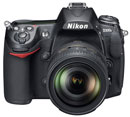
The D300 is Nikon’s latest semi-professional DSLR. Announced in August 2007, the new D300 comes less than two years after its predecessor, the popular D200. This is in some contrast to the three and a half year wait between the D100 and D200, and proves Nikon now truly understands what needs to be done to compete aggressively in the current market.
The time-frame between models may have halved, but Nikon’s certainly not skimped on the D300’s capabilities. It features a new 12.3 Megapixel CMOS sensor, 6fps continuous shooting, a new 51 point AF system, 3in screen with VGA resolution, 100% viewfinder coverage, Live View facilities, the option of 14-bit RAW file recording, anti-dust capabilities and an HDMI port for direct connection to HDTVs. These features are packed into tough body with excellent ergonomics, making it an ideal camera not just for high-end enthusiasts, but also as a backup body for professional photographers.
| ||
 | ||
The D300’s Live View facilities also offer the choice of focusing system: either the traditional phase-change system where the mirror temporarily flips down to take a reading, or a contrast-based system which works like a compact camera without interrupting the view.
It may feature a number of high-tech gadgets, but at its heart the D300 remains a semi-pro workhorse with superb ergonomics and great handling. There’s also a wide range of optional accessories including a battery grip which can boost continuous shooting to 8fps, a cable to directly connect to GPS units, and a Wifi transmitter.
After years of forcing DSLR owners to buy its Capture NX RAW processing program, Nikon has finally relented and includes it free with the D300 – albeit for an initial period only. Other optional software also includes Capture Pro II which allows you to control the camera with a PC and see a live feed on-screen.
It’s an impressive specification, but up against tough competition. For a tad less you could buy the flagship Olympus pro camera, the E-3, which claims the world’s fastest AF (with the right lens) and a flip-out screen. For a little more you could go full-frame with Canon’s EOS 5D. Then there’s what are likely to be its two biggest rivals, the Canon EOS 40D and Sony Alpha A700. Both models have many features in common with the D300 along with some key benefits, most notably coming in at a body price of approximately 50% less. Finally there is of course its predecessor the D200, which is also available much cheaper.
In our Nikon D300 review we’ll see how it measures-up against these models, comparing features, handling, usability, and of course will illustrate how the image quality compares against key rivals. There’s no doubt Nikon has built another superbly-featured DSLR, but has its strategy of offering a step-up at higher prices gone a little too far this time? Read on to find out, and as always you can see a demonstration of its key features in our Nikon D300 video tour.
Testing notes
We tested a final production Nikon D300 running Firmware versions A 1.01 and B 1.00. Following our convention of using default factory and best quality JPEG settings to test cameras unless otherwise stated, the D300 was set to its best quality Large Fine JPEG mode (optimised for quality) with Auto White Balance and the default Standard Picture Control, Normal High ISO NR and Active D-Lighting switched off. We have examples showing the other High ISO NR and Active D-Lighting settings in the review.
Support this site by checking prices above or shopping via our affiliate stores |