Nikon 1 V1
-
-
Written by Gordon Laing
Intro
|
The Nikon V1 is a compact interchangeable lens camera (ILC) with 10.1 Megapixels, Full HD video, a selection of innovative shooting modes, quick burst modes and what Nikon describes as the world’s fastest AF system to date. The V1, along with the simpler J1, are the first two models in Nikon’s new ‘1’ series, announced in September 2011. Unlike existing APS-C and Micro Four Thirds models though, the Nikon 1 system is based around a new ‘CX-format’ CMOS sensor. Measuring 13.2×8.8mm with a 2.7x field-reduction factor, the CX format is smaller than APS-C and Micro Four Thirds sensors, but comfortably larger than those in point-and-shoot cameras or the Pentax Q system. The 10.1 Megapixel CX-sensor in the V1 and J1 also boasts a hybrid AF system, automatically switching between contrast-based and phase-detection technologies. These allow it to quickly and continuously autofocus for both stills and Full HD video, with Nikon even claiming it’s the World’s fastest. In addition both models boast supremely quick continuous shooting, at 10fps with autofocus, or a massive 60fps with the focus locked at the first frame. You can also take high resolution stills while filming HD video, or opt for one of the fun shooting modes which capture short video clips with every image, or grab a bunch of shots before automatically choosing the best ones. These capabilities along with the sheer speed of the Nikon 1 system could, for many photographers, more than make up for a sensor that isn’t as large as most rival ILCs. After all, in many situations, especially with sports or kids, it’s the camera which reacts the quickest which takes home the best shots. I tested the V1 side-by-side against the J1 and a selection of other ILCs over an extended period of six weeks to bring you this in-depth review. Here I’ll test each of the new features in practice, along with seeing how the photo and video quality stacks-up against the competition. Read on to find out if this – or indeed its more affordable counterpart, the J1 – is your ideal camera!
Want to jump ahead to something specific? See my Nikon V1 viewfinder, Nikon V1 Movie mode, Nikon V1 Continuous Shooting, Nikon V1 focusing, Nikon V1 quality.
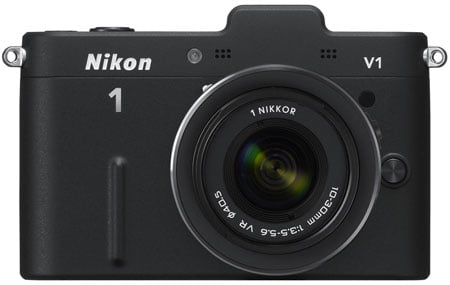
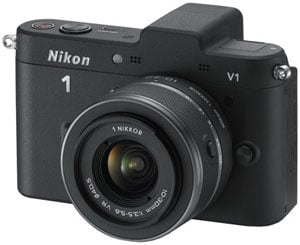
Nikon V1 design and build qualityThe Nikon V1 is a solid, no-nonsense looking camera with a virtually flat-front and slightly raised head to accommodate its electronic viewfinder. In person it’s comparable in size to – or even slightly larger than – many existing ILCs, which initially comes as a surprise given its smaller sensor. The V1 is available in black or white, and there’s also black and white versions of each lens to match; note the cheaper J1 is additionally available in silver, red and pink, and again there’s lenses to match these colours too.
The V1 measures 113x76x43.5mm (slimming to 36mm at its thinnest point) and weighs 383g with battery and card but no lens. For reference, the Sony NEX-7 (the company’s biggest ILC to date and the only one with a built-in viewfinder) measures 120x70x42.6mm, dipping to 25.3mm at its thinnest point, and weighs 350g including card and battery. So the NEX-7 is 7mm wider than the Nikon V1, but 6mm shorter and while the thickest portions are roughly the same, the Sony is 10mm thinner at their respective narrowest points. The NEX-7 is also 33g lighter, and lest we forget has a much larger sensor inside. Compared to Micro Four Thirds, the Lumix G3 with its more traditional DSLR styling and built-in viewfinder measures 115x84x47mm and weighs 382g with battery; this makes the G3 taller and wider, but otherwise surprisingly close in size and weight given its chunkier styling. Panasonic’s latest ILC for enthusiasts, the Lumix GX1, is very similar in overall size to the V1 at 116x68x39.4mm, but noticeably lighter in your hands at 318g, again with battery and no lens; that said, the GX1 doesn’t have a viewfinder built-in as standard. Nikon’s cheaper J1 is noticeably smaller and lighter than the V1, measuring 106x61x29.8mm and weighing 277g with battery and card but no lens. This also means the J1 is actually a tad smaller than the smallest Olympus and Panasonic ILCs, but not massively so, which again may be a disappointment if you thought a smaller sensor might translate into smaller bodies. It’s also worth noting neither of the Nikon 1 cameras feature the built-in stabilisation of the Olympus PEN ILCs, nor the tilting screens of several rivals. But it’s important to consider the bigger picture and also take lenses into account; note all of the lenses I’m about to mention share similar actual coverage. Sony may have some of the smallest ILC bodies out there with tilting screens and the biggest sensors to boot, but a big sensor needs a big lens and so far the company’s resisted developing a collapsing zoom. As such the standard 18-55mm NEX kit zoom is the biggest of all the standard ILC lenses, measuring a not insignificant 62x60mm (diameter x length) and weighing 194g. Panasonic employs the slightly smaller sensor of the Micro Four Thirds standard, but the basic Lumix G kit zoom is roughly the same size as the Sony and doesn’t collapse either: the 14-42mm kit zoom measures 61x64mm and weighs 165g. Olympus also employs the Micro Four Thirds standard, but has implemented collapsing lenses for some time, so the latest 14-42mm shrinks to 56.5x50mm and weighs 113g. In comparison, the standard Nikon 1 kit zoom, the 10-30mm, collapses to 58x42mm and weighs 115g, making it one third shorter than the Sony or Panasonic non-collapsing kit zooms, and 8mm shorter than the collapsing Olympus zoom. It may not be as small as you’d hope considering the smaller sensor behind it, but it’s not bad. At this point it would however be remiss of me not to mention the latest Panasonic 14-42mm power zoom lens, which collapses to an amazing 61x27mm and weighs just 95g. Indeed with the 14-42mm power zoom mounted on the Lumix GX1, the entire package is impressively smaller and noticeably lighter than the standard Nikon V1 kit, but to be fair, the Panasonic power zoom adds considerably to the overall price. So when comparing standard, affordable kit zooms, the Nikon 1 still has the edge. If you were hoping the Nikon 1 system would allow a lens that’s significantly smaller than the competition though, just look beyond to the optional 30-110mm telephoto zoom (81-297mm equivalent) which really is tiny in its collapsed configuration at just 60x61mm and 180g. So the Nikon 1 telephoto zoom is actually roughly the same size and weight as the standard Sony and Panasonic kit zooms. Indeed it’s only when you carry this twin lens kit that the overall size of the Nikon 1 system really begins to impress. The two Nikon kit zooms also have a neat trick: as you know already, both collapse, and like the Olympus collapsing zoom, there’s a control to unlock this mechanism. On the Nikon 1 kit zooms, it’s a button you need to press down as you twist the zoom ring, but the clever part is this also powers-up the cameras, making them ready for action without you having to press another control. I’ve got more detailed information regarding lenses lower on this page in the Nikon 1 lenses section. In terms of build quality, there’s no complaints with the Nikon V1: with a magnesium alloy shell and matt finish, it feels reassuringly solid with a heft which will delight owners of higher-end DSLRs. Indeed it’s one of the toughest, most confident-feeling ILCs around, although I should add there’s no mention of weather-sealing by Nikon, and the initial lenses, while impressively employing metal mounts, do not have any kind of rubber sealing. The V1’s construction also makes it one of the heaviest ILCs to date and those upgrading from a point-and-shoot or simply looking for a more portable camera to accompany a DSLR may prefer to trade the V1’s build quality for the lighter J1. Indeed despite its plasticky shiny finish and lesser build quality, I ultimately preferred carrying the J1 for day-to-day photography and also though it looked better too, especially in the white finish. This is of course a highly personal choice. I’ve pictured the J1 in its five different colours below.
Nikon V1 viewfinder and screenThe Nikon V1 is equipped with an electronic viewfinder (EVF) in addition to a 3in screen for composition, playback and menu navigation. This is one of the major differences between it and the cheaper J1, which only has a 3in screen, and no means to connect an optional viewfinder accessory. Viewfinders are often preferred to composing with the screen under very bright conditions and also have the stabilising benefit of the camera being held to your face; some people also simply prefer composing with them.
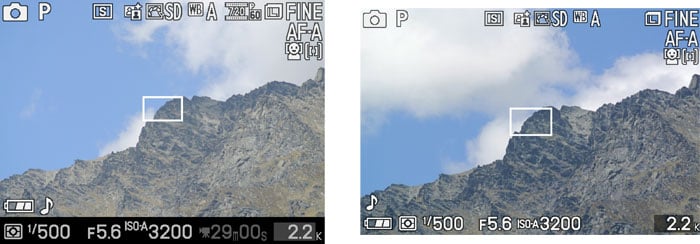
A proximity sensor to the side of the V1’s viewfinder detects if your eye is close, and automatically switches the image between the screen and viewfinder. This is certainly convenient, but the brief pause while it switches will invariably annoy those who automatically raise a camera to their eyes to grab a spontaneous moment. You may also find the camera’s proximity to your body (while powered-up and hanging round your neck), can cause the viewfinder to switch on, again causing a delay as it switches back to the screen when raised-up for composition. Since there’s no physical switch or even menu option to default to the viewfinder, spontaneous moments are best left to compose with the screen. Nikon really needs to fix this with a firmware update as it’s easy to become frustrated with the otherwise great quality EFV and compose almost exclusively with the screen instead. With a 0.47in panel sporting 1440k dots, the V1’s viewfinder delivers a large and detailed image which also manages to avoid the rainbow tearing of some rival EVFs when glancing quickly around the frame. Like most EVFs, the V1’s viewfinder image is also larger than the optical viewfinder in most budget to mid-range DSLRs, although it’s not as large as the models like the Panasonic G3. As always there’s also pros and cons to both viewfinder technologies. For example the EVF of the V1 supports a wealth of information, but becomes noisy in very low light. I’ll comment on how well it (and the screen) works for continuous shooting in that section at the bottom of this page. The option to compose with a viewfinder is a key advantage of the V1 over the J1, and the absence of one or any means to connect an optional accessory may be a deal-breaker on the cheaper model for some people. But it’s important to think how you’ll use the camera. Even ignoring the annoying delay, I was surprised to find myself rarely using the viewfinder on the V1, even under the often bright and stark conditions of my home in Queenstown, New Zealand. I found the screens on both the V1 and J1, while inevitably fading in bright light, were fine for all my compositions. Moving onto the screens, both models are equipped with 3in panels, but there’s some interesting differences. In terms of specification, the V1’s is more detailed with 921k dots compared to 460k on the J1. This should give the V1 an advantage, but in practice it’s less than you’d think. This is due to the screens on each model actually having slightly different shapes: 4:3 on the V1 and 3:2 on the J1. This means the native 3:2 shaped images of the Nikon 1 system fill the screen of the J1, but are displayed with a thin black border at the bottom of the V1 screen. The V1 uses this ‘wasted’ strip to display shooting information with the benefit of keeping the image cleaner (although never entirely clear), whereas the J1 super-imposes these details over the image.
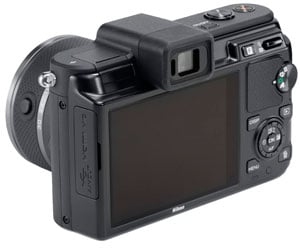
The net result though are on-screen images which look very close in actual detail side-by-side despite their difference in total dots; you only really notice the higher resolution of the V1’s screen on the edges of menu fonts. It’s also worth noting that by filling the entire screen area, the J1’s image is fractionally larger and also doesn’t shift during playback; in contrast, the V1’s live image is justified to the top of the screen during composition (see above), but is centred on playback which can be annoying when you’re trying to line-up details between them – this may only be an issue for camera and lens testers though! 16:9 video also appears slightly larger on the J1 screen thanks to its wider shape. So beware of Nikon’s promotional photo of the V1 showing an image of a man holding a football under a bridge filling the 4:3 shaped screen. This will not happen on the V1 in practice, so for the rear-view photo above I’ve replaced Nikon’s image with one of my own screengrabs to show how it really looks. In use, the screens on the V1 and J1 are bright and fairly usable in sunlight, and you can overlay a grid if desired, but there’s no live histogram or level gauge. This is annoying, but my biggest complaint concerning the V1 and J1 screens is that neither are articulated. There’s no excuse either considering the Sony NEX (not to mention some Olympus PEN) bodies are thinner yet manage to squeeze-in not just a tilting screen, but a bigger sensor too. Another missed opportunity is the lack of touch-screen technology. I’d have loved to pull-focus while filming on the V1 and J1 by tapping the desired area on-screen, and their phase-change AF would have avoided the focus searching on models like the Panasonic GX1.
Nikon V1 flash, connectivity and batteryMore key differences between the V1 and J1 regard their flash and connectivity options: the former is equipped with a proprietary accessory shoe / port and a built-in electronic viewfinder, whereas the J1 has neither but does sport a popup flash that’s absent on the V1.
Yes, that’s right, the higher-end V1 does not have a built-in flash, nor does it (like the Sony NEX-C3 and 5N) come with a flash accessory as standard. Instead you’ll need to buy the optional SB-N5 Speedlight. This is powered by the V1, has a tilt and swivel head with a Guide Number of 8.5 at 100 ISO and a handy built-in lamp for illuminating video. It’s a nice little unit, but would have been nicer still to have it supplied with the V1, or provide some sort of built-in flash in addition to the accessory shoe / port. Nikon would probably argue there’s only space on the top surface for either the accessory shoe or a popup flash, but while I appreciate the aesthetic of the V1’s smooth viewfinder head, I’d have found a standard hotshoe on the top ultimately more useful. Meanwhile the J1 may not have the accessory shoe / port of its pricier counterpart, but feels more rounded for general-use with its built-in popup flash (Guide Number 5). It’s ironic, as one of the ‘benefits’ of the V1 over the J1 is its mechanical shutter, allowing a faster flash sync speed of 1/250 compared to 1/60 – but you’ll only get to exploit it when you connect the optional SB-N5.
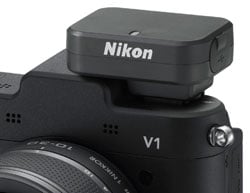
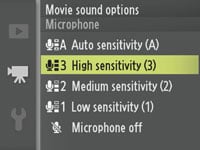
The V1’s accessory port isn’t just for the optional flash unit. Nikon also offers the GP-N100 GPS receiver (shouldn’t these be built-in by now?) and has shown prototype screen and projector accessories. Nikon’s also shown a prototype microphone which slots into the accessory port, although the addition of a 3.5mm jack on the side of the body offers greater flexibility to connect third party microphones, and there’s the choice of three preset audio levels or auto adjustment. An external mic jack is a very welcome feature – and something that’s absent on the cheaper J1 – although of course there’s nowhere to mount a third party mic on the V1 as standard. Not even Nikon’s own ME-1 microphone will squeeze into the small accessory shoe of the V1, which in my view makes it a little misleading to describe it as a compatible accessory. Nikon’s solution is to sell you the AS-N1000 Multi Accessory Port Adapter, which is a fancy description for a simple box which slots into the V1’s shoe and equips it with the standard hotshoe it should always have had. Again Nikon might argue it needed a proprietary port to support gadgetry like the projector and GPS accessories, but I’d wager there’s many more people who’d prefer to mount a third party flashgun or microphone. Besides, Olympus and Panasonic solved this problem ages ago. Simply fit a standard hotshoe, but just next to it, wire-in your proprietary port. Then the manufacturer’s own accessories can exploit the port, while third party accessories can simply ignore it and just use the hotshoe as a mount. If you’d like to hear the V1 with an external microphone in action, check out the intro to my GoPro HD Hero 2 review video. My entire intro, including the description of the new features was filmed with the V1 and a Rode SVM, connected to the 3.5mm mic jack via an extension cable and screwed into a microphone stand. Not ideal, but it proves it can be done and can sound great. Tell you what Nikon, you can make some amends by giving away an AS-N1000 for every V1 owner that wants one.
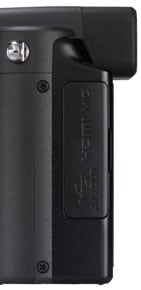
Staying on the subject of ports, both the V1 and J1 are equipped with HDMI and USB ports, the latter on the V1 doubling-up as a standard AV output; as described above, the V1 also has a 3.5mm microphone input. There’s no cable release port, nor any suggestion at the time of writing the USB port could support a cabled accessory, but both cameras will work with the optional ML-L3 infra-red control, a standard accessory across the Nikon DSLR range. Note the J1 only has one IR sensor on the front compared to front and rear sensors on the V1. Both cameras accommodate their Lithium Ion batteries and SD card slots in compartments on their undersides, but the batteries are quite different: the J1 uses the EN-EL20 pack, rated at 1020mAh, whereas the V1 uses the considerably chunkier EN-EL15, rated at 1900mAh. As you’d expect, this translates into almost double the lifespan for the V1, allowing it to shoot 400 images or 120 minutes of HD movie footage per charge compared to 230 shots or 70 minutes of HD video on the J1. The bigger battery of the V1 may add to its overall size and weight, but there’s no denying I recharged it noticeably less than the J1 during my extended testing period with both models. Note: both cameras also support optional AC adapters – handy for extended timelapse sequences with their standard Intervalometer feature. Speaking of which I made two timelapses, each with a freshly charged V1. The first took a one second exposure every 45 seconds during a mild night, and captured 373 images before expiring, while the second, during late afternoon and dusk, captured 511 images every 30 seconds with average daylight exposures; you can see the video of the latter lower on this page. Finally in terms of memory cards, the Nikon 1 cameras will exploit the extra speed of UHS-1 cards when it comes to flushing their buffers following a continuous burst or shooting stills while filming video. So if it’s important to have the camera refreshed and ready to go as soon as possible, I’d strongly recommend investing in a UHS-1 card. You can see actual timings in my Movie Mode and Continuous Shooting sections below.
Nikon V1 controlsAfter all these physical differences, it’s interesting to note both the V1 and J1 share almost identical controls. On the top there’s three buttons: on / off, a shutter release and a dedicated button to start recording video.
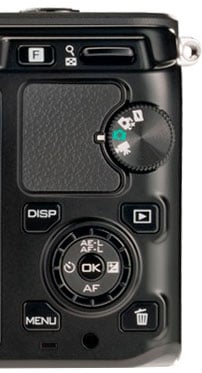
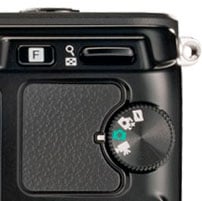
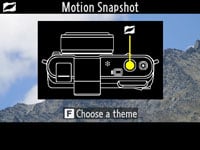
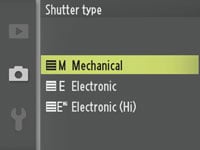
All the controls on the rear surface are to the right of the screen. Starting at the top are an ‘F’ Feature button alongside a lever which can be nudged up or down. These change their function depending on the mode. For instance in normal shooting the F button presents a menu to choose between mechanical and electronic shutter on the V1. In the movie mode, the F button lets you choose between normal video or slow motion. In the Motion Snapshot mode it lets you choose between themes, while in playback it lets you rate your photos. In any case, the satisfyingly tactile lever can be nudged up or down to select the desired option. The lever is also used to set the aperture and shutter in their respective priority modes or to shift the Program exposure values. Note the ‘F’ button is not reprogrammable, and as an aside, the lever is a little shorter on the J1. Below the F button and lever is the main mode dial, a thin wheel with only four options: Motion SnapShot, Smart Photo Selector, Still Image and Movie. You’ll note there’s no traditional Auto, PASM or scene positions on the dial, as these are actually selected from a menu. I’ll discuss all of this in later in the review, but for now only comment this dial can be turned very easily by mistake and when pulling either camera from a pocket or bag, I invariably found the camera set to a different mode or an in-between position. Finally in the lower right corner are a tilting wheel surrounded by four buttons. This wheel provides nice tactile stepped feedback when turning, and when pushed up, down, left or right locks the exposure and or focus, presents the AF, self-timer and exposure compensation menus respectively. The J1 is identical except pushing the wheel down sets the built-in flash options, meaning you’ll need to set the AF options from the main menu system instead. Meanwhile the four buttons around the wheel fire-up the menu pages, cycle through display options, enter playback or delete images. There’s no super-imposed menu system on the Nikon 1 cameras, nor any buttons to offer direct access to things like the ISO or white balance, nor even any programmable function keys. Combine this with the traditional shooting modes also being hidden away and you’d think it could be a control nightmare for enthusiasts. But in use I actually found it quicker and more intuitive than the Sony NEX user interface. Sure it can be annoying for enthusiasts not to have direct access to a PASM mode dial, but the options are only a couple of clicks away and once in the desired mode you can easily adjust the key options with the lever. Adjusting the ISO, white balance and other settings will require regular trips into the menus though, so if you need to change these frequently, you should think carefully whether the Nikon 1 is for you. Of course simplified controls and a different approach to the mode dial are key parts of what the Nikon 1 system is about. It’s not meant for enthusiasts or traditionalists, but for beginners, or at least people who want a simpler life or a different approach to picture-taking. But while this strategy applies nicely to the cheaper J1, it sits a little uncomfortably with the higher-end V1. After all the V1 is a relatively pricey ILC, which with its accessory port, EVF, magnesium alloy build and choice of mechanical or electronic shutters, really is aimed at a tech-savvy audience. These same people are inevitably going to find the basic and non-standard controls at best odd and at worst, annoying. That said, I’ll conclude this section by repeating that when using the V1 and J1 as an ‘enthusiast’, I personally found their user interface much less annoying than the Sony NEX system.
Nikon 1 system lensesThe V1 and J1 are the first cameras to employ the new Nikon 1 lens mount. Nikon offers the FT1 adapter (costing around $270 USD) which lets you fit full-sized Nikon F-mount lenses (all of which effectively have their field of view reduced by 2.7 times), but of course much of the charm, not to mention performance, of an ILC comes from native lenses.
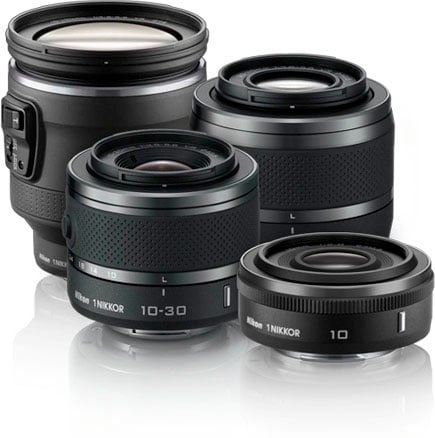
Nikon launched the V1 and J1 with four new lenses designed for the Nikon 1 mount. The standard kit zoom is the Nikkor VR 10-30mm f3.5-5.6, delivering an equivalent focal length of 27-81mm with built-in optical vibration reduction. It weighs 115g and retracts to a reasonably portable 42mm long by 58mm in diameter. As discussed earlier, that’s a little smaller than most ILC kit zooms, but in most cases not by a huge margin; indeed Panasonic’s premium 14-42mm power zoom kit lens is actually 15mm thinner. Twin lens kits also include the Nikkor VR 30-110mm f3.8-5.6 telephoto zoom, which takes over where the 10-30mm left-off, with an equivalent range of 81-297mm, and again built-in optical vibration reduction. Like the 10-30mm, it’s retractable design which measures 60mm in diameter, folds down to 61mm in length, and weighs 180g. Now this is where the Nikon 1 mount and CX format really begins to make sense, as you have a telephoto zoom that’s considerably smaller than those on rival systems; indeed the Nikon 30-110mm is similar in size to the Sony 18-55mm standard kit zoom. Coupled with the 10-30mm, it’s a highly portable twin lens kit to carry around. Nikon’s also the only company that’s been bright enough to realise the extending of a collapsing lens is an indication you’d like to take a picture, so on the 10-30mm and 30-110mm it uses the unlocking mechanism to actually power-up the cameras. Very neat. I should also add the zoom rings on both kit lenses are slightly smoother than most, giving you a reasonable chance of adjusting them while filming without lurching between focal lengths. Oh, and that the 30-110mm comes with a nice lens hood which reverses over the barrel for transportation. The third lens is the only prime in the initial launch, the Nikkor 10mm f2.8. This pancake prime delivers an equivalent wide-angle focal length of 27mm and is the smallest in the initial collection, measuring 56mm in diameter, 22mm in length and weighing 77g. The fourth and final lens is the Nikkor VR 10-100mm f4.5-5.6 PD-ZOOM, a super-zoom model with a 10x range equivalent to 27-270mm and built-in vibration reduction. The PD in the title refers to Power Drive, which uses a motor to smoothly operate the zooming mechanism, making it ideal for movies. Unsurprisingly this is the largest of the four Nikon 1 lenses, measuring 77mm in diameter, 95mm in length when retracted, and weighing 530g. Overall the lens selection at launch will satisfy most buyers: there’s the compact twin kit lenses for general-use, the super-zoom for videophiles with the added glamour of a motorised zoom, and the mandatory pancake lens to illustrate the portability of the system. It’s actually one more lens than Sony launched NEX with, and again the superzoom is motorised, making it much more useful for video work. What we haven’t got is a dedicated macro lens, any longer (and arguably more useful) general-purpose primes, or anything with a really bright focal ratio. One of the promises of an ILC over a typical point-and-shoot is the ability to use lenses which can deliver a shallow depth-of-field for nice blurred backgrounds on portraits. As the sensor size – and corresponding lens focal length – reduce though, achieving this becomes harder, so the odds are already stacked against the Nikon 1 system. This coupled with a selection of lenses with modest focal ratios will mean shallow depth-of-field effects will be hard to achieve with the current crop of native lenses. Portrait fanatics who are happy to splurge on the FT1 adapter to access full-sized F-mount lenses will find the Nikkor 35mm f1.8G or 50mm f1.8G good options with their equivalent focal length of 95mm and 135mm respectively. I hope to test such a combination in the near future, but hope even more that Nikon releases equivalent options in the native CX mount.
Nikon V1 focusingAutofocusing is one of the highlights of the Nikon 1 system, with Nikon making bold claims that it’s the fastest in the world. We have of course heard similar claims from other manufacturers recently, but the way the Nikon 1 system goes about autofocusing is different from almost any other camera to date.
The 10.1 Megapixel CX-sensor in the V1 and J1 boasts a hybrid AF system, offering both contrast-based and phase-detection AF systems, the latter actually built-into the sensor itself at the focal plane. In use both cameras automatically switch between phase and contrast-based AF depending on the subject, with the former allowing them to quickly track action even while filming video. If the subject is shiny or in motion, the V1 and J1 employ phase detection AF with up to 73 points (for single AF point selection) or 41 (when set to auto area). If the subject is stationary or poorly lit, the V1 and J1 switch to their contrast based AF system, which uses up to 135 areas. So if nothing else, Nikon can certainly lay-claim to having the world’s most focusing points. There’s no way to manually choose between the two AF systems, and the only indication of which is in use is by carefully watching the actual focus-searching process. Phase-detect AF systems are able to adjust until the subject is sharp then stop dead, whereas contrast-based systems normally focus slightly beyond the point of sharpness to confirm, then return again. This certainly bears-out in practice with the Nikon 1 cameras. Under bright conditions (when Nikon says it’ll use phase-detect), the camera’s tend to lock-on without drifting, while under dimmer conditions (when Nikon says it’ll use contrast-based AF), the camera’s visibly search back and forth. Nikon wouldn’t reveal any further details, such as why the phase-detect system wasn’t used in dim conditions, but it could do with the implementation on-sensor along with the maximum aperture of the lenses. Either way, with the Nikon 1 cameras, you’ll have phase-detect AF under bright conditions and contrast-based under dim conditions. This approach inevitably leads to a camera with two different autofocusing personalities. Under bright conditions the Nikon 1 cameras are very impressive, with their AF frames turning green almost the instant you half-press the shutter release. Indeed at times there’s virtually no visible focusing -Â the subject just eerily becomes sharp almost immediately. Even when it has to move from one end of the scale to the other, it’s a very swift and confident process. This is particularly impressive when you’re also talking about using the bog-standard kit lenses, and not exotic luxury models. The phase-detect AF system also has the crucial benefit of offering continuous autofocusing during movies or burst shooting, and in practice it also works a treat. I’ll discuss this in greater detail in the movie and continuous shooting sections, but briefly here say the Nikon 1 cameras under bright conditions can autofocus and track more confidently than any other mirrorless ILC I’ve tested. The only other camera system which comes close at non-pro price points are Sony’s SLT models, but these implement phase-detect AF with a semi-reflective mirror which means some light is always lost and the body is physically larger than a mirrorless ILC. The Nikon 1 cameras boast this degree of performance in a smaller body without any light loss from a mirror in the optical path, while also eliminating calibration errors thanks to integrating the AF sensors on the imaging sensor. So far so good, but as mentioned earlier, this is a tale of two AF systems. Under dimmer conditions the Nikon 1 cameras switch to their contrast-based AF systems, at which point much of the speed is lost. To be fair, the contrast-based AF on the Nikon 1 cameras isn’t bad, but it is noticeably slower than the phase-detect system. It turns the Nikon 1 into normal cameras. So the ultra-fast and continuous autofocusing capabilities rely on the phase-detect AF system, which in turn relies on bright conditions. Daytime activities and brightly floodlit sports are fine, but under dimmer conditions there’s no AF speed advantage to the Nikon 1 over rival models.
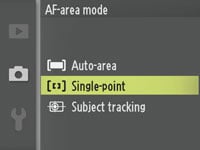
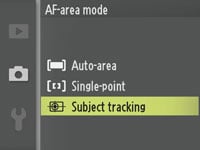
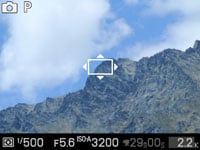
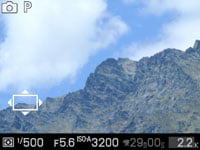
The Nikon 1 AF system is about more than speed though. It has a huge number of AF areas / points, and you can have the camera choose automatically (from 41 areas) or set them yourself (from 135 areas). In the Single-point AF mode you can position the AF frame to any of 135 areas including pressed right up against the edge of the frame. It’s also really easy to adjust the position: with Single-point AF selected in the menu, you just press the OK button while composing and use the tilting wheel to move the AF area to the desired location.
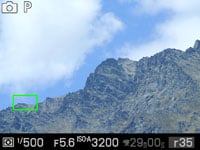
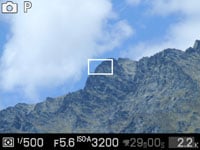
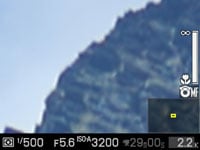
In terms of focusing modes, the Nikon 1 cameras offer AF-S (Single AF), AF-C (Continuous AF), AF-A (Auto-Select AF which chooses between AF-S and AF-C), AF-F (Full-time AF, a continuous mode which applies when shooting movies), and finally Manual Focus. Unlike most ILCs, there’s no manual focusing ring on the Nikon 1 lenses, so manual focusing is achieved electronically via the screen. With MF selected, you press the OK button to enter the manual focusing adjustments. At this point this screen shows a magnified area, which can be moved around using the rocker wheel or adjusted to one of three sizes using the lever in the top right corner. Then to actually manually focus, just spin the wheel on the back.
With the highest magnification it’s possible to accurately manually focus fairly easily, although there’s no focus-peaking assistance as found on the Sony NEX models. Note both the V1 and J1 are fitted with AF illuminators – particularly handy for the V1 since there’s no flash it could alternatively use. The illuminator only lights in Auto-area mode or when the centre point is chosen for Single-point mode. You’ll also need to enable ‘Built-in AF Assist’ from the menu.
Nikon V1 shooting modesThe Nikon 1 cameras take a unique approach to picture and video taking with a degree of integration and innovation which really stands out from the crowd. It’s obvious something is very different about these cameras when there is a mode dial, but one without any evidence of traditional PASM modes or scene presets. To allay any fears, PASM modes with full manual control are available, but via the menu system which I’ll describe later. I’ll start here with the main shooting modes which form the heart of the Nikon 1 system.
Both the Nikon V1 and J1 are equipped with the same mode dial, a thin wheel with only four options: Motion SnapShot, Smart Photo Selector, Still Image and Movie. Still Image and Movie are the most conventional of the foursome, allowing you to take photos or videos respectively, but even then the Nikon 1 system does things a little differently. With Still Image selected, you can also capture video at any time by pressing the dedicated record button, although the best quality is limited to 720p. The video can be interrupted at any time by pressing the shutter release to take a full resolution still photo, but the video will stop. This is the same whether you’re using the V1’s mechanical or electronic shutter. The Movie mode of course allows you to capture video (full details of which are in the Movie Mode section below), but you can also take still photos at the same time by pressing the shutter release. Many cameras also let you capture still photos while filming video, but normally you have to choose between low resolution stills at the same resolution as the video, or interrupting the video to capture full resolution images. With the Nikon 1 cameras you’ll never interrupt the video while capturing stills, but you will need to be in the right mode to maximise their resolution. With the camera set to 1080p or 720p, the still photos will measure 1920×1080 or 1280×720 pixels, essentially doing nothing more special than frame-grabbing from the video. But set the video to 1080i and you can uniquely capture up to 20 stills at 9 Megapixels (or 15 with the J1); these are effectively the maximum 10 Megapixel resolution, but cropped to a 16:9 shape. There’s more details in the movie mode section below, but just briefly, the ability to capture high resolution stills and HD video simultaneously without interrupting the latter is a unique capability of the Nikon 1 system and one of the major highlights. Now it’s time for the two really different shooting modes, starting with Smart Photo Selector. This starts quickly buffering images the moment you half-press the shutter release and records 20 as you push all the way down. A number of these frames are actually captured following the press of the shutter release, which allows the V1 and J1 to record not just the moment you pressed the button, but just before and afterwards too. The camera then evaluates the burst of 20 images for focus, composition and facial expression, before then selecting what it believes are the best five, with the best of all shown immediately on-screen. This mode maximises your chances of grabbing the right moment – with a few extra thrown in for good measure. The automatic selection process can tie up the camera for several seconds after the burst, so you need to be sure there isn’t another opportunity coming up straightaway. With people, it also works best on smaller groups, but it remains an easy way to exploit the speed of the camera without having to manually sift through countless images from a burst. Great for small group shots. The fourth mode is Motion Snapshot, which also starts recording just prior to the main button press, but this time it’s capturing a one second burst of Full HD 1080 video at 60p in addition to your main still image (cropped to 16:9). The video is then encoded at 24p, for a semi slow-motion effect, 2.5 times slower than normal, and stored alongside the high resolution 16:9 still. During playback the 2.5 second video is shown, followed by the still photo, both accompanied by a short 10 second piece of music previously chosen from one of four themes. The theory behind Motion SnapShot is you get the best of both worlds with the video putting the still photo into context. In use I had mixed results. For general portrait snapshots your video will invariably show the subject just blinking or moving their head a little. Often the effect isn’t all that flattering, although it can certainly generate a laugh or two. Switch to subjects who’s expression (or position) changes quickly though, such as kids, and you’ll have more fun with the video giving a background to the photo. You can of course also organise contrived effects like deliberately shaking long hair before stopping for a pose like a shampoo advert on TV. On your computer, there’s two files for each Motion Snapshot capture, one for the still and one for the silent video. You’re welcome to click and play either in turn, or use Nikon’s supplied software to play them together to replicate the experience of viewing them from the camera itself. Nikon also supplies software to edit together the various video files captured by the camera. Stepping back for a moment, the four shooting modes are basically just different ways of packaging and presenting the Nikon 1’s core capabilities of fast bursts, quick processing and simultaneous video with stills. I really admire Nikon’s approach here to have fun with the unique capabilities and have you think differently about picture and video taking. These alone could sell a Nikon 1 to many people. That said, the traditionalist in me invariably saw me selecting the Still photo and Movie modes for general use, albeit still exploiting the power of the camera. Yes, I’d use the Still photo mode for pictures, but I’d be firing bursts of 10fps or more to capture the exact moment or expression I desired. Yes I’d use the Movie mode for capturing video, but I’d also press the shutter release at key moments to also grab high resolution stills in the knowledge the motion wouldn’t be interrupted. So even though I generally avoided the Smart Photo Selector and Motion Snapshot modes for personal use, I was always making the most of the camera’s speed and flexibility. Â Stills and video have never converged and complemented each other to this degree on a consumer camera.
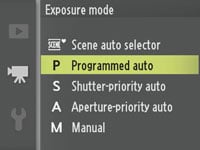
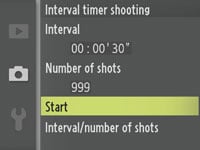
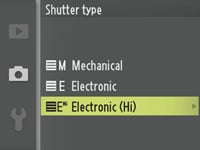
As mentioned earlier, you also have the chance to switch to traditional PASM modes if desired. Press the Menu button and the second option on the Shooting page lets you choose the Exposure mode from Program, Aperture and Shutter Priority, Manual or Scene Auto selector. In use I found the Scene Auto mode did a good job at evaluating most situations, but when it automatically selected portrait mode after detecting a face, it often used shutter speeds around 1/60, which is generally too slow for sharp photos of kids. So be warned if you’re shooting kids, you may want to switch to Shutter Priority and dial-in a minimum of 1/125 to avoid motion blur. Both the V1 and J1 give you full manual control over exposures and Program shift, but the V1 takes it one step further with a choice of using a mechanical or electronic shutter at any time, whereas the J1 is electronic only. There’s pros and cons to both. The electronic shutter on the V1 and J1 operates silently and enjoys the benefit of a faster maximum shutter speed of 1/16000 and quicker continuous shooting options at 10fps, 30fps or 60fps, but the fastest flash sync speed is 1/60 and still photos can suffer from skewing due to the rolling shutter effect – although to be fair I only experienced this on a few frames of thousands shot with the V1 and J1. The V1’s mechanical shutter supports flash sync speeds up to 1/250, avoids rolling shutter / skewing artefacts and gives a nice tactile and audible feedback when firing, but the maximum continuous shooting speed is 5fps and the fastest shutter is 1/4000. At the opposite end of the exposure scale, you can dial-in shutter speeds down to 30 seconds or go for Bulb, best-triggered by the optional ML-L3 remote control. In a surprise but welcome addition the V1 and J1 come with a Interval Timer options which let you take photos at set intervals – great for timelapse photography, although you’ll need to provide the software to create a video file from the bunch of stills captured by the camera. The V1 and J1 let you set the interval between each shot to anywhere from one second to 24 hours, and the number of shots from one to 999. Unlike more sophisticated timers, you can’t set a delay before the first shot – here it’ll just start shooting after about three seconds. You can see an example below which I shot with the V1 and 10mm f2.8 pancake lens. I set the camera to take a photo every 30 seconds for 999 frames, or until the battery ran out. The latter unsurprisingly happened first, but the V1 still out-lasted its quoted life by capturing 512 frames before expiring. I also made another timelapse at night under much cooler conditions with one second exposures, where the V1 managed to capture 373 images before the battery ran out. Clearly this is an area where the V1’s longer battery life is an advantage over the J1, although Nikon does offer optional AC adapters for both, which will be necessary if you want to approach anywhere near the 999 shot limit. Note my timelapse was generated by loading the photos as an Image Sequence in Photoshop Extended and exporting at the full 10 Megapixel resolution, before then scaling down into a 1080p frame in Premiere Pro.
What neither the J1 and V1 offer though is exposure bracketing, not even a measly three-frame option. In this respect they’re no different from the company’s entry-level DSLR, the D3100, but that still doesn’t justify the decision to leave it out, especially on the enthusiast-targeted V1. It’s such a missed opportunity too as the Nikon 1’s super-fast continuous shooting is perfect for handheld HDR, not to mention supporting other multi-frame modes to reduce noise. Nikon’s engineers should really get hold of Sony’s NEX and SLT cameras to see the potential of multi-frame capture modes. It’s arguably even stranger in today’s market to find the Nikon J1 and V1 bereft of any kind of special effects. No sepia, no grainy black-and-white, no miniature tilt-and-shift. Effects which may at times seem cheesy, but which are conspicuous by their absence here, especially on the cheaper J1. And after the amazingly friendly D3100, it feels odd not to have any on-screen guidance or help. So while including features like an intervalometer are very nice, Nikon should really ensure its covered the bases first and I sincerely hope AEB and some effects are added with a firmware update very soon. They’d make the cameras more popular with enthusiasts and beginners alike.
Nikon V1 movie modeThe Nikon V1 and J1 offer a selection of movie modes including several unique options which allow them to stand out above the competition. The highlights? The ability to continuously autofocus while filming HD video along with taking high resolution stills without interrupting the movie.
Video is a highly integrated part of the Nikon 1 modes: in Motion Snapshot mode, one second of HD video is captured at 60p, then encoded at 24p to slow it down by two and half times in playback. These short clips are then shown alongside a high resolution still photo as a fun backgrounder to the shot. Meanwhile in the Still Photo mode you can start recording 720p video at any time by pressing the dedicated record button. In this section though I’ll be concentrating on the dedicated Movie mode position on the dial. With this selected, the F button and lever lets you choose between HD Movie and Slow motion, with the actual resolution, exposure mode and frame rates for each being adjustable in the main menu system if desired. Nikon recommends using an SD card rated as Class 6 or faster and the Nikon 1 bodies support UHS-1 cards too. By default, the Nikon V1 and J1 have their HD Movie mode set to 1080/60i (59.94 fields actual) which encodes at a rate of 24Mbit/s and can record clips up to 20 minutes long. From the menu you can change this to 1080/30p (29.97fps actual), which also encodes at 24Mbit/s for clips up to 20 minutes long, or 720/60p (59.94fps actual) which encodes at 16Mbit/s for clips up to 29 minutes long. Note these frame rates and clip lengths apply to all models across the World, so there’s no 50i/25p for PAL regions, nor any option to record for longer than 29 minutes in any mode. Also note the sensor outputs 1080/60p, but there’s sadly no means to record video in this format beyond the one second bursts in Motion Snapshot mode. Both the J1 and V1 are equipped with built-in stereo microphones, but the V1 additionally offers a 3.5mm microphone input jack and a proprietary accessory port which could also accommodate an external mic. Nikon’s shown a prototype mic which could connect to this port, but for now, you’ll be using the 3.5mm jack and figuring out some way to physically support the microphone itself as the built-in accessory shoe is narrower than a standard hotshoe. As discussed earlier, Nikon offers an adapter which slots into the shoe and provides a proper hotshoe mount. I tried the V1 with a Rode SVM mounted on a separate stand via an extension cable for the introduction section of my GoPro HD Hero 2 video review and the sound quality is certainly a step-up from the built-in microphones. I just wish Nikon had made it easier to mount standard microphones (including its own ME-1) on the body with a normal hotshoe. In any of the HD Movie modes you can change the exposure mode from the default Scene Auto to Program, Aperture, Shutter Priority or Manual. You can also adjust exposure compensation, set the ISO or white balance if desired. You can also choose between single AF (AF-S) or continuous AF (AF-F) options, with the latter exploiting the phase-change AF system to track subjects with a fair degree of confidence and minimal searching. This is a key benefit of the Nikon 1 system and you’ll see some examples in a moment. The cameras will also automatically detect faces if desired and give these priority for tracking. Another key advantage is the ability to capture still photos while filming video. Many cameras also offer this functionality, but there’s normally a compromise between the quality of the stills or the motion of the video. Some can capture stills without interrupting the video, but they’re at the same resolution as the video itself which for 1080p is just 2 Megapixels. Others let you capture full resolution images while filming, but interrupt the video during the process. Not so with the Nikon 1 cameras which can uniquely capture high resolution still images while filming, without interrupting the video. There are however some important caveats which I’ll describe fully after the clips below. Now let’s check out some clips filmed with the 1080i and 1080p HD Movie modes. I’ll follow these with a discussion on the slow motion options. As always, all the videos are available for Vimeo members to download in their original formats for evaluation, and I find VLC Player is a good option for playing them back.
In the third clip, above, I mounted the V1 on a tripod with the 10-30mm lens and manually zoomed all the way in and back out again. While it’s hard to smoothly adjust the focal length of lenses without motorised-zooms, the ring on the Nikon 1 10-30mm kit lens doesn’t catch and allows for a fairly smooth effect. As seen on the first clip here, it’s much harder to smoothly adjust the zoom when filming handheld, but firmly fixed to a tripod you’ll have a much better chance. Note Nikon does offer one motorised zoom lens for the 1 system: the 10-100mm superzoom. This is the preferred choice for anyone who wants to zoom in and out while filming.
In this clip above, I made a handheld pan under dim lighting conditions. I chose Movie Mode from the V1’s dial and let the camera work everything out using the fully automatic Scene Auto Selector exposure mode. I subsequently reshot the same sequence moments later with manual ISO and found the V1 had selected 3200 ISO. Considering the high sensitivity, the clip looks reasonably clean in terms of noise – certainly better than most point-and-shoot cameras under similar conditions. Note there’s a small amount of jerkiness due, I presume, to the Vibration Reduction catching up with itself while panning.
In the clip above, I panned the camera around the scene, allowing it to rest on various subjects to refocus. Notice how it does this very confidently as I recompose. The refocusing may not be lightning-fast, but it’s visually preferable at this speed. Notice how when adjusting the focus, the camera doesn’t drift past the point of maximum contrast before returning to it a moment later; instead it stops dead when focus is achieved, which is a benefit of the phase change AF system over a contrast-based one. We’ve seen this effect before, when filming video with the Sony SLT cameras, but the clever thing here is there’s no mirrors absorbing precious light or making the body larger. Then again, the sensor in the V1 is much smaller, so there’s pros and cons when comparing both systems. Note this clip was recorded at 3200 ISO, so the noise levels look pretty good considering the high sensitivity.
In my sixth clip, above, I really put the continuous AF capabilities to the test with a subject steadily approaching the camera. I fitted the optional 30-110mm lens to the V1 and zoomed it into 110mm (297mm equivalent). I then set the movie AF mode to AF-F, set the focus area to centre and kept the Skyline logo on the cable car in the middle of the frame as it approached. The V1’s done a pretty good job here at keeping the cable car in focus during the clip, and while the focus drifted as the cable car came very close, the camera always managed to retrieve it again. This ranks the V1 amongst the best cameras I’ve tested for AF tracking, alongside Sony’s SLT models.
In the clip above, I handheld the V1 as one of the Shotover Jet-boats zoomed-past. The camera was fitted with the optional 30-110mm telephoto zoom lens, initially zoomed all the way in, before zooming-out to around 30mm as the boat makes its spin, and finally zooming back in again at the end. The camera confidently refocuses throughout the sequence, only losing it fractionally for a moment as I adjust the zoom. The quick, confident and continuous AF while filming is one of the major highlights of the Nikon 1 system, and this clip would be difficult to reproduce with a traditional DSLR. Also note that while twisting the zoom ring manually isn’t ideal for smooth adjustments, the subject here has been quite forgiving. Finally notice the VR system again introducing slight jerkiness as I panned the camera, but again it’s not bad compared to some other cameras I’ve tested.
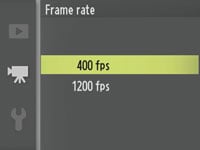
Like many cameras these days, the Nikon V1 offers Slow Motion video at a reduced resolution. It defaults to a 400fps option which captures up to five seconds of 640×240 video at 1.8Mbit/s; when played back at 30fps, the action is slowed by 13.3 times. From the menu you can switch this to a 1200fps mode if desired, which captures up to five seconds at a lower resolution of 320×120 and a rate of 0.6Mbit/s; when played back at 30fps, the action is slowed by 40 times. These are impressive capabilities, although the very wide and non-standard aspect ratio (approx 2.5:1) is an interesting choice, presumably made to minimise the amount of data being captured and processed.
Above is a clip filmed in the 400fps mode, and you’re looking at the video at its actual 640×240 size. Meanwhile, on the left is an example of the 1200fps mode, again at actual size. The thin, wide aspect ratio may not suit subjects like bursting balloons, but given the right subject it can work really well – and Nikon’s decision to capture such a short height has allowed the faster than average frame rates. For comparison, Canon’s PowerShot SX40 HS can capture slow motion video at 640×480 at 120fps or 320×240 at 240fps. As such the V1 looks pretty strong in the slow motion department, although personally speaking I’d stick with the 400fps mode for the larger frame size. There’s just one more video to show you here and once again it’s of the Shotover Jet fast-approaching before executing a spin. What’s different here I hear you ask? Well this time I was filming in the 1080/60i mode which allows you to also capture up to 20 still frames (or 15 on the J1) during the clip at the camera’s full 16:9 resolution of 8 Megapixels. So first here’s the video, actually filmed with the J1, but the operation and result is exactly the same as the V1 apart from the maximum number of frames you can capture.
This is a killer capability of the Nikon 1 models as most cameras only allow stills to be grabbed at the same resolution as the video, which for Full HD is a mere 2 Megapixels. Others let you grab full resolution stills, but interrupt the video. Uniquely the Nikon 1 cameras let you grab 8 Megapixel stills while filming 1080i video without interrupting it. As mentioned earlier though, there are some caveats. Most importantly it’s only possible in the 1080i mode, where 8 Megapixel (cropped 16:9) stills can be captured while filming. Switch to either of the progressive movie modes (1080p or 720p) and the stills will be at the video resolution. The second caveat regards the number of shots you can take while filming, and the subsequent writing to the card. The V1 only lets you take up to 20 shots during a 1080i video, while the J1 only lets you take 15. After you’ve reached that number you won’t be able to take any more photos until you stop filming, even if you let the clip run for the maximum 20 minutes. The moment you stop recording, the buffer also has to empty, which takes just over a second for every photo you took using a fast UHS-1 card, or about 1.5 seconds per photo on a Class 10 card. You can’t start filming a new video until this writing period has completed, although at least the cameras do let you snap more stills if desired. So if you shot the maximum 20 frames allowed on the V1, this means the camera won’t be able to start filming again until between 20 and 30 seconds later depending on the card. If you only took, say, five photos though, that locked time will be a more reasonable five to seven seconds. And if you do find yourself in a position where you’ve snapped all the available shots while filming, you do at least have the choice to either keep recording video (for up to 20 minutes), or simply stop recording and take more stills. The third caveat regards the actual operation. The cameras may allow you to take stills while filming video, but require you to press down on the shutter release each time, which runs the risk of visibly nudging the camera. Annoyingly there’s no continuous shooting option for stills while filming video. Don’t get me wrong, I’m not expecting 10fps, but the ability to simply hold down the shutter release and grab a still, say every second, would eliminate the constant jabbing and potential wobbling of the camera. Clearly this process works best of all with the camera mounted on a tripod, and with the shutter triggered by the remote control (I’m verifying if the latter works during movies). The fourth caveat regards exposure and potential blur. By default in Scene Auto the movie mode will select an exposure with a slowish shutter speed to maximise smooth motion. This is perfectly normal and for the best results at 30p/60p/60i, most videographers prefer to use shutter speeds of 1/60 or even 1/30. Of course such shutter speeds are not conducive to freezing even slow action on photos, so the first time you try this option on the Nikon 1, you’ll invariably be disappointed by motion blur on the stills. The solution is to switch to Shutter Priority mode and set a speed that’s sufficient for your stills and accept the video motion may not be as smooth as it could be. In practice this worked pretty well in my tests, and with a shutter speed of 1/500, I was able to capture a selection of reasonable still photos of Jetboats and rafts racing past while also recording what looked like a smooth video. You’ve already seen the video above, so below are the 15 stills I captured while filming, and each links to the original image at flickr.
Do be careful with fast action though whether it’s a boat racing past or a kid running towards you. If you wobble the camera too much, the images (taken as they are with an electronic shutter to avoid interrupting the video) can suffer from a little skewing / jello which can introduce some distortion to the subject. To be fair it rarely happened during my tests but when it did the effect wasn’t flattering. The ability to capture stills and photos simultaneously becomes especially useful when an event will only take place once, such as the candle blowing at a kid’s birthday party. I successfully used this technique at several parties over the test period and even in Scene Auto managed to grab some good stills while also having videos of the event. When it works well, this is a killer application for the Nikon 1 as it solves the problem of having to choose whether to shoot stills or video at an event when you only have one camera and one set of hands. Even if you did have two cameras and operators, the subject could only look into one of them at the critical moment. Just remember when taking photos while filming with the Nikon 1 cameras though, the video is the primary event and photos, while potentially decent, still won’t not be as good as when shooting in the dedicated Photo mode. There’s always a compromise, although the Nikon 1 makes it much less of one than before. Note: In case you’re wondering about flash usage while filming, I can’t comment on the SB-N5’s operation on the V1 as it wasn’t available at the time of testing, but I can tell you the flash won’t fire even if you want it to on the J1 while filming video.
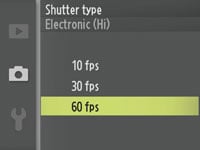
Nikon V1 continuous shootingContinuous shooting is another highlight of the Nikon 1 system with both the V1 and J1 boasting 10fps with autofocus, or a massive 30 or 60fps with the focus locked at the first frame. These speeds employ an electronic shutter which sets the ISO automatically and offers shutter speeds up to 1/16000. The V1 and J1 additionally offer slower 5fps options where you can set the ISO; at 5fps, the V1 also gives you the choice of using a mechanical or electronic shutter, whereas the J1 is limited to an electronic shutter only. Nikon quotes up to 58 Large Fine JPEG or 44 RAW files for the V1 at 5fps with the mechanical shutter. Switch to the faster electronic shutter modes and Nikon claims up to 100 JPEGs can be captured at 10fps, or 30 JPEGs in either the 30 or 60fps modes. The cheaper J1 shares the same quoted figures at 10, 30 and 60fps, but in its 5fps mode shoots up to 28 Large Fine JPEG or 19 RAW files. The larger buffer of the V1 will please action aficionados, but how do the cameras perform in practice?
To put these figures to the test I fitted the V1 with a freshly formatted 16GB SanDisk Extreme Pro UHS-1 card rated at 45MB/s. With the camera set to Large Fine JPEG and 1/500 at 400 ISO with the mechanical shutter, I captured 58 frames in 13.3 seconds before the camera slowed to about 1fps; for the initial burst, this corresponded to a rate of 4.4fps. Nikon’s quote for RAW files was almost bang on the nose, with the V1 capturing 43 NEFs before stalling, again for the same rate of approximately 4.4fps. I then switched to the Electronic Hi shutter, first trying out the ‘slowest’ 10fps mode. This grabbed 34 Large Fine JPEG frames in 3.32 seconds, confirming Nikon’s rate, although coming in much below the 100 frames quoted. Increasing the compression level to ‘Normal’ or ‘Basic’ made no difference, although impressively the V1 could alternatively shoot 33 RAW files at exactly the same speed. Setting the camera to the 30fps mode, I captured exactly 30 frames in exactly one second before the camera stalled. At 60fps the V1 grabbed 30 frames in exactly half a second before it stalled. These times were measured by photographing a digital stopwatch. While the mechanical shutter mode operated about half a frame per second slower than quoted, and the 10fps electronic option couldn’t grab more than 34 Large JPEGs in an uninterrupted burst, the V1 performed pretty much exactly as billed. The electronic shutter modes captured images at exactly the quoted speeds of 10, 30 or 60fps, while the mechanical shutter mode was happy to keep shooting at about 4.4fps for just over 13 seconds. In any of the electronic shutter modes, it took the V1 about 25 seconds to completely flush its buffer when filled with Large Fine JPEGs, or 45 seconds when filled with RAW files; this was using a UHS-1 card. Switching to a slower Class 10 card saw the same flushing process take 41 seconds for Large Fine JPEGs or 78 seconds for RAW files. This confirms the Nikon 1’s support for quicker UHS-1 cards, and if you’re into shooting frequent bursts of action, these are clearly the ones to go for. I am however pleased to report that unlike many cameras, the Nikon 1 bodies don’t lock-up once their buffers fill. Give them just a couple of seconds and you’ll already have between five and ten frames available for a subsequent burst. This means even after filling the buffer you can start shooting again – admittedly for smaller bursts – almost straightaway. Just for the record, the J1 (equipped with the same UHS-1 card) captured 28 Large Fine JPEGs in 5.95 seconds in its normal 5fps mode, corresponding to a rate of 4.7fps in practice; this was flushed in 17 or 32 seconds using a UHS-1 or Class 10 card respectively. Switching to RAW saw the J1 capture 19 shots in four seconds, corresponding to a rate of 4.75fps; this was flushed in 23 or 48 seconds with a UHS-1 or Class 10 card respectively. So the shooting speed was approximately the same as the V1, but the pricier model could capture just over twice as many in a burst: 58 vs 28 JPEGs or 44 vs 19 RAW files. Moving onto the Electronic Hi modes and starting with the 10fps option, the J1 took 13 JPEGs in 1.22 seconds, essentially confirming the quoted speed. Switching to RAW at the same speed saw the J1 capture 12 NEF files in 1.19 seconds, again confirming the speed. In the 30fps mode, the J1 grabbed 12 JPEGs in 0.36 seconds, corresponding to a rate of 33fps. Finally in the 60fps mode, the J1 again captured 12 JPEGs, but this time in 0.18 seconds, corresponding to a rate of 66fps. I wouldn’t read too much into the slight difference in measured speed there. The important difference again regards the buffer depth, with the V1 capturing up to 34, 30 and 30 photos in the 10, 30 and 60fps modes respectively, compared to 13, 12 and 12 on the J1. This makes the 30 and 60fps options almost impractical on the J1 as you’re only able to capture one third or one fifteenth of a second of action compared to one second or half a second on the V1. But while the J1 could only grab bursts of just over a second in the 10fps mode, this still proved practical for grabbing great shots of action or tricky portrait subjects. And again the buffer flushes sufficiently quickly so that moments after a burst you can shoot a few frames again; if the flushing speed is important to you, definitely get a UHS-1 card. One of the major downsides to shooting action with a live view system though is the lack of live feedback between frames. So far, all ILCs and SLTs have been forced to play the previous frame between shots rather than provide a live view. In a fast burst this leads to a strange experience where you’re actually viewing what’s just happened, not what’s actually happening right now. This isn’t a serious problem if the subject is stationary or heading directly towards or away from you, but if it’s travelling horizontally, vertically or unpredictably, it can be very hard to keep it centred on the frame when panning around. To be fair some models can provide a live image between frames, but only at much reduced frame rates. So how does the Nikon 1 compare in this regard? Set the Nikon 1 cameras to their normal 5fps continuous shooting modes and you’ll experience the same playback effect between frames, making it hard to keep up with fast panning action. But switch them to their high speed electronic shutters at 10fps or faster and something different happens: you appear to see a live update to the image as you shoot. Now maybe the Nikon 1 is actually showing you an uninterrupted live video stream while it’s shooting stills in this mode, or maybe it’s processing the images so fast that when there’s ten or more of them per second, you simply get the illusion of live and smooth motion. Either way, the bottom line is at 10fps, you can follow the action as easily if you were composing with an optical viewfinder on a DSLR. This for me is the killer combo: bursts of JPEG or RAW files at 10fps with AF and live feedback. Pretty unique for a camera this size and price. For me, the most useful overall continuous shooting mode on either the V1 or J1 was the 10fps option, which could grab 34 Large Fine JPEGs or 33 NEF files on the V1 (13 JPEGs or 12 NEFs on the J1) with autofocus and a live image (or at least the illusion of one) while shooting. So while the Nikon 1 cameras are ‘only’ shifting 10 Megapixels per frame, it’s still very impressive performance. Just compare that to the best-selling Canon EOS 600D / T3i which can only shoot 18 Large Fine JPEGs or six RAW files at about 3.5fps; even when you factor in their higher resolution of 18 Megapixels, it still can’t compete with the V1 on speed and depth. Sony’s NEX-5N sounds comparable in speed with 10fps – and boasts 16 Megapixels too – but that speed is without AF and in my tests it dropped to 2fps after the initial ten frame burst. Sony’s SLT-A65 arguably comes closest to the V1 with 10fps and AF (so long as the aperture is wide open) but you’re only looking at bursts of 15 or so JPEGs or RAW files before the buffer fills, albeit with a much higher resolution of 24 Megapixels. A pattern should be emerging by now. The V1 can shoot faster and longer than its rivals, but it does so with a relatively modest frame size of 10 Megapixels. Sure the Nikon 1 system certainly has a super-fast image processor, but part of its ‘secret’ is simply having fewer pixels per frame to process than its rivals. Surely the answer then for high resolution DSLRs and ILCs would be to offer a lower resolution mode which could shoot faster and for longer, but strangely this hasn’t been available outside Nikon’s pro sports DSLRs and a handful of super-zoom point-and-shoot cameras. So in this case the Nikon 1 cameras enjoy the fastest, longest and most usable continuous shooting options outside of the pro sports DSLR arena. Camera Labs’ HQ in Queenstown New Zealand is packed with adventure activities and gave me a real chance to test the V1 and J1 with fast action subjects. In each case the cameras excelled, capturing bungee jumps, white water rafting and jetboats, not to mention mountain bikes and skateboards with the kind of continuous shooting speed and depth I’d not enjoyed since testing the Canon EOS 1D Mark IV pro sports DSLR. Here’s a ten frames from a sequence of the Shotover Jet taken in the 10fps electronic shutter mode.
Fast continuous shooting isn’t just for action sports though: as any portrait photographer will tell you, it can be invaluable when shooting unpredictable subjects like kids. Rather than taking just one shot and hoping for the best, just keep your finger pushed down to grab a whole bunch and you’ll be able to see tiny but significant changes in expression, allowing you to choose exactly the right moment. Coupled with a camera with fast AF it’s highly effective and highly addictive. The V1 and J1 were also the only consumer cameras I’ve tested where I didn’t have to ask kids to slow down or pause for a moment. Indeed I positively encouraged them to run around at full pelt, including straight towards me. In these challenging conditions, I was enjoying about a 70-80% hit rate even with the 30-110mm at 110mm, which at 10fps will give you plenty of keepers to choose from. During the extended test period I had several popular ILCs to hand, but always picked up the V1 or J1 when I was out with the family, visiting parties or attending sporting events. Sure neither camera could deliver as clean an image at high ISO as, say, the Sony NEX-5N, but their ability to shoot long and fast bursts with quick and confident autofocus made them the ideal cameras for sports, action and kid photography. Admittedly Sony’s SLTs come close in this regard, but their phase-change AF requires a semi-reflective mirror which not only makes the body considerably bigger, but also takes away 30% of the incoming light. As such, the Nikon V1 and J1 become the smallest cameras to offer this degree of continuous speed and depth. Soccer Moms, this is the camera for you, especially with the optional 30-110mm telephoto zoom. Note as described in the AF section earlier, the Nikon 1’s fast phase-change AF system only applies under good lighting conditions. So if your action takes place under dimmer conditions, the V1 and J1 will switch to their much slower contrast-based AF systems. They’ll still be able to shoot fast bursts if the shutter speed is quick enough, but the slower AF means you’ll almost certainly not have as many in sharp focus. So I’ll rephrase my earlier recommendation: the J1 and V1 are ideal for Soccer Moms who’s social and sporting events are under reasonable lighting conditions.
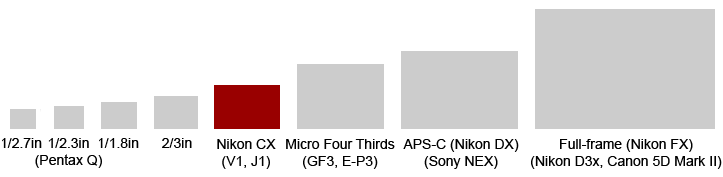
Nikon V1 sensorThe Nikon V1 employs a 10 Megapixel ‘CX’ format sensor, which measures 13.2×8.8mm and applies a 2.7x field-reduction to all lenses. This is smaller than the 17.3x13mm and 2x reduction of Micro Four Thirds sensors, as used in Olympus and Panasonic ILCs, or the 23.4×15.6mm and 1.5x reduction of APS-C sensors as used in Sony NEX ILCs and most DSLRs, including Nikon’s own DX format models. Note the sensor in the V1 is identical to that in the J1, although in the former it can be exposed with a mechanical shutter and better combat dust with a vibrating filter. You can choose between three image sizes in the Still Image and Smart Photo Selector modes (3872×2592, 2896×1944 or 1936×1296), and apply Fine, Normal or Basic JPEG compression. 12-bit RAW files in Nikon’s NEF format can be recorded by themselves or accompanied by a Large Fine JPEG. Best quality Large Fine JPEGs measure around 5MB each, while RAW NEF files weigh-in at around 10MB each. Like Nikon’s other consumer DSLRs, there’s only basic software supplied for converting RAW files – you’ll need to invest in Capture NX 2 or third party software to perform more sophisticated processing. Unlike Nikon’s latest DSLRs, there’s no option to process RAW files in playback – or indeed apply much at all in playback beyond D-Lighting or cropping. The native aspect ratio of the CX-format sensor is 3:2, just like a traditional DSLR or Sony’s NEX models. Interestingly there’s no option to manually adjust the aspect ratio of stills on the V1, although if you capture photos in the Motion Snapshot or Movie modes, they’ll automatically be cropped to 16:9. The sensitivity ranges from 100 to 3200 ISO with a Hi1 option equivalent to 6400 ISO. Three Auto ISO options operate in a range of 100-400 ISO, 100-800 ISO and 100-3200 ISO. Long Exposure and High ISO Noise Reduction can be switched on or off, the former applying to shutter speeds longer than one second. Many of the image processing options are inherited wholesale from Nikon’s DSLRs. The V1 and J1 share the same six Picture Controls as the D5100 and D3100, with the same degree of adjustment too. The Standard, Neutral and Vivid, Portrait and Landscape Picture Controls all offer adjustment of Sharpening (0-9), Contrast (+/-3), Brightness (+/-1), Saturation (+/-3) and Hue (+/-3), while the Monochrome Picture Style swaps Saturation and Hue for nine Toning and four Filter Effects, the former fine-tunable by seven values. If Active D-Lighting is enabled, it takes over the Contrast and Brightness settings, and if you’re in a real hurry, a Quick Adjust option can boost or lessen a group of settings in one go. White Balance can be set to Auto, Incandescent, Fluorescent, Direct Sunlight, Flash, Cloudy, Shade or a custom preset. There’s no manual entry of colour temperature here, nor the seven Fluorescent sub-categories of many Nikon DSLRs, but each of the standard presets can be adjusted on a grid. Like exposures though, there’s sadly no bracketing of any description on the Nikon 1. As mentioned earlier, one of the stranger omissions from the V1 and J1 is the absence of any special effects whether applied at the time of capture or even during playback. Especially odd since they’d appeal to much of the Nikon 1’s target market, not to mention the fact Nikon made a big deal about introducing live effects on the earlier D5100. So any sepia, grainy black and white or miniature effects will have to be applied in third-party software later. There’s also no built-in HDR or multi-frame noise reduction, which is a daft omission given the fast shooting and processing speed of the Nikon 1. While Nikon’s CX format is comfortably smaller than Micro Four Thirds and APS-C, it is larger than the sensors employed by typical point and shoot cameras. These tend to employ sensors described as being 1/2.7in or 1/1.8in, which measure 5.37×4.04mm or 7.18×5.32mm respectively. There’s also the 2/3in sensor size, measuring 8.8×6.6mm but rarely used in point-and-shoots anymore. Finally there’s the 1/2.3in size, recently adopted by Pentax for its Q system, which measures 6.16×4.62mm and applies a 5.53x field reduction to lenses. You can clearly compare each sensor size in my scale diagram below.
Nikon’s strategy is two-fold: it doesn’t want to jeopardise sales of its DX-format DSLRs, which employ APS-C sized sensors, and it’s also spotted a gap in the market between these and traditional point-and-shoot sensors. In these respects it’s a sound strategy, but those who equate sensor size to quality have understandably been disappointed by Nikon’s decision. It’s also important for Nikon to realise it’s not operating in a vacuum. By adopting a smaller sensor for its ILC range, Nikon might avoid cannibalising its DSLR sales, but that’s not stopping the competition from doing so. Just look at Sony which makes DSLRs, ILCs and even SLTs, all using APS-C sensors. Sony understands each type of camera may jeopardise sales of another, but doesn’t care so long as those sales stay within the company. Nikon’s decision, for better or worse, will mean that anyone who wants an ILC with a big sensor will look elsewhere.
It’s also worth looking into that 2.7x field reduction for a moment. This would seem to benefit telephoto work, as a relatively small focal length on a CX-format body could deliver a large effective focal length in practice. But make a 10 Megapixel crop from the middle of a high resolution APS-C sensor, such as the 24 Megapixel Sony NEX-7, and it too will deliver a magnified view with a modest lens. And while 24 Megapixels packed into an APS-C sensor may sound like a lot, the density is actually less than the 10 Megapixels in the CX format: you’re looking at photo-site areas of 11.5 and 15.2 square micrometers respectively, which gives the Sony NEX-7 around 50% greater light-gathering area per pixel, implying higher sensitivity. Food for thought. But all of this is assuming a camera should be evaluated on sensor performance alone. If this were the case, then a larger format will undoubtedly beat the V1 and J1 on resolution and noise, as indeed confirmed by my results pages. But hopefully it should be apparent by now the Nikon 1 cameras are very special in terms of continuous shooting, autofocus and video, boasting unique advantages over rival models, and in some cases offering a taste of pro sports DSLR performance in a small and affordable form factor. I’ll be discussing all this on the verdict page, and you’re welcome to head straight over there if you like by clicking the tab below, but if you’re interested in seeing how the image quality measures-up, check out my Nikon V1 quality, Nikon V1 RAW vs JPEG and Nikon V1 noise results pages; I also have a selection of full resolution images for you to download in my Nikon V1 sample images gallery. Or if you’ve seen enough proceed directly to my Nikon V1 verdict! | ||||||||||||||||||||||||||||||||||||||||||||||||||||||||||||||||||||||||||||||||||||||||||||||||||||||||||||||||||||||||||||||||||||||||||||||||||||||||||||||||||||||||||||||||||||||||||||||||||||||||||||||||||||||||||||||||||||||||||||||||||||||||||||||||||||||||||||||||||||||||||||||||||||||||||||||||||||||||||||||||||||||||||||||||||||||||||||||||||||||||||||||||||||||||||||||