Nikkor AF-S DX 35mm f/1.8G
-
-
Written by Gordon Laing
The Nikkor DX 35mm f/1.8G is a standard prime lens designed for use on Nikon’s range of DX format DSLRs. Announced in February 2009, this low cost model is primarily aimed at owners of Nikon’s budget and mid-range DSLRs, such as the D40(x), D60, D3000, D5000 and D90, but will equally work on any DX body including semi-pro models like the D300(s). Like other DX-format lenses, it’s only corrected for use on the smaller sensors employed by DX-format bodies. So while you can mount it on a full-frame FX format body, it’ll only be corrected up to the edges of the cropped DX area.
Mounted on a DX format body, it delivers an equivalent focal length of 52.5mm, which is considered ‘standard’ coverage in photographic terms. This avoids the distortion of wide angle lenses and the flattened perspective of telephoto models to deliver a natural view which roughly matches the magnification (albeit not the coverage) of human vision. So this focal length may be fixed, but at arguably the most useful point for general-purpose photography. Lest we forget, not so long ago, the vast majority of 35mm film SLRs were equipped with 50mm lenses as standard, so by delivering essentially the same coverage, the Nikkor DX 35mm f/1.8G respectfully harks back to a time when many photographers needed nothing else.
Of course today, most of the target audience already own a zoom lens which includes the 35mm focal length, but there’s many compelling reasons to complement it with this fixed focal length model. The Nikkor DX 35mm f/1.8G is smaller and lighter than any Nikkor zoom lens, gathers over four times more light than a kit zoom at the same focal length, and has the potential to deliver superior image quality too. Not only that, the lens will autofocus on any Nikon DX body and it’s also very affordable, costing less than almost any other lens in the Nikon catalogue. In our full review of the Nikkor DX 35mm f/1.8G we’ll directly compare its build and image quality against three popular Nikkor zooms to see exactly what it offers to typical owners of DX-format DSLRs.
The Nikkor DX 35mm f/1.8G is pictured below on the left, alongside three popular DX-format zooms: from left to right are the DX 35mm f/1.8G, DX 16-85mm VR, DX 18-105mm VR and DX 18-200mm VR II. All the zooms are set to their widest focal lengths where their barrels are shortest, with each extending by at least 1cm when set to 35mm.
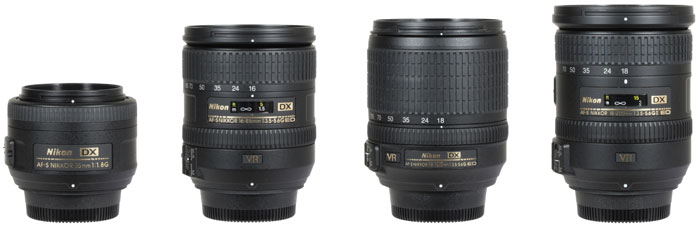 |
It’s clear from the photo just how much smaller the DX 35mm f/1.8G is than the zooms; measuring just 70mm in diameter by 53mm in length, it’s comfortably more compact than even the DX 18-55mm VR zoom (not pictured).
 | |
|---|---|
What you can’t judge from the photos though is the weight of the lens, which at just 200g feels feather-light. To put it in perspective, the already compact DX 18-55mm VR kit lens weighs 265g, while the DX 16-85mm VR, DX 18-105mm VR and DX 18-200mm VR II pictured above weigh-in at 485, 420 and 565g respectively. By only being corrected for the smaller DX frame, it’s also almost one third lighter than the Nikkor AF-S 50mm f1.4G.
Mount the DX 35mm f/1.8G on any DX format DSLR and you’ll have a much smaller, lighter and more portable combination than any zoom. We’ve pictured it here on a Nikon D90 body and it’s clear to see how the camera has been transformed into a much more compact proposition. The lens is also a perfect match in size and weight for Nikon’s range of budget DSLRs, and feels surprisingly good on the semi-pro range too. Suffice it to say the short length of the lens means the coverage of built-in flash units will easily clear it without any risk of shadows.
In terms of styling, the DX 35mm f/1.8G looks similar to the AF-S 50mm f/1.4G and recent DX format zooms, like the DX 16-85mm VR and DX 18-200mm VR II. Thanks to its much lighter weight though, the DX 35mm f/1.8G can’t help but feel less substantial and more plasticky, but its actual integrity and construction remains similar to the kit zooms.
|
The lens may be pitched and priced as a budget option, but features both a metallic mount and rubber ring providing some degree of environmental sealing – classy aspects you won’t find on kit lenses like the DX 18-55mm VR and DX 18-105mm VR.
The manual focusing ring is positioned at the end of the barrel, although in-line with the kit lenses mentioned above, there’s no window to indicate focusing distance. The manual focusing rings turns fairly smoothly, although you can feel the gearing behind the scenes a little more than kit models like the DX 18-105mm VR. As such it’s not in the same league as the silky smooth operation of Nikon’s top lenses, or even the AF-S 50mm f/1.4G, but it’s certainly sufficiently good for usable and accurate manual focusing.
There’s a single switch on the side of the barrel, setting the focusing to automatic with full-time manual override (M/A) or fully Manual (M). A narrower barrel section protrudes from the end of the main lens housing and features a 52mm filter thread and bayonet fitting for the supplied (but rather short) lens hood. This section does not rotate while focusing, which will be a relief for users of polarising or graduated filters. A pouch is also supplied. Canon, take note: here’s a budget lens which is supplied with both a pouch and a hood.
Nikkor DX 35mm f/1.8G optical design
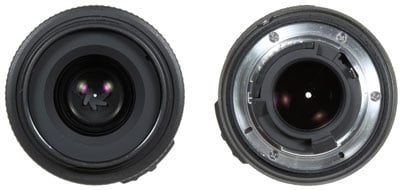 |
The Nikkor DX 35mm f/1.8G employs eight elements in six groups with one aspherical lens element. It has a closest focusing distance of 30cm and seven rounded aperture blades. The maximum focal ratio is f1.8, and the minimum is f22.
In comparison, the AF-S 50mm f/1.4G employs eight elements in seven groups, with nine rounded aperture blades and a closest focusing distance of 45cm. The combination of a longer focal length, slightly brighter focal ratio and more aperture blades allows the 50mm f/1.4G to deliver a shallower depth-of-field with more natural-looking bokeh, but that’s not to say the DX 35mm f/1.8G can’t produce nice out-of-focus effects. As you’ll see in our sample images gallery, it’s capable of taking a portrait against a blurred background more effectively than most kit zooms. So while it’s too short to be a classic head-and-shoulders portrait lens, it can still take good-looking people shots from the waist-up.
Like most shorter prime lenses, there’s no Vibration Reduction (VR) facilities for counteracting camera-shake. Instead the DX 35mm f/1.8G relies on its bright focal ratio to achieve faster shutter speeds. A focal ratio of f1.8 is roughly two and a half stops faster than the brightest f4.5 setting offered by most general-purpose zooms when set to the same 35mm focal length. So under the same lighting conditions and ISO sensitivity, the DX 35mm f/1.8G could employ shutter speeds roughly two and a half stops quicker than a typical zoom – for example at 1/60 when the zoom would be forced to use around 1/10.
Of course the Vibration Reduction facilities of most zooms would mean camera shake should be avoided at the 35mm focal length with a shutter speed of 1/10, but any subject in motion would become blurred. By gathering more light and using a faster shutter speed as a result, the DX 35mm f/1.8G is better-equipped to freeze a subject in motion.
Nikkor DX 35mm f/1.8G coverage
The Nikkor DX 35mm f/1.8G is designed for use on DX-format bodies, where the cropped sensor reduces the field-of-view by 1.5 times; this in turn delivers an effective focal length of 52.5mm, which as discussed above is considered standard in photographic terms. As such it avoids the distortion of wide-angle lenses and the flattened perspective of telephotos to deliver a natural-looking view which roughly matches the magnification (albeit not the coverage) of human vision.
Mounted on a DX-format body, it essentially matches the coverage of 50mm lenses fitted to classic 35mm film SLRs. These were used for general-purpose photography, capturing everything from landscapes to portraits and buildings to close-ups. It’s arguably the most flexible focal length, and the absence of a zoom encourages you to move around and explore a composition rather than standing still and twisting a ring.
To illustrate the coverage of the lens on a DX format body, we took photos from the same tripod-mounted position using both it and the Nikkor DX 18-105mm VR kit lens, the latter when fully zoomed-out and in. We’ve pictured the three shots below with the DX 35mm f/1.8G in the middle.
Nikkor DX 18-105mm VR Coverage at 18mm |
Nikkor DX 35mm f/1.8G Coverage at 35mm |
Nikkor DX 18-105mm VR Coverage at 105mm | ||
 |
 |
 | ||
DX 18-105mm VR at 18mm (27mm equivalent on DX format body) |
DX 35mm f/1.8G at 35mm (52.5mm equivalent on DX format body) |
DX 18-105mm VR at 105mm (157.5mm equivalent on DX format body) |
As you’d expect, it delivers approximately half the field of view of the zoom when the latter set to its widest position. You can see other examples of the lens in our sample images gallery, and full comparative analysis in our results pages.
Like other standard lenses, it’s too long for capturing big landscape views or cramped interiors and equally, too short for classic head-and-shoulder portrait shots. But by exploring different angles and distances, you can actually achieve a great deal with this lens. This won’t come as any surprise to anyone who owned a film SLR with a 50mm lens, but those who have become used to zoom lenses will find it surprisingly flexible over time.
A popular way to figure out if a fixed focal length lens will be useful to you is to check existing photos to see if you already commonly select the same length from a zoom. But even if most of your photos are taken at slightly wider or longer focal lengths, you could actually achieve a similar effect with this lens by simply moving closer or further away. Zoom lenses inevitably encourage you to stand rooted to the spot, relying on an adjustable focal length to achieve the desired coverage. In contrast a fixed lens will force you to move around and often find better angles as a result.
But while the DX 35mm f/1.8G is a great all-rounder, we wouldn’t recommend as your first choice if you’re looking for a classic portrait lens. The AF-S 50mm f/1.4G, Sigma 50mm f1.4 DC HSM or better still, one of Nikkor’s 85mm models, will deliver superior results, albeit at a much higher price. You can take portraits with the DX 35mm f/1.8, but to avoid distortion and unflattering results, you’ll want to get no closer than compositions which include the whole person from the waist-up- and even then you’ll need to be careful with the positioning on the frame.
Nikkor DX 35mm f/1.8G focusing
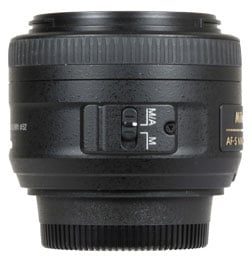 |
The Nikkor DX 35mm f/1.8G is an AF-S model, which in Nikon’s terminology means it’s equipped with a Silent Wave Motor (SWM) for autofocusing. Since the focusing motor is built-into the lens, it will autofocus on any of Nikon’s DSLRs, including the budget models which doen’t feature their own AF motor for driving older, non AF-S lenses.
AF-S lenses also have the potential to be quick and quiet, although be aware there’s a gulf in performance between a top-end AF-S lens and a budget one. But while the DX 35mm f/1.8 doesn’t focus as quickly or quietly as one of the premium Nikkor lenses, we never found it particularly slow or noisy in use.
The bright focal ratio ensures the DSLR almost always has sufficient light to make a swift focusing calculation without searching back and forth – so even though the lens doesn’t have the fastest AF motor, the fact most bodies will get it to snap onto the subject first-time means you’ll find it quite responsive in use. It’s certainly refreshing to find it focusing in low light when many typical zooms struggle.