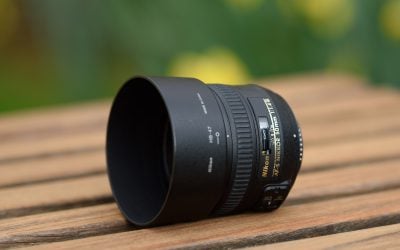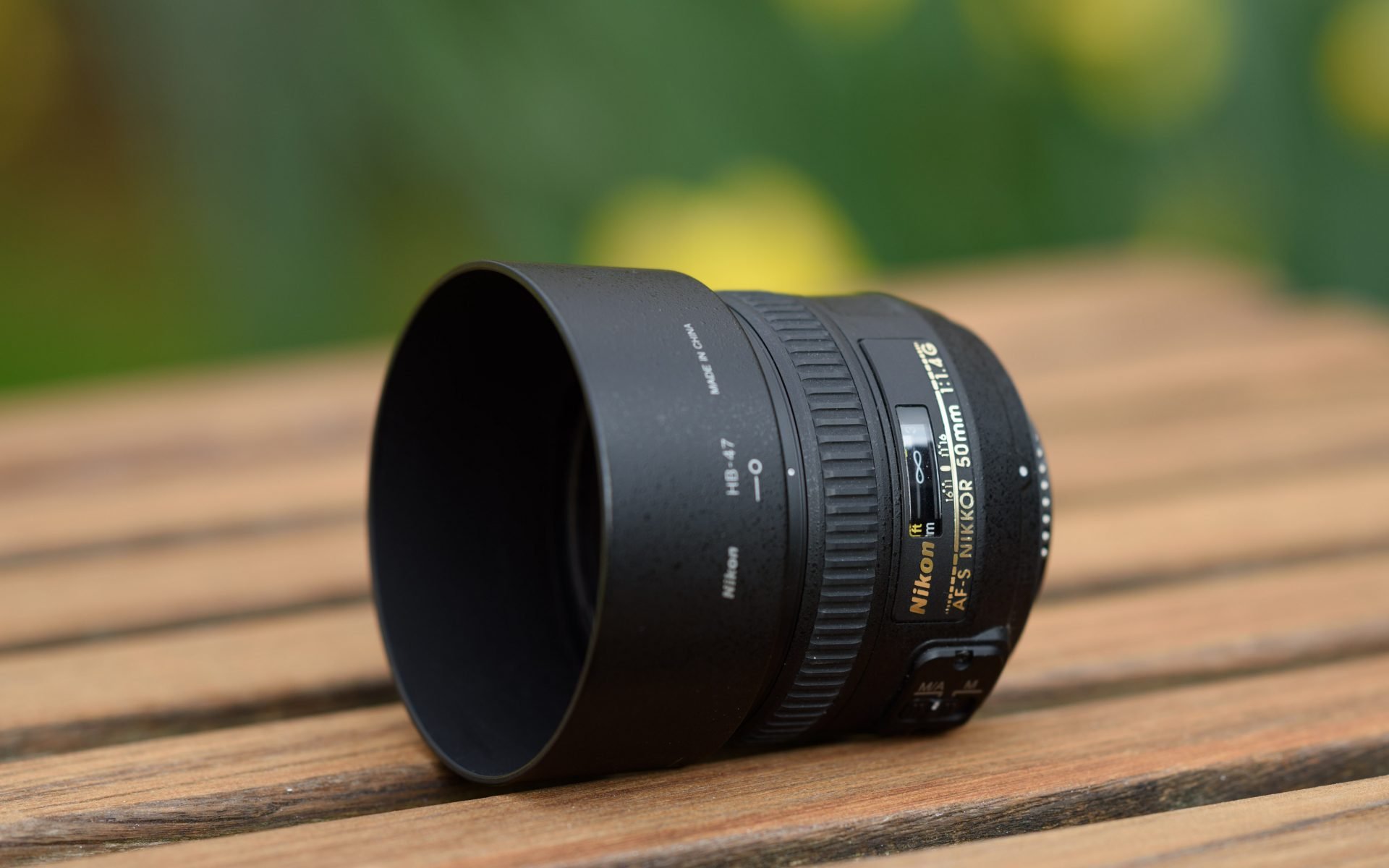
 The Nikon AF-S 50mm f1.4G shows a very appealing optical performance that alone would earn it a Recommended. But factoring in its small size, light weight, weather sealing and price/performance ratio I'd upgrade this lens to Highly Recommended! Good points: The most affordable f1.4 prime from Nikon; great image quality on DX and FX bodies; quiet and reliable AF operation; small and light; weather sealing at the lens-mount. Bad points: Longitudinal CA can be outright nasty; coma shows in high-contrast situations; some nervousness in background Bokeh; no image stabilization.
Nikon 50mm f1.4G review
-
-
Written by Thomas
Intro
The Nikkor AF-S 50mm f1.4G was announced in September 2008 as the company’s flagship standard prime lens. It shares the same bright f1.4 aperture and standard focal length as the much older AF 50mm f1.4D, but features an SWM focusing motor, which means it’ll autofocus quickly and quietly on all Nikon DSLRs, including the D3x00 and D5x00 bodies. Since then Nikon has expanded its line-up of standard lenses with the more affordable AF-S 50mm f1.8G and the gold-ringed pro-class AF-S 58mm f1.4G.
The original 50mm f1.4G is compatible with full-frame models like the D6x0/700/D800 and D3/D4, on which it’ll deliver standard coverage. Mounted on a DX-format body like the D3x00, D5x00 or D7x00, its field is reduced by 1.5 times to deliver an equivalent of 75mm, which is a perfect short-telephoto length for portraits. The fast maximum aperture of f1.4 is also ideal for achieving shallow depth-of-field effects and working in low light. To put this in perspective, an f1.4 lens will gather 16 times more light than one at f5.6, such as the standard Nikkor DX 18-55mm kit lens when zoomed-in. In my Nikon 50mm f1.4G review I’ll present my findings from testing this lens on a 36 Megapixel Nikon D800.
Facts from the catalog
As usual I’ll have a look at the technical data first. I’ve rated the features with a [+] (or [++]), when it’s better than average or even state of the art, a [0] if it’s standard or just average, and [-] if there’s a disadvantage.
 |
Most features are compared to Sigma’s 50/1.4 EX DG HSM.
Size (diam. x length): 74 x 54 mm (2.9 x 2.1 in.). Smaller than the Sigma at 85 x 68 mm. [+]
Weight: 280 g (9.9 oz). 225g lighter than the Sigma. [+]
Optics: 8 elements in 7 groups. This is about standard for “normal” lenses. The Sigma has 8 elements in 6 groups. [0]
Closest focus distance/max. magnification: 45cm (1.5 ft.) / 1:6.5. The Sigma offers 45 cm / 1:7.4. [0]
Filter-thread: 58mm, much smaller than the 77mm standard of many pro-lenses. So filters are cheaper, but chances are you need to buy new ones unless you already own 58mm filters. The Sigma takes 77mm filters. [0]
Image stabilization: No, same as any other fixed focal large aperture lens from Nikon or third parties below 200mm focal length. [0]
AF: AF-S with SWM (silent wave motor), so it does work on Nikon D3x00/5×00-bodies. Manual-focus override by simply turning the focus ring. [+]
Covers full frame/FX or smaller = very good [+]
Price: around 330 EUR new (incl. 19% VAT). This is the cheapest 50/1.4 lens you can buy for a Nikon body if you discount the old AF 50/1.4D. The Sigma is around 400 EUR. [+]
Comes with a flexible lens pouch (no padding, no strap), the lens-shade is included, reversible for transport, and the lens-caps are standard Nikon’s. [0]
Distance information is relayed to the camera, so the Nikon body (and CLS flash-system) can do all the advanced exposure-related stuff with this lens. [+]
Aperture ring: No, just like all competitors with AF. [0]
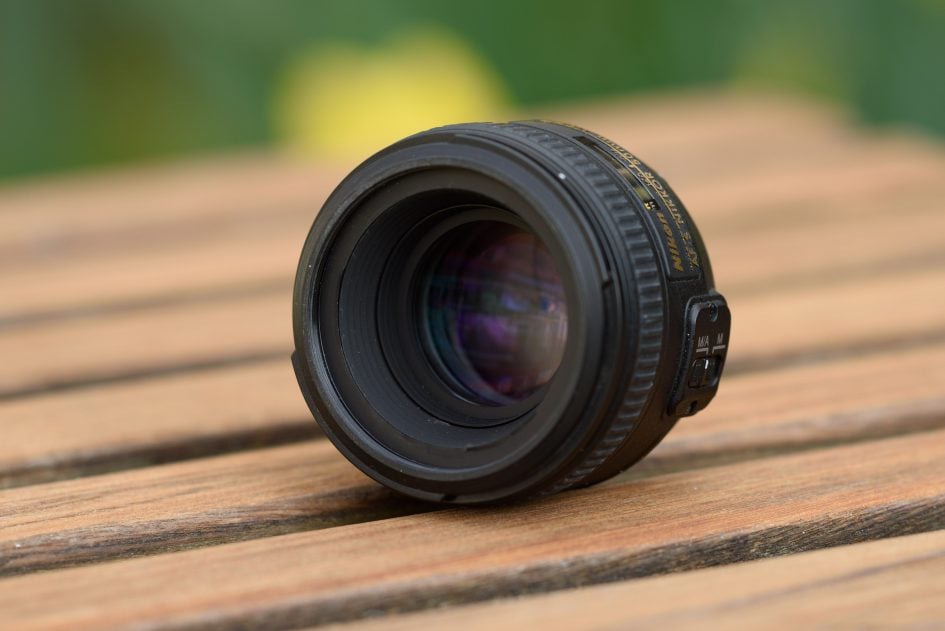
Sealing: Yes. The standard Nikkor rubber grommet at the lens-mount – but no further weather-sealing. [0]
The score in the “features-department” is 0[-]/7[0]/6[+]. On paper the lens looks pretty good including its low price. So if the performance turns out to be convincing this lens could be a winner.
Motivation
The 50mm focal length is considered a “normal”-lens on a full-frame camera-body. Lenses are called “normal” when their focal length is close to the diagonal of the sensor (43mm for a FX-sensor). These lenses produce a life-like perspective and natural look when the images are also viewed from a distance that is equivalent to the diagonal of the print/monitor. But mind you: it is not long enough for a flattering perspective in tight head-shots on an FX body. Framing a 60 x 40 cm portrait requires you to go as close as 0.8m which is generally considered too close. For that type of shot you better get a 85mm lens for your FX body. Of course when you mount it on a DX body it delivers a much more portrait-friendly 75mm equivalent.
50mm is also the focal length that lets you get the much coveted f1.4 aperture for a full-frame body with auto-focus at a much lower price than at other focal lengths like 35mm or 85mm. So if you chose only one f1.4 lens for your work this is the affordable alternative. And at f1.4 the lens gives you two-thirds of a stop more light-gathering power than comparable f1.8 lenses and produces a larger blur-circle all of which comes in handy if you’re shooting under low(er) light or try to better isolate your subject from the background.
Alternatives
– Sigma’s AF 50/1.4 EX DG HSM is around 400 EUR. It earned a recommendation in my Sigma 50mm f1.4 review. There’s also Nikon’s old AF 50/1.4D still on offer and it’s the cheapest of the bunch. But from what I’ve seen in other reviews the 50/1.4G seems the better choice.
– Then there are other alternatives if you can do with manually focusing the lens. But as the dof at f1.4 is pretty shallow make sure that your focusing capabilities are up to that challenge! If so you can choose from the Zeiss ZF.2 Planar T* 50/1.4 at 600 EUR and the Voigtlander SL II Nokton 58/1.4 at 500 EUR. Both lenses perform very well in the image center according to reviews but the Zeiss seems very soft in the FX-corners and the Voigtlander produces a nervous Bokeh.
– Looking even further up-market there’s Nikon’s more recent AF-S 58/1.4G at around 1700 EUR (it earned a recommendation in my Nikon 58mm f1.4G review), plus Sigma’s newly announced and completely redesigned 50mm F1.4 DG HSM “Art” (more information in our Sigma 50mm f1.4 Art discussion in the Camera Labs forum) but neither a price nor an expected delivery date was set at the time of writing. And finally there’s the new Zeiss ZF.2 Otus 55/1.4. It has no auto-focus but at a price of 3500 EUR and over 900g weight plus a completely different optical design than other “normal” lenses it sets a new benchmark on optical performance in this group. See my Zeiss Otus 55mm f1.4 review.
Focus and build quality
Focus accuracy and repeatability is critical to consistently produce sharp shots, especially with large aperture primes. Repeatability (the accuracy of focus on the same subject after repeated focus-acquisition) of this lens is very good with only very slight variations and no real outlier over a series of 40 shots. And the lens focuses in around 0.7 sec from infinity to 60 cm, which is OK. The Sigma 50/1.4 does this in 0.5 sec.
The focus ring has no slack/play between its movement and the focus-action and a throw of around 190 degrees, which is very convenient for accurate manual focus wide open (the Sigma 50/1.4 turns only 90 degrees). The focus ring is a bit small with a 0.9 cm wide profiled rubber surface but it is still easy enough to grip and moves smoothly. AF-operation is pretty quiet from the outside. If you record video with the built-in microphone focus-movement starts and stops with the typical “clack” but the AF-drive itself is not too annoying. Focus breathing is visible: things in the background become larger the closer you focus. But I’d rate the effect pretty harmless.
The lens needed some micro AF adjustment for optimal AF on my D300. The adjustment varied with the distance from the subject: Close-up to the test-chart at 60cm the optimum Micro AF-adjustment was -15, but at 1m it was -5, and finally at 1.8m it was around zero. This also turned out to be the optimum (non-)adjustment for further-away subjects, such as those at 20m. The need for micro AF adjustment typically depends on the body(-type). So be aware that this lens (and other large aperture primes) may need different adjustments depending on shooting distance. Go for the adjustment which best matches your typical shooting distance with this lens.
Focusing in very low-light with this lens can be pretty amazing: I was able to nail focus under conditions that required 2 sec exposures at f1.4 and 200 ISO on a D300. This is pretty dark, and the focus didn’t even hunt or stutter.
The lens has a weather sealed metal lens-mount and nine rounded aperture blades. The outer barrel is plastic. It’s pretty easy to produce kinks in the front-disk directly behind the filter-thread by simply re-attaching the lens-cap without caution. But this is only cosmetic and does not influence the optical performance.
Now it’s time to check out some results in my Nikon 50mm f1.4 quality and Nikon 50mm f1.4 sample images pages!