Support Cameralabs by shopping at our partner stores or donating via Paypal
 

Follow me!
Camera Labs RSS Feed
Gordon Laing and Cameralabs on Google+
Camera Labs on Facebook
Camera Labs on Twitter

 
  Latest camera reviews

Olympus E-PM1
Nikon V1
Sony NEX-5N
Canon 100HS / 115HS
Canon 300HS / 220HS
Canon S100
GoPro HD Hero 2
Canon 510HS / 1100HS
Canon 310HS / 230HS
Canon SX150 IS
Olympus E-PL3
Canon SX40 HS
Sony NEX-C3
Panasonic GF3
Fujifilm HS20 EXR
Panasonic FZ150
Olympus E-P3
Panasonic FZ47 / FZ48
Nikon COOLPIX S9100
Sony Cyber-shot HX100V
Sony Cyber-shot HX9V
Panasonic FX77 / FX78
Canon SX230 HS
Canon EOS T3 / 1100D
Panasonic Lumix G3
Sony Cyber-shot TX10
Canon 500HS / 310HS
Nikon D5100
Sony Cyber-shot W510
Nikon COOLPIX L24
Canon PowerShot A1200
Panasonic FS18 / FH5
Canon PowerShot A800
Panasonic TZ18 / ZS8
Canon PowerShot A3300IS
Canon EOS 600D / T3i
Panasonic TZ20 / ZS10
Canon IXUS 1000/SD4500
Sony Alpha SLT-A33
Panasonic Lumix GH2
Nikon D7000
Canon PowerShot G12
Canon PowerShot S95
Panasonic Lumix LX5
Nikon D3100
Canon EOS 60D
Canon EOS 550D / T2i
Canon EOS 7D
Nikon D300s
Canon EOS 5D Mark II
Nikon D90

All reviews ....


  Best Buys: our top models
   
  Best Canon lens
Best Nikkor lens
Best Sony lens
Best budget DSLR
Best mid-range DSLR
Best semi-pro DSLR
Best point and shoot
Best superzoom
Best camera accessories


Camera Labs Forum

Any questions, comments or a great tip to share? Join our Forum and let everyone know.
   
 
  DSLR Tips


lens rental
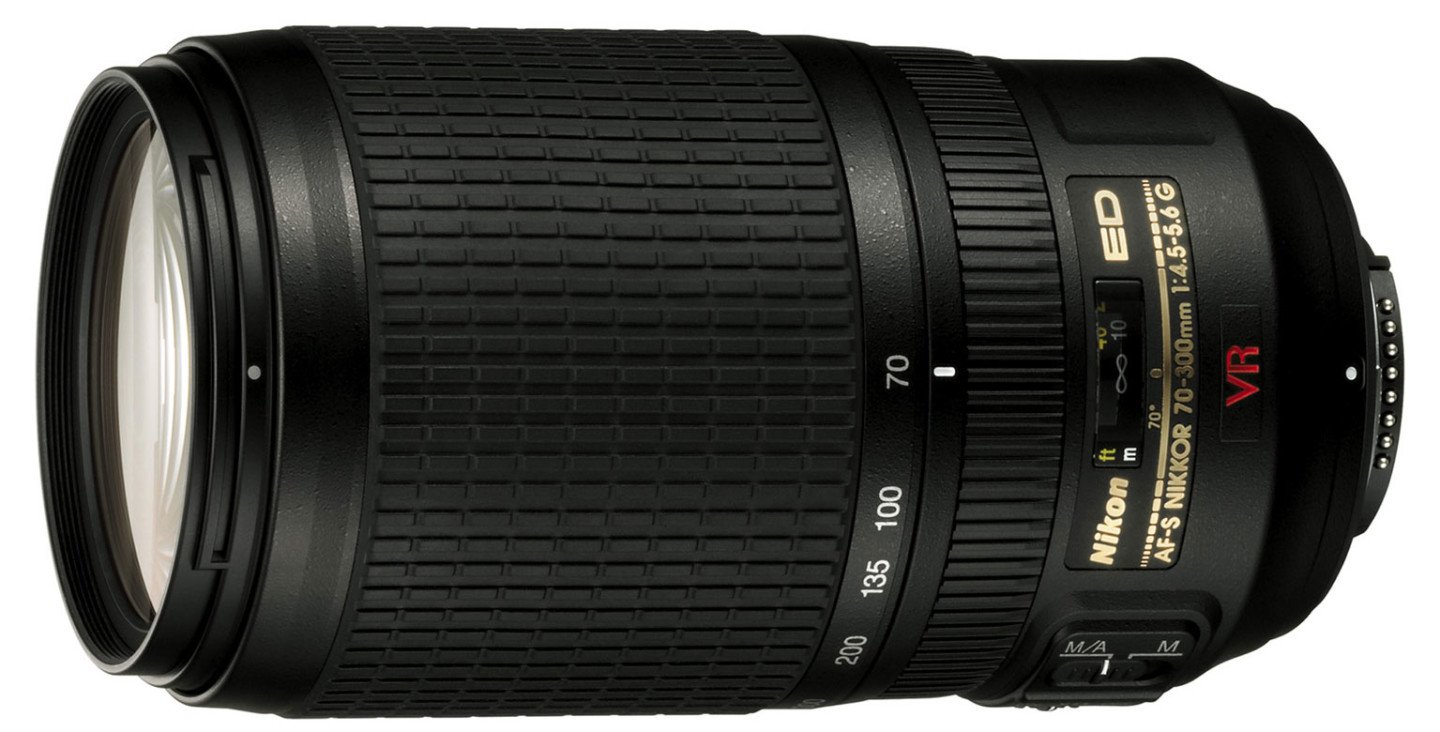
Nikkor AF-S VR 70-300mm f/4.5-5.6 G IF-ED Gordon Laing, September 2007
 
Nikkor 70-300mm VR coverage, zoomed-out

The Nikkor 70-300mm VR is an up-market telephoto zoom designed to perfectly complement the range of the DX 18-70mm kit lens. It literally starts where the other stops, giving you a total range of 18-300mm on a full-frame film or digital body – or an equivalent of 27-450mm on a DX-format body like the D80.

Most people thinking of buying the 70-300mm VR will be weighing it up against the cheaper DX 55-200mm VR model, so to compare their coverage in practice, we mounted a Nikon D80 on a tripod and took photos with each lens from the same spot, when fully zoomed-out and fully zoomed-in.

Below are examples of both lenses zoomed-out to 70 and 55mm respectively and you can see how the DX 55-200mm VR captures a slightly bigger field of view. If you already have the DX 18-55mm kit lens and are thinking of going for the 70-300mm VR though, you certainly won’t miss much between 55 and 70mm, so having an uninterrupted range shouldn’t sway your opinion too much.

 
Nikkor DX 70-300mm VR with D80
Nikkor DX 55-200mm VR with D80
Nikkor DX 55-200mm at 55mm f8
70-300mm at 70mm f8 (105mm equivalent)   55-200mm at 55mm, f8 (83mm equivalent)

Nikkor 70-300mm VR coverage, zoomed-in

Below are examples of each lens zoomed-into their longest focal lengths and the difference is clearly much greater. The 70-300mm VR with a maximum equivalent of 450mm clearly allows much tighter crops than the DX 55-200mm can at an equivalent of 300mm. This extra reach makes a big difference if you’re into photographing small or distant subjects, such as wildlife or sports, and can really isolate people (or indeed anything else) against their backgrounds in portraits.

Nikkor DX 70-300mm VR with D80
Nikkor DX 55-200mm VR with D80
Nikkor DX 55-200mm VR at 200mm f8
70-300mm at 300mm f8 (450mm equivalent)   55-200mm at 200mm, f8 (300mm equivalent)

So ultimately you have to ask yourself how powerful would you’d like your telephoto zoom to be. The DX 55-200mm VR will certainly give you respectable telephoto coverage, but if you’re after something longer, then you’ll need to spend more on a model which zooms to 300mm or even beyond. We tested the 70-300mm VR at the same time as the DX 55-200mm VR, so have several examples identical subjects taken with each – so to see how they compare when fully zoomed-in, check out our 70-300mm VR sample images and DX 55-200mm VR sample images. Stick around here for a moment though to see how the 70-300mm VR’s anti-shake facilities measure-up.


Nikkor 70-300mm VR anti-shake

The Nikkor 70-300mm VR is equipped with Vibration Reduction to counteract camera-shake. It’s an optical system, which means you see the benefit through the viewfinder, and like Canon’s IS system, it’s very reassuring to see your composition steady itself as you half-press the shutter release. It also makes framing the shot at the 70-300mm VR’s longer focal lengths much easier, especially with the additional field-reduction of a DX-format body.

 
Nikkor 70-300mm VR controls
 
Support this site by
shopping below


Unlike the simple on / off switch of the DX 55-200mm VR, the 70-300mm VR features a pair of switches related to Vibration Reduction. Along with the VR on / off switch is one to change the VR mode between Active and Normal. Quoting Nikon directly, Normal Mode reduces camera shake in handheld shooting, detecting panning automatically. Active Mode can compensate for vibration when shooting from, say, a moving vehicle.

Nikon claims up to four stops of compensation for the 70-300mm VR – a whole extra stop beyond the DX 55-200mm VR – and to put it to the test we took a series of photos of a distant house zoomed-into 300mm with and without VR enabled. We mounted the lens on a D80 body, so were working at an effective focal length of 450mm. Conventional photographic advice would recommend a shutter speed of at least 1/450 without VR to ensure an absence of camera-shake. So we started each series of shots at a shutter speed of 1/500 and progressively reduced it until 1/8.

Without VR, we required a shutter speed of at least 1/400 for a perfectly steady result, whereas with VR (in Normal mode) we achieved the same result at shutter speeds as slow as 1/25. This corresponds to four stops of compensation, confirming Nikon’s claims and also the effectiveness of the system in practice.

Nikkor 70-300mm VR without VR
Nikkor 70-300mm VR with VR
Nikkor 70-300mm VR without VR
Nikkor 70-300mm VR with VR
Nikkor 70-300mm at 300mm (450mm equivalent using D80), VR disabled.
50% crop, 100 ISO, 1/25th second
  Nikkor 70-300mm at 300mm (450mm equivalent using D80), VR enabled.
50% crop, 100 ISO, 1/25th second


Left are examples of shots taken with and without VR at 1/25, reproduced here at 50%. They immediately reveal the kind of benefit you’ll enjoy, although like all anti-shake systems it will only stabilise a subject that’s static; if you want to freeze a subject in motion, you’ll simply need a faster shutter speed.


If you found this review useful, please support us by shopping below!
All words, images, videos and layout, copyright 2005-2012 Gordon Laing. May not be used without permission.

/ How we test / Best Cameras / Advertising / Camera reviews / Supporting Camera Labs