Support Camera Labs by price checking using the flags below


or by shopping via our affiliate stores
- thanks!

RSS Feed Camera Labs RSS Feed


Latest camera reviews

Nikon D90
Panasonic Lumix LX3
Canon EOS 1000D / XS
Nikon D700

Pentax K200D
Olympus E-520
Panasonic Lumix FX500

Olympus E-420
Pentax K20D
Canon EOS 450D / XSi
Sony Alpha A350

Panasonic Lumix TZ5

Nikon D60
Sony Alpha A200
Nikon D300
Canon EOS 40D

All reviews ....
   
 
  Latest DSLRs


Canon
Olympus
Pentax
Nikon
Panasonic
Sony
     
 
  Best Buys: our top models


Compacts / Super-zooms
Budget DSLRs / Semi-pro / Lenses


Camera Labs Forum

Any questions, comments or a great tip to share? Join our Forum and let everyone know.
   
 
  DSLR Tips


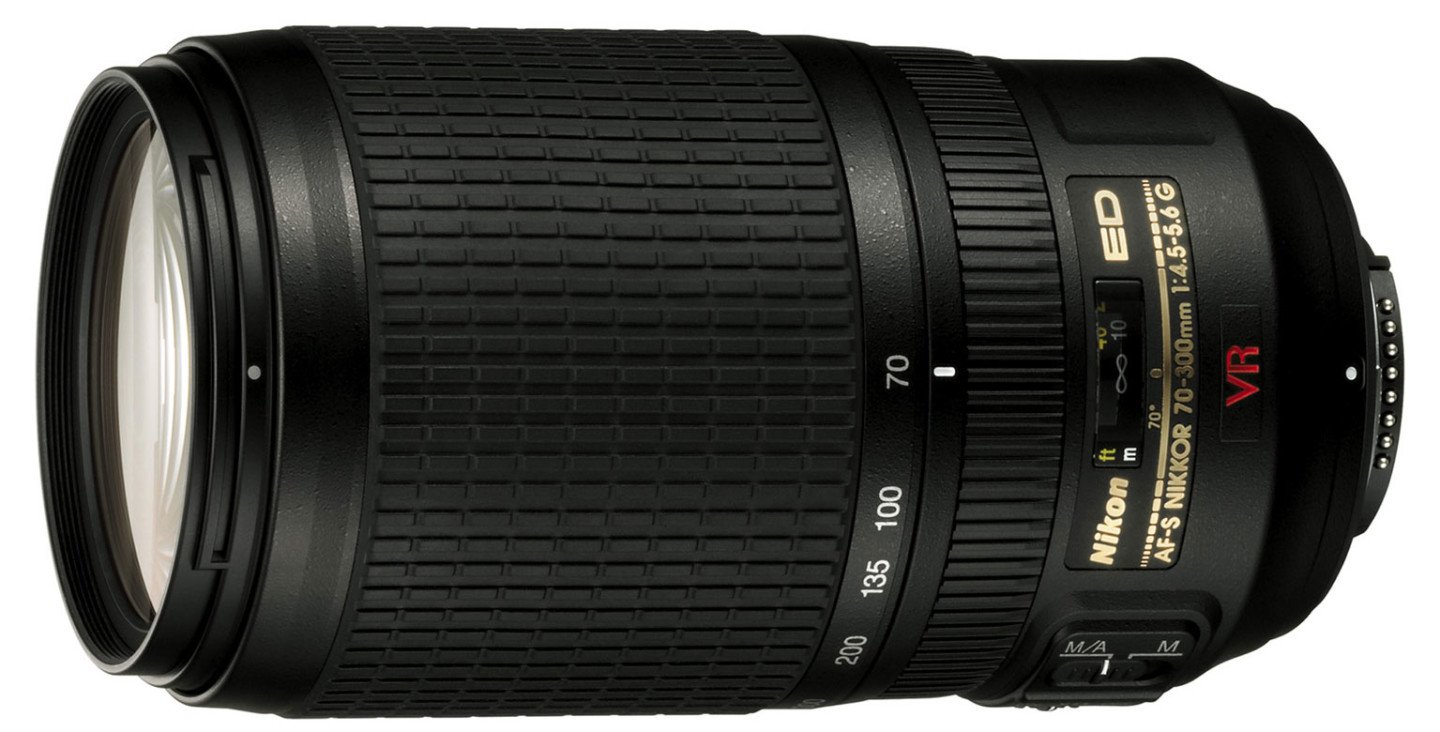
Nikkor AF-S VR 70-300mm f/4.5-5.6 G IF-ED Gordon Laing, September 2007
 
Nikkor 70-300mm VR design and build quality

The Nikkor DX 18-135mm, DX 55-200mm VR and 70-300mm VR lenses are pictured below, from left to right, zoomed-out to their shortest focal lengths. For each lens, this represents their physically most compact configuration.

Support this site by price checking below

Nikkor DX 55-200mm VR

Nikkor 18-200mm VR

from left: Nikkor DX 18-135mm, DX 55-200mm VR and 70-300mm VR lenses - zoomed out


Measuring 80mm in diameter and 144mm in length when zoomed-out, the 70-300mm VR is clearly by far the biggest of the three lenses pictured here, It’s wider and almost half as long again as either the DX 18-135mm or DX 55-200mm VR lenses when all are zoomed-out, and this makes a big difference when carrying it around.

Zoom each lens into their longest focal lengths, as seen below, and they grow in length by between 35 and 59mm. Interestingly it’s the DX 18-135mm which extends the most, but by adding 49mm to its length, the 70-300mm VR remains by far the biggest lens here.


from left: Nikkor DX 18-135mm, DX 55-200mm VR and 70-300mm VR lenses - zoomed in


In terms of weight, you won’t be surprised to learn the 70-300mm VR is also the heaviest of the group here, weighing in at 745g. This is almost exactly twice the weight of the DX 18-135mm kit lens and over twice the weight of the DX 55-200mm VR, which at just 335g, feels remarkably light. It’s also comfortably heavier than the 560g of the DX 18-200mm VR.

Held in isolation the 70-300mm VR doesn’t feel particularly heavy – instead you get the impression of a product that’s confident and well-built. But there’s no denying if you compare it directly against one of the other lenses mentioned, you’ll realise immediately there’s a huge difference in practice. If weight is an issue and you want a lighter telephoto lens to carry around, you’ll be better off getting the DX 55-200mm VR.

That said, the build quality of the 70-300mm VR is far superior to the DX 55-200mm VR. If we’re comparing both models against general-purpose lenses, the 70-300mm VR’s design and build quality is roughly equivalent to the DX 18-70mm, whereas the DX 55-200mm VR is closer to the DX 18-55mm.

The 70-300mm VR also features a metal lens mount and a proper manual focusing ring with a window showing distance marks. We’re also pleased to report the 70-300mm VR comes supplied with a lens hood and pouch. It is without a doubt far classier than the DX 55-200mm VR, but the price is a larger, heavier and more costly lens. The bigger lens also means a bigger filter thread of 67mm – the same as the DX 18-200mm VR, compared to the 52mm thread of the DX 55-200mm VR.

One final design note: the large zoom ring of the 70-300mm VR is relatively stiff in operation. It’s sufficiently loose for it not to catch during fine adjustments though and does have the benefit of eliminating creep where the barrel can fall up or down under its own weight.

Nikkor 70-300mm VR optical design

The Nikkor 70-300mm VR employs 17 elements in 12 groups and features a nine-blade aperture diaphragm. Compare this to the 15 elements in 11 groups and seven-blade diaphragm of the cheaper DX 55-200mm VR. The nine-blade diaphragm of the 70-300mm VR arguably produces more attractive bokeh effects than the DX 55-200mm VR, although you can judge for yourself in our Galleries of each lens: see our 70-300mm VR sample images and DX 55-200mm VR sample images.

Interestingly though, the budget DX 55-200mm VR has a slight edge when it comes its maximum aperture of f4 when zoomed-out, although it is at a shorter focal length. The 70-300mm VR has a maximum aperture of f4.5 at 70mm and f5.6 at 300mm.

Nikkor 70-300mm VR focusing

Nikkor 70-300mm VR manual focusing
 

In terms of focusing, the 70-300mm VR is equipped with one of Nikkor’s SWM Silent Wave Motors, built into the lens itself. This makes it an AF-S model, and as such will auto-focus on the D40 and D40x, along with every other Nikon SLR, film or digital.

The 70-300mm VR takes just under one second to focus from one extreme to the other when fully-zoomed-in, which makes it fractionally quicker than the budget DX 55-200mm VR. Like the cheaper model, the focusing also takes place internally, so the barrel neither extends nor rotates during focusing – great news for users of polarising filters. You can see and hear an example of this in our Nikkor 70-300mm VR video tour.

Unlike its budget counterpart though, the 70-300mm VR features a proper manual focusing ring (and a window with distance markings), along with full-time manual focusing which allows you to make fine adjustments without having to disengage the mechanism. This makes manual focusing much quicker, easier and more usable than the DX 55-200mm VR, so if you’ll be using this feature regularly, you know which model to go for.


Support this site by checking prices below or shopping via our affiliate stores


USA readers


UK readers
Jessops discount voucher


All words, images, videos and layout, copyright 2005-2008 Gordon Laing. May not be used without permission.

About Us / How we test / Best Buys / Home