Support Camera Labs by price checking using the flags below


Follow us!
Camera Labs RSS Feed
Camera Labs on Facebook
Camera Labs on Twitter


Latest camera reviews

Sony Cybershot DSC-W220
Canon PowerShot G11
Canon IXUS 95 / SD1200IS
Canon EOS 7D
Sony Cyber-shot DSC-H20
Olympus 'PEN' E-P1
Nikon D3000
Canon PowerShot SX120IS
Panasonic Lumix TS1 / FT1
Canon PowerShot D10
Canon PowerShot SX20 IS
Nikon D300s
Panasonic Lumix FS25
Panasonic Lumix FZ38 / 35
Sony Alpha DSLR-A330
Sony Cyber-shot W270/290
Canon PowerShot A2100IS
Sony Alpha DSLR-A380
Canon IXUS 980 / SD990IS
Nikon D3x
Panasonic Lumix GH1
Sony Cyber-shot HX1
Olympus E-620
Nikon D5000
Canon EOS 500D / T1i
Canon PowerShot SX200IS
Nikon COOLPIX P90
Canon IXUS 100 / SD780IS
Panasonic Lumix TZ7 / ZS3
Panasonic Lumix G1
Canon PowerShot SX1 IS
Canon EOS 5D Mark II
Sony Alpha DSLR-A900
Canon EOS 50D
Nikon D90
Panasonic Lumix LX3
Canon EOS 1000D / XS
Nikon D700


All reviews ....
   
 
  Best Buys: our top models


Compacts / Super-zooms
Budget DSLRs / Mid-range DSLRs / Semi-pro DSLRs


Camera Labs Forum

Any questions, comments or a great tip to share? Join our Forum and let everyone know.
   
 
  DSLR Tips


Canon WFT-E3(A) wireless file transmitter Gordon Laing, January 2008


Canon WFT-E3(A) verdict

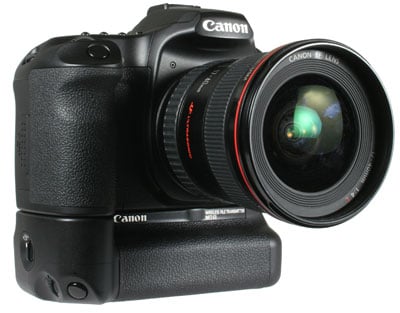
The Canon WFT-E3 is certainly a feature-packed accessory for owners of the EOS 40D and EOS 50D. It’s primarily billed as a wireless transmitter, but also offers external storage and GPS connectivity, along with the convenience and comfort of a portrait grip.

In use the wireless modes worked well, although unsurprisingly at slower speeds than direct cabled connections. So you probably wouldn’t use the wireless connection to transfer a full card’s worth of photos, but it’s certainly usable for individual images and remote control over a distance.


It’s already fun to see the live view from the 40D / 50D and focus its lens from your computer with the standard USB connection, but to do the same with the camera on a tripod at, say, the bottom of your garden without a cable in sight is undeniably cool stuff. Obviously this has fairly specialist applications. Time-lapse or HDR work spring to mind, as does studio-based macro-photography, or perhaps astro-photography without getting cold.

Beyond PTP, the WFT-E3 will be embraced by studio or sports photographers who want to take photos which are automatically transferred to a picture desk without them having to pause. And remember the picture desk doesn’t have to be connected to the same wireless network, as images could be uploaded direct to an FTP server. It’s also neat to fire the 40D’s shutter via a webpage from anywhere in the world.


As far as the other features are concerned, the wired Ethernet connection may not be as quick as USB, but isn’t far off, while operating over much longer distances – great for tethered studio work. The GPS connectivity works well, although we’d ultimately prefer to have the required USB connectivity built-into the camera itself – that said, the ‘built-in’ GPS connectivity of Nikon’s D300 requires an optional cable accessory which mates with an older style 9-pin serial plug, so the fact the WFT-E3 can use a simple USB cable is certainly some consolation. The portrait grip also makes the 40D very comfortable to hold and use in a portrait orientation.

Support this site by price checking below


On the downside, the external storage aspect didn’t work so well in our tests. The options to backup data or record separate or duplicate images were great, but scuppered by the requirements of the storage devices. The WFT-E3 didn't have sufficient juice to reliably power our 2.5in portable hard disks through its USB port, which meant external power was required - and since none of our disks had battery options, that meant an AC adapter and a studio environment. We have heard reports that lower-powered 1.8in portable hard disks can be successfully port-powered by the WFT-E3, but couldn't verify this during our test period. If this feature is important to you, we'd recommend trying it with a proposed drive before buying.

It’s also slightly annoying to have to remove the WFT-E3 in order to access or change the camera’s own battery, and while there’s a good chance 40D and 50D owners will already have a spare BP-511A pack, it would have been nice if Canon had supplied one with the WFT-E3. In defence of the design though, the WFT-E3’s portrait grip form factor looks neater than the bolt-on WFT-E2 unit for the EOS 1Ds Mark III.

Ultimately the WFT-E3 is a neat device that’s great fun to use, but you’ll really need a specialist application to justify it. As mentioned earlier, it’s targeted at sports and studio photographers who want to wirelessly transmit images to a picture desk, but it’ll equally be enjoyed by enthusiasts who like remote-controlling their camera but feel restricted by the USB cable length. The GPS and external storage options are the icing on the cake. So if you’re a 40D or 50D owner, who’s style of photography can exploit the WFT-E3’s capabilities, it easily comes Recommended.

See our video tour for a demonstration of the WFT-E3’s wireless remote control and GPS capabilities.


Good points

Supports many wireless options.
GPS connectivity
Matches the 40D / 50D’s build quality.
Supplied with case and pouch for storage.

Bad points
Blocks 40D / 50D’s battery compartment.
Battery not supplied with unit.
Can’t port-power a 2.5in portable hard disk.
Only works with EOS 40D and 50D bodies.


Support this site by checking prices above or shopping via our affiliate stores

All words, images, videos and layout, copyright 2005-2009 Gordon Laing. May not be used without permission.

About Us / How we test / Best Buys / Advertising / Home