Canon PowerShot SX30 IS
-
-
Written by Gordon Laing
Intro
The Canon PowerShot SX30 IS is a 14 Megapixel super-zoom with a 35x optically-stabilised zoom lens. Launched in September 2010 it replaces the hugely popular PowerShot SX20 IS. The most obvious enhancement is the extension of the zoom range from the SX20 IS’s already impressive 20x to a whopping 35x. The PowerShot SX30 IS zoom extends through a 35mm equivalent of 24 – 840mm, spanning the range from ultra-wide-angle to super-telephoto.
The sensor resolution has been increased by 2 Megapixels and the new model is fitted with a slightly larger 2.7 inch articulated screen. Improved image stabilisation provides a claimed four and a half stops of compensation and Canon has abandoned AA cells in favour of a proprietary Lithium-Ion battery.
Scene detection, introduced in the SX20 IS, has been improved with the addition of new scenes and extended to movie shooting which also benefits from a new Dynamic IS mode. The SX30 IS retains fully manual control with PASM exposure modes and also benefits from some of the new scene modes that have been introduced in Canon’s compact range, such as Fish-eye and Miniature.
The SX20 IS earned one of the top spots in the super-zoom market in the face of stiff competition from manufacturers like Panasonic. As you’d expect, they too have been busy introducing new models and we’ve pitched the PowerShot SX30 IS against two new super-zooms from its major rival, the Lumix FZ45 / FZ40 and the Lumix FZ100. Both share similar specifications with the SX30 IS and with each other. The Lumix FZ45 / FZ40 is a 14 Megapixel super-zoom with a 24x optical zoom and 3in screen which replaces the popular Lumix FZ38. The Lumix FZ100 is a premium version of the FZ45 / FZ40 with a 14 Megapixel CMOS sensor, a higher resolution flip-out screen, 1080p AVCHD video and fast continuous shooting.
Read our full review to see if the PowerShot SX30 IS, with its phenomenal zoom reach and combination of advanced manual and easy-to-use auto modes, is the best choice for you.
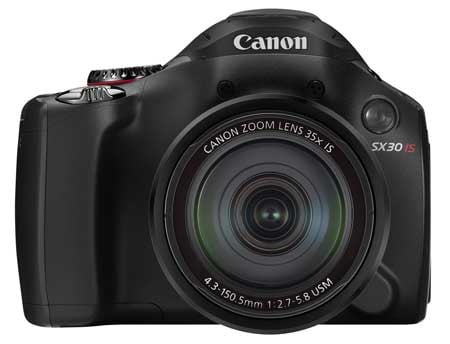 |
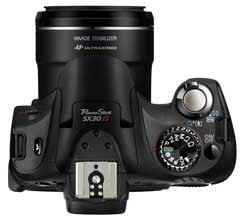
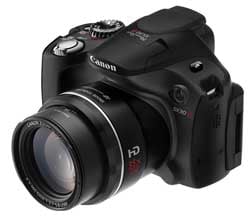
The PowerShot SX30 IS enjoys a significant body restyling over its predecessor with the new shape being noticeably more rounded and a little larger. The hand grip has been slimmed down and the top panel has a more moulded shape incorporating a deep thumb recess, all of which results in a camera body that not only looks better, but is even more comfortable and secure in the hand. The contoured look isn’t spoiled by the presence of the flash hot shoe which is deftly hidden underneath a removable cover. Canon very thoughtfully provides a case for this which attaches to the camera strap so you won’t lose it. You may be tempted to describe the SX30 IS styling as a mini-DSLR, but measuring 123x92x108mm, it’s actually roughly the same size as an entry-level DSLR.
Surprisingly it’s not far-off in terms of weight too: despite the change from four AA batteries to a smaller, lighter, proprietary Li-Ion cell, the PowerShot SX30 IS still weighs-in at a not inconsiderable 601g with battery and card. That may be 46g less than the SX20 IS when it was fitted with four typical AAs, but both cameras still come close to an entry-level DSLR – Canon’s own EOS 1000D / Rebel XS weighs 700g with battery, card and EF-S 18-55mm IS kit lens.
To be fair, the SX30 IS sports a 35x zoom to the DSLR kit’s 3x range, but it illustrates Canon’s latest super-zoom is neither particularly compact nor lightweight. Revealingly, Panasonic’s Lumix FZ45 / FZ40 may share a similar width from the front, but is 12mm shorter and 16mm thinner when both are powered-down; crucially the FZ45 / FZ40 is noticeably lighter too at 498g with battery and card. Note the FZ100 falls roughly inbetween in terms of weight at 540g including battery and card.
 |
 |
The SX30 IS’s mode dial fits snugly into the top panel as it curves upward towards the flash, making it possible to operate it with the index finger and thumb of your right hand while you’re holding the camera in the shooting position – all very ergonomic. In addition to the manual PASM modes, the mode dial includes Auto, Portrait, Landscape and Sports scene modes. A SCN position provides menu access to 13 remaining scene modes and there are also two custom settings positions as well as the movie mode.
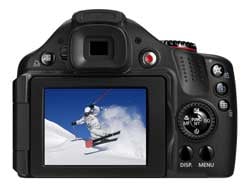
The flush mounted on/off button sits next to the mode dial, while the shutter release, with its zoom collar surround, is mounted at the extreme front of the grip extension. At the back of the camera the articulated screen takes the lion’s share of the space, locked into position below the electronic viewfinder. To the left of the viewfinder is a direct print button which doubles as a shortcut button to which you can assign a custom function. On the right of the viewfinder is a movie record button that works whatever the currently selected shooting mode.
To the right of the screen you’ll find the familiar Canon control wheel which is used to make navigating the menu system easier and to activate exposure compensation, ISO sensitivity, self-timer functions and focussing options. The PowerShot SX30 IS wheel differs from most other recent Canon cameras in that it retains the stepless ‘freewheeling’ motion introduced on the SX20 IS – there are no click stops, which takes a bit of getting used to.
The arrangement of buttons to the right of the thumb recess is a altered from the SX20 IS and adds some new functions. The topmost of the three is the Zoom framing assist button. When zooming all the way in to the full 840mm telephoto it’s easy to lose track of your subject. Pressing the Zoom framing assist button zooms the lens out to around 200mm so you can locate your subject in the centre of the frame before releasing the button to zoom back in again.
Next is the playback button, followed by an AF frame selector button which is used to relocate the Centre AF frame using the Flexizone AF system, about which more later. Below the Control wheel are two further buttons, one switches between the main panel and viewfinder modes as well as toggling display overlays and the other activates the menu system.
A soft plastic cover on the right provides access to the combined USB and A/V port along with the HDMI mini port, while the card / battery compartment is located beneath a spring-loaded door on the bottom. This will undoubtedly come as something of a disappointment to those who preferred the separate side-mounted card compartment of the SX20 IS as you can’t now change cards with the camera mounted on a tripod. It come as some small compensation to learn that the PowerShot SX30 IS now takes the new SDXC cards as well as SDHC and standard SD cards.
|
The PowerShot SX30 IS has a built in flash that you need to manually lift up to operate. Once the flash is lifted it works in auto mode, firing only in low light conditions. A flash button on the left side of the top panel activates an on-screen overlay from which other options can selected, depending on the exposure mode. In Program mode you can force the flash to fire and set Slow synchro mode – there’s no need for a forced off setting as you just need to push the flash back down to turn it off.
Pressing the Menu button immediately after the flash button takes you directly to the Flash settings section, from where you can adjust flash exposure compensation to +-2EV, select rear curtain sync, activate the red-eye lamp and red-eye correction, and Safety FE which automatically adjusts exposure to avoid blown highlights. In Manual exposure mode the Flash exposure compensation and Safety FE options are replaced with a flash output option that can be set to one of three levels.
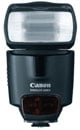
Like its predecessor, the SX30 IS has a fully-functional flash hotshoe which can be used to mount an external Speedlite 270EX, 430EX II or 580EX II. With any of these three models fitted, the flash control menu switches to external control, offering the same options as Canon’s latest DSLRs. Other Canon Flashes fire at full strength and you’ll need to adjust exposure manually depending on the guide number. Support for external flashguns, especially proper Speedlite units, is an impressive feature to have on the SX30 IS and elevates it beyond cheaper models – or indeed its rival, the Panasonic Lumix FZ45 / FZ40; note the pricier FZ100 does have a hotshoe.
The PowerShot SX30 IS replaces the four AA batteries used in its predecessors with an NB-7L Lithium-Ion battery. Though lighter, this hasn’t resulted in any overall weight savings and at 601g the PowerShot SX30 IS is still a bit of a heavyweight compared with the lighter Lumix FZ45 / FZ40 and FZ100. The SX30 IS’s Lithium Ion battery provides enough power for 370 shots using the screen, or 400 if you stick to the electronic viewfinder. That’s significantly fewer than you’d get from the PowerShot SX20 IS with a set of 2500mAh NiMH rechargeables, and also falls short of the Lumix FZ45, but is similar to the Lumix FZ100.
If there’s no weight and performance gain from switching to a proprietary battery, then why do it? The NB-7L weighs a lot less than 4 AA batteries, but the scales have been swung back in the opposite direction no doubt due to the extra weight added by the longer zoom lens.
The PowerShot SX30 is equipped with a 4.3 – 150.5mm zoom lens which is the equivalent on a full-frame 35mm camera of 24 – 840mm and a magnification ratio of 35x. That’s almost double the range of the earlier SX20 IS and by any standards an impressive sweep that will allow to frame your subject exactly the way you want in almost any situation. If you need to go wider or longer you’re going to be looking at a DSLR and a bag of lenses with all the cost and weight implications that involves.
Canon PowerShot SX30 IS coverage wide |
Canon PowerShot SX30 IS coverage tele | |
 | 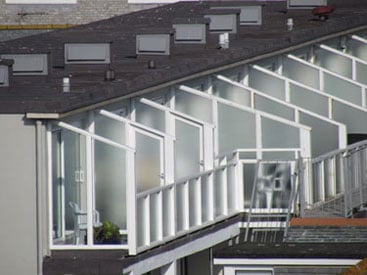 | |
| 4.3-150.5mm at 4.3mm (24mm equivalent) | 4.3-150.5mm at 150.5mm (840mm equivalent) |
The SX30 IS lens cap attaches to the extending portion of the zoom barrel, so you can power up the camera with it still in place. The LH-DC60 Lens hood is no longer included, which is a shame, but it is available as an optional extra as is an adaptor for 67mm filters.
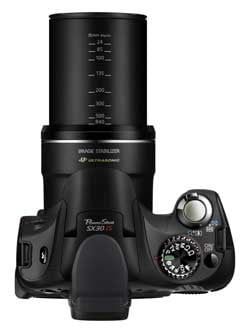 |
When powered on, the lens extends by 18mm from its housing and the camera is ready for action in a little over a second. Like its predecessors, the zoom is powered by a two-speed USM motor which is almost silent on the slower of the two speeds and is operational during video recording. At the faster of the two speed the lens extends through the full range to 840mm in two and a half seconds and can be nudged through around 55 discrete steps. When fully extended the lens barrel produces 60mm from its housing – that’s comparable with the Panasonic Lumix FZ 45 / FZ 40 and Lumix FZ100, despite its extra zoom range.
As you can see in the picture opposite, the top of the extended lens barrel is marked with the 35mm equivalent focal length which is handy if you like to know the approximate focal length you’re using, for portraiture for example you might want to set it in the 85 to 100mm range.
Having such a wide zoom range can make it difficult to keep track of your subject as you zoom in – particularly if it’s moving. To help deal with this problem Canon has added a Zoom framing assist button right next to the thumb rest. Shifting your thumb over and pressing the button temporarily zooms the lens out so that you can reframe the subject in the central area of the viewfinder or screen, releasing the button then returns the lens to the previous zoom setting. It’s a clever idea which could prove to be really useful in all sorts of situations from fast moving sports to wildlife and nature photography.
At f2.7 – 5.8 the SX30 has retained almost the exact same focal ratio as it’s predecessor – slight larger at the wide angle and a little smaller at the telephoto end of the range. As soon as you start to zoom the maximum aperture reduces to f2.8, and quickly falls to f4. At around the 300mm mark it drops down to f5 and the f5.8 maximum aperture comes into play at around 500mm.
Canon PowerShot SX30 IS: off / continuous | ||
 |  | |
100% crop, 4.3-150.5mm at 150.5mm, 1/25, 80 ISO, Tv mode, IS off. |
100% crop, 4.3-150.5mm at 150.5mm, 1/25, 80 ISO, Tv mode, IS on. | |
With an 840mm maximum telephoto and a maximum aperture at that focal length of f5.8, image stabilisation is of crucial importance to the PowerShot SX30 IS. Canon has improved the camera’s optical image stabilisation claiming it’s the most effective optical image stabiliser ever to be used in one of its compact cameras, offering up to 4.5 stops of compensation.
The two crops above were taken with the PowerShot SX30 IS in shutter-priority (Tv) exposure mode. For the crop on the left, IS was set to off and for the one on the right it was set to continuous. At a focal length of 840mm the photographers rule of thumb suggests a shutter speed of 1/840 to avoid camera shake. With a sharp image at 1/25 the PowerShot SX30 IS has exceeded Canon’s quoted figure of 4.5 stops and managed a remarkable five stops of compensation. To be fair, the PowerShot SX30 IS is an easy camera to hold steady and this is one situation in which its weightiness is a positive advantage. In our tests we managed to achieve reasonably sharp results without image stabilisation at 1/200. Against this benchmark 1/25 of a second represents three stops of compensation, but whichever way you look at it, this is exceptionally good performance.
 |
The PowerShot SX30 IS has two autofocus modes – Face Detect and Flexizone AF. Face Detect identifies faces in the frame and, as well as focusing, sets the exposure and white balance. Each detected face is framed – the main subject has a white frame and other faces have a grey frame. You can select an alternative main subject by repeated pressing of the AF frame selector button and half pressure on the shutter release locks the focus, identifying the main subjects with up to nine green frames.
Canon’s Digic 4 processor provides one of the best face detection AF systems there is. It’s quick to lock onto faces and is sticky – once a face is detected it’s held even when turning almost to full profile. Like all such systems it becomes less effective in low light and with distant subjects but is just as effective at high zoom magnifications as at the wider focal lengths.
Like the PowerShot SX20 IS, the SX30 IS has blink detection so you can identify shots in which people’s eyes are closed (providing they were first identified by Face Detect).
Flexizone is a version of Canon’s Centre AF in which you can move the central AF frame around the screen by pressing the AF frame selector button then using the control wheel. You can choose one of two frame sizes by pressing the Display button. While this is useful, unless you have the camera mounted on a tripod, it’s invariably easier to use the AF frame in its default central position then recompose your shot if necessary.
To focus manually with the PowerShot SX30 IS you press the right side of the control wheel and select Manual focus from the menu overlay. A distance scale is then displayed on the right side of the screen which you can adjust, again, using the control wheel. The centre portion of the screen is magnified to provide a better view, all the same, it’s quite difficult to focus accurately so the Safety MF feature, which uses AF to ‘fine tune’ your efforts is a useful option. Alternatively, Focus bracketing can be used to automatically take three shots using set focus distance points in front of and behind it. In use we found the SX30 IS’s AF system was sufficiently quick to grab basic action shots even when zoomed-in, but it did need to be under decent lighting, so anyone hoping to grab shots from the side-lines of dimly-lit sports grounds may be disappointed. The slow continuous shooting speed also rules it out for serious action sequences.
Like most super-zooms, the PowerShot SX30 IS has an electronic viewfinder (EVF) in addition to the main screen. The EVF displays exactly what you’d see on the main screen including menus and overlays. The PowerShot SX30 IS’s EVF has a resolution of 202 thousand pixels and provides a clear bright view that’s comparable with the Lumix FZ45 / FZ40 and Lumix FZ100. Aside from extended battery life, the advantages of using the EVF are that it’s much easier to see in bright sunlight and spectacle wearers can adjust the dioptre so that they can shoot without needing their glasses. Arguably, you might also gain a bit of extra stability for low-light exposures with the camera pressed to your face. The one drawback with using the EVF is that it can make locating some of the controls a bit tricky without taking your eye away from the viewfinder. On the PowerShot SX30 IS this is particularly a problem with the thumb-operated movie record button which is positioned close to the right side of the viewfinder.
The PowerShot SX30 IS’s main screen is fully articulated and while the viewfinder is in use is docked facing inwards on the camera back. Opening it (a tricky business that involves prising a finger or thumb into a recess on the right side and pulling it out, overcoming the resistance of a locking catch) automatically activates it and switches off the EVF. Once open, the screen can be moved into almost any position including folded back on itself for protection or front-facing for self-portraiture.
This screen is one of the feature highlights of the SX30 IS. At 2.7 inches it’s a little bigger than the the 2.5in screen of its predecessor, albeit with the same 230 thousand pixel resolution. For shooting stills and standard resolution video the size and resolution of the screen are more than up to the job. Both the Lumix FZ45 / FZ40 and FZ100 have 3in screens and the FZ100’s screen, like the PowerShot SX30’s is articulated. The Lumix screens are wider, but no taller than the PowerShot SX30 IS’s, which means that for 4:3 shooting modes there are black bars either side and the viewable image is more or less identical on all three cameras. It’s only when you switch to 16:9 movie modes that the wider dimension of the Lumix screens comes into play. There’s no doubt that the Lumix screens provide a bigger, better view for HD movie recording, but for stills shooting there’s little if any difference.
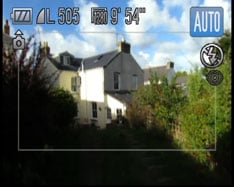 |
 |
 |
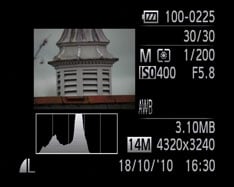
Pressing the Menu button in shooting modes displays tabbed menu system. Shooting settings are arranged on one menu and Camera settings on another. The camera settings include all the things that you’re likely to either leave on the default settings or change rarely – sound options, power saving, language, date and time and so on. This menu also contains formatting, screen brightness and hint’s and tips. The latter was introduced on the SX20 IS and provides a one line explanation of selected menu functions. It’s quite useful to begin with and when you become familiar with the function of menu options you can turn it off. The PowerShot SX30 IS also has a third tab which you can use to create your own custom menu set-up, adding preferred options from the shooting settings.
 |
 |
 |
| ||
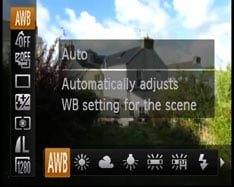
Commonly used options can be quickly accessed from the Function menu. Pressing the Func.Set button at the centre of the control wheel overlays the Function menu on the current view on the EVF or the main screen. Options are dependent on the selected exposure mode, in Program mode they include white balance, colour rendering, exposure bracketing, continuous shooting, flash power, metering mode, image size and movie size. Settings are displayed down the left side of the screen with options for each arrayed along the bottom. ISO sensitivity, normally a regular on Canon Function menus is absent as it has a dedicated button on the control wheel.
The camera settings tab is joined by a playback and print settings tab in playback mode. The playback menu includes slideshow, erase, and protect options, basic editing functions like rotate, red-eye correction, trimming and resizing and i-contrast – Canon’s dynamic range enhancement. You can also assign categories to images which can then be used to filter playback.
The PowerShot SX30 IS has a shutter speed range of 15 to 1/3200 of a second, the full range of which can be selected in manual exposure mode. Like most compacts however, the available range is dependent on the selected aperture. At the wide angle lens focal length, the fastest 1/3200 speed is only available at f8. At f7.1 the fastest available speed is 1/2500, dropping to 1/2000 at f5 and 1/1600 from f3.5 to the maximum f2.7 aperture.
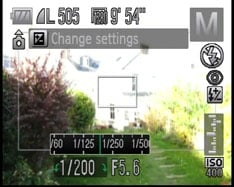
Manual exposure is set by rotating the control wheel – with a quick push on the top to toggle between aperture and shutter speed. A scale on screen shows exactly where you are in the available range, which is a big improvement on the digital readout you get on the Lumix FZ45 / FZ40, and Lumix FZ100.
Manual mode is flanked on the mode dial by Aperture and Shutter-priority semi auto modes, Program mode, Auto, Portrait, Landscape and Sports scene modes, a SCN position that provides menu access to a further 13 scene modes, movie mode and two positions to which you can allocate custom settings. These aren’t to be confused with similar modes which allow you to assign a favourite scene mode, they’re much more versatile and potentially useful. The C1 and C2 positions can be used to save and instantly recall shooting settings including things like zoom and manual focus position, self timer settings and so on. Finally, there’s the Movie mode position; although you can record movies in any shooting mode by pressing the movie button, switching to Movie mode switches the screen to 16:9 view (assuming the movie size is set to the 1280 option).
In Auto mode the PowerShot SX30 IS uses scene detection which was introduced in the SX20 IS. For the new model it has been enhanced with the addition of new scene types making 28 in all. New scenes include spotlit subjects and people shots with strong facial shadows; combined with the existing backlit, blue skies, sunset and dark lighting situations, Canon’s Smart Auto Scene detection mode is able to make intelligent exposure decisions that can make a real difference in terms of picture quality. Smart Auto is also available in movie mode, with 21 scene types, though as there is no means of selecting (or deselecting) it, it would appear that this is the default and only exposure mode used for movie recording.
The SX30 expands the number of scene modes available on the SCN menu from 8 to 13. New additions include a fisheye effect and a digital tilt-shift effect called Miniature which can also be used to create fast motion videos. And of course, the PowerShot SX130 IS includes the smart shutter mode which makes use of the Digic 4 processors capabilities to provide smile detection and wink and face self-timer functions.
Canon PowerShot SX30 IS Movie Mode
Like its predecessor, the PowerShot SX30 IS can shoot 1280 x 720 HD video at 30 frames per second and has two standard resolution video modes – 640 x 480 and 320 x 240 also at 30fps. You can use the optical zoom while recording and you’ll only hear the quiet USM motor when there’s no ambient noise – you can just hear it during zooming in our test clips. You can also take still pictures while recording video, images are recorded in the W (3733 x 2105) size and appear in the movie along with shutter visual and audio effects as well as being saved separately.
HD image quality is excellent and the stereo mics do a good job of picking up voices at distances of up to several metres. The only criticism we’d make of the video quality is that, like all video cameras with a CCD sensor, the PowerShot SX30 IS is prone to streaking when shooting brightly lit subjects. You can see the effect this has in our second video clip when the camera turns into the sun. This would have been lessened (though not eliminated) by the use of a lens hood, so it’s a shame Canon has decided not to include one as it did with the PowerShot SX20 IS.
With the camera placed around three metres from a talking head, speech was clearly audible and easily understood, so interviews, press conferences would be no problem. Like the Lumix FZ45 / FZ40 and FZ100, the PowerShot SX30 IS has a wind filter to alleviate the effects of wind noise and the sheltered position of the mics makes it easy to provide protection in the form of a cupped hand. You can even set the recording levels manually if desired, using a single channel peak meter as a guide.
HD video is compressed using the H.264 codec and saved in a QuickTime wrapper as a .mov file, while stereo audio picked up by mics located under the flash housing is encoded as 16 bit 48kHz PCM. The maximum recording time is technically a second short of half an hour when filming HD, although the maximum file size of 4GB per clip will actually be reached sooner, after about 21 minutes. Canon recommends using SD cards rated as Class 4 or faster, which includes affordably priced SanDisk Ultra II models.
| |
|---|---|
|
In the clip above you can see the ful extent of the PowerShot SX130 IS 35x optical zoom. The AF does a good job and the focus doeasn’t wander at all. Despite the Image stabilisation it’s very difficult to hold the camera steady at the maximum zoom setting.
| |
|---|---|
|
This clip above, taken with the camera on a tripod shows the best case scenario. Note the streaking and flashing, typical of CCD sensors as the camera pans into the sun. Once again, the AF is rock steady.
| |
|---|---|
|
This last clip, above, is a hand-held panning shot taken in low light conditions.
Canon PowerShot SX30 IS Continuous shooting and sensor
At a quoted rate of 1.3 frames per second, the PowerShot SX30 IS’s continuous shooting rate is nothing to write home about, and that’s with the focus locked. In Continuous shooting AF mode it falls to a paltry 0.6fps. If you want anything approaching useable continuous shooting you have to resort to low light mode which will record 2 Megapixel images at a rate of 3.6fps.
This effectively means the PowerShot SX30 IS has no meaningful continuous shooting capability and in this respect it loses out to the Lumix FZ45 / FZ40 which, although also lacking fast continuous shooting at full resolution, offesr a range of burst modes providing up to 10fps if you’re prepared to compromise on image size and /or compression. Then there’s the Lumix FZ100 which offers up to 11fps at the full resolution thanks to its CMOS sensor, along with a high speed 60fps mode at 3.5 Megapixels. So Canon’s really falling behind in this regard.
The PowerShot SX30 IS has a 14 Megapixel 1 / 2.3in CCD sensor with an ISO sensitivity range of 80 to 1600 ISO at maximum resolution. Unlike the Panasonic rivals, there’s no RAW option and all images are saved as JPEGs using a single compression mode that produces file sizes of around 3.5MB.
To see how the quality of the SX30 IS measures-up in practice, take a look at our real-life resolution and high ISO noise results pages, browse the sample images gallery, or skip to the chase and head straight for our verdict.