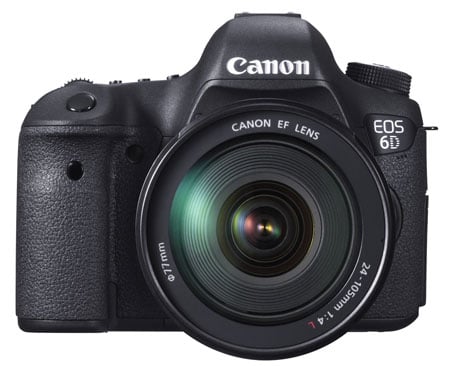
 The Canon EOS 6D is an extremely capable and well-designed full-frame digital SLR that provides a clear upgrade choice for anyone looking to graduate from an APS-C model to a full-frame DSLR. It combines excellent image quality with superb high ISO noise performance, has an AF system that works in very low light levels and adds built-in GPS and Wi-Fi features in a tough, moisture and dust resistant body that's lighter and more compact than other full-frame bodies.
Canon EOS 6D review
-
-
Written by Ken McMahon
Intro
Canon’s EOS 6D is the company’s first ‘affordable’ full frame DSLR. It’s positioned above the EOS 60D (and in some respects the EOS 7D), providing a stepping stone into full-frame photography for owners of Canon’s mid-range and semi-pro APS-C models. It also has the potential to serve as an affordable back-up body for EOS 5D Mark III owners.
The EOS 6D has a newly designed 20.2 Megapixel sensor delivering slightly lower resolution than the 22.3 Megapixel EOS 5D Mark III. It has an 11-point phase-detect AF system with a single cross-type point at the centre that’s sensitive down to -3EV or, as Canon is fond of putting it, about as much light as you get from a full moon. So, it’s good in low light, but not especially well-suited to fast moving action. Likewise the EOS 6D’s continuous shooting capabilities aren’t particularly swift: at 4.5fps many DSLRs, and mirrorless compact system cameras can outrun it. But the EOS 6D isn’t about action, Canon likes to describe it as a camera for landscape, travel and portrait photographers.
Plus, it has a other features that compensate: it becomes the first Canon DSLR to feature built-in GPS and Wifi, squeezed in on either side of the prism head. The GPS allows you to tag images with location data as well as keeping a tracklog that you can use to plot your route on a map later. The built-in Wi-Fi allows the wireless transfer of images to a device or direct to the internet, as well letting you wirelessly control the camera using either a computer or smartphone.
The EOS 6D was released within a month of Nikon’s D600 with which it directly competes. As well as a higher resolution 24 Megapixel sensor, the D600 offers faster continuous shooting, a more sophisticated 39-point AF system, a built-in flash, twin SD card slots, built in interval timer and a headphone socket. So, on paper at least, the D600 looks to have the upper hand. But if the specs were all that mattered you wouldn’t be reading this, so to find out if it’s as clear cut as it appears, or whether the 6D has much more to offer when you look beneath the surface read on. (Many thanks to Stacey Field for the loan of her D600 in our tests).
 |
Canon EOS 6D design and controls
The Canon EOS 6D body measures 145x111x71.2mm and weighs 755g with the battery and SD card. It’s the most compact full-frame EOS DLSR Canon has ever produced and a comparison with the 60D and 5D Mark III puts its size in perspective. The 60D measures 145x106x78.6mm and weighs 755g; so they weigh exactly the same but the full-frame EOS 6D, though a little taller, is quite a bit narrower. The EOS 5D Mark III measures 152x116x76.4mm and weighs 950g; a more substantial step up in both size and weight. So it’s not just about price – Canon is attempting to win over enthusiast photographers who might previously have ruled out a full-frame body on the grounds of size and weight. Interestingly, the size and weight difference between the 6D and EOS 5D Mark III is roughly the same as between the Nikon D600 and the higher end D800.
Side-by-side with the Nikon D600, which measures 141x113x82mm and weighs 850g with battery and a memory card, it’s evident, that the D600 is not quite so wide, a little taller and noticeably thicker, with a beefier grip than the 6D. It also weighs almost a hundred grams more, which is noticeable when you pick it up and will make a difference if you’re carrying it around for any length of time.
One of the reasons for the weight differences is that the EOS 5D Mark III has an all Magnesium alloy body frame whereas the EOS 6D has Magnesium alloy front and rear panels with a polycarbonate top. So it’s not quite so rugged as the EOS 5D Mark III, but it does, according to Canon, offer the same degree of protection from dust and moisture, described by the company as ‘Dust and drip-proof’. The Nikon D600 is also partly constructed from Magnesium alloy, in this case it’s the front and top panels, and is also sealed against dust and moisture.
 |
The 6D body is very similar in terms of the control layout to the EOS 60D, and anyone following that upgrade path will find the transition very straightforward. From the front the two bodies look almost identical barring the 5mm extra height of the 6D and the pop-up flash on the 60D. The only noticeable differences being the slightly lowered location of the AF illuminator on the inside of the 6D grip and the repositioning of the mono mic from above to below the name badge on the left of the body (as you hold it). The shutter release, IR receiver and lens release are all in the same place but, with the lens off, the most obvious difference is of course the full-frame 6D’s larger mirror.
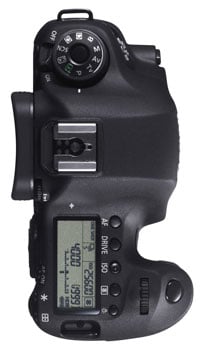
On top, the EOS 6D’s mode dial is a simplified version of the 60D’s without the dedicated scene mode positions. Instead, a single SCN position provides access to all of them via a menu. There are of course the PASM mode positions – P, Tv, Av and M – as they’re identified on Canon DSLRs, as well as a B(ulb) position, two custom settings, Creative Auto and Scene Intelligent Auto. Like the Nikon D600, a button in the middle of the mode dial releases the lock which prevents accidental movement. Like the 60D the 6D’s on/off lever is situated at the rear of the mode dial where it can be flipped with your left thumb.
On the right side of the viewfinder prism is the LCD info display which provides exposure, drive, focus and metering modes, ISO, card capacity, battery life GPS and Wi-Fi status. Forward of that are the same four buttons for AF, Drive, ISO and metering mode that you’ll find on the EOS 60D in addition to a button that turns on back illumination. It’s not quite as comprehensive as the dual-mode buttons of the 5D Mark III, but it has the advantage of being simpler and less cluttered.
The main dial is located forward of the four buttons and behind the shutter release – the opposite way around to Nikon DSLRs which have the main dial forward of the shutter release at the very front of the grip; I don’t think there’s any particular advantage in either layout.
The rear panel is home to the 3in screen, about which more in a moment. As for the control layout, it’s a bit of a mixture of the 60D and 5D Mark III. Like the 5D Mark III, Menu and Info buttons are on the left of the viewfinder and operated by your left thumb. And on the right side of the viewfinder you’ll find the same dual mode switch for Live view and movie shooting. In the camera position pressing the central Start/Stop button switches in and out of live view. Rotate the switch to the movie position and the camera enters Live view and prepares for video recording with a 16:9 display. In this position the Start/Stop button starts and stops recording. It’s pretty intuitive, and Nikon obviously think so as they adopt a very similar setup on the D600 and D800.
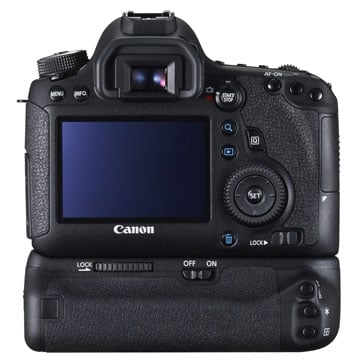 |
On the right shoulder the 6D shares the same three buttons as the 5D Mark III which activate the AF, lock the exposure settings and allow selection of AF points. From here on is where the two models diverge; the 5D Mark III’s nipple for navigation isn’t present, neither is the five button array down the left side of the screen. Instead playback and magnify buttons sit to the immediate right of the screen with the Q button for the quick menu just to the right of them.
Below that is a control dial with an inner pad and central Set button exactly as on the 60D. The outer Quick Control dial is primarily used for exposure compensation and there’s a lock button below, conveniently positioned for your right thumb to prevent accidental operation. The inner 8-way Multi-controller is used for menu navigation and in some situations is used together with the Quick Control dial. Lastly, near the base of the body next to the dial lock button is the delete button.
On the right side of the 6D is a single SD card slot which is compatible with SD, HC and XC cards including UHS-1. This is something of a surprise if you think the 6D should, like other full frame DSLRs provide twin slots. So Canon has compromised for the sake of compactness and affordability, in my view the right choice. For pro photographers and those with the cash to burn a spare slot for big capacity, backup, or the convenience of shooting movies on one card and stills on another isn’t a luxury or an extravagance, but for an enthusiast moving up to full frame for the first time it’s something I expect they’ll be happy to do without. Having said that, if they opt for the Nikon D600 with its dual SD card slots they wont have to.
On the left side of the body there are two three-quarter length soft plastic covers. Under the front one you’ll find a remote socket plus a 3.5mm input for an external microphone. There’s no headphone socket for monitoring audio while shooting movies though, so that’s one area where the Nikon D600 scores over the EOS 6D.
The rearmost protects the mini HDMI port and A/V / USB port. Above them a small triangular grille reveals the location of the speaker. The 6D’s USB port, like the D600’s is USB 2 rather than the faster USB 3 standard available on the D800. And in a move which will make Canon videographers jealous, the D600’s HDMI port, like the D800’s, will also output a clean uncompressed signal, allowing you to connect a larger and more detailed monitor, or capture the feed with a higher quality external recorder. Interestingly at the time of writing, Canon announced a firmware update for the EOS 5D Mark III which would also equip it with uncompressed HDMI output, but not until April 2013; there was no mention of upgrading the EOS 6D with the same functionality though.
On the base the tripod bush is located on the lens mount axis with a ridged grid to provide a good grip for a quick-release plate. And on the right side a door below the grid provides access to the battery compartment.
The EOS 6D takes the same LP-E6 Lithium ion battery pack as the EOS 5D Mark III, the 60D and the 7D, so whether you’re upgrading from one of the higher end APS-C bodies or looking for a 5D Mark III backup body you’ll be able to use your existing batteries. Under normal temperature conditions (in Canon’s view that’s a rather balmy 23 degrees C) you’ll get 1090 shots on a full charge which compares well with the 900 shots of the 600D.
Those looking for longer battery life have the option of fitting the BG-E13 battery grip which takes a second LP-E6 battery thereby doubling the number of shots to more than two thousand. The grip also provides controls for easy handling in portrait orientation as well as the option to use AA batteries, which could be a lifesaver if you’re prepared to carry a four pack in your camera bag for emergencies, or are within reach of a newsagents or supermarket.
Like all Canon full-frame DSLRs, the 6D lacks a built in flash. Given Canon’s desire to make the 6D attractive to upgraders countered by its striving for compactness this could have gone either way. The lack of a pop-up flash is I think undeniably a drawback, particularly given its something that you can rely on from Nikon. The D600’s built-in flash may not be massively powerful, it may add to the camera’s size and weight and make it less robust, but it’s tremendously useful for fill-in and wireless activation of other off-camera units. While you can see Canon’s argument for not previously including a flash on full-frame bodies, I’m really not sure it works for the 6D. Though it lacks a built-in flash, the 6D does of course have an ISO standard hotshoe which in which you can mount an external flash unit.
Caon EOS 6D screen and viewfinder
The EOS 6D has a 3in screen with a resolution of 1040k dots. The screen is 3:2 proportioned which means the full area is used for composing and playback of still images with black bars top and bottom only when you switch to 16:9 movie shooting. Like all Canon full-frame models the 6D’s screen is fixed, so if you’re trading up from the 60D you’ll have to learn to live without a flip out screen and if you’re looking for a 5D Mark III back-up body you’ll be settling for a marginally smaller view. The articulation is a bigger sacrifice than the marginal size reduction, but as a compromise for the cost size and weight advantages the 6D offers I think it makes a good deal of sense.
The Nikon D600’s LCD screen is also fixed, though at 3.2 inches, like the 5D Mark III’s it’s a little bigger. However, the D600’s screen is 4:3 proportioned and the native 3:2 image area sits at the top with a black information strip below, so there’s actually a slightly smaller image area than the wider 3:2 shaped 3in screen on the EOS 6D.
In use the screen is bright and punchy with a wide angle of view and good for most conditions with the usual caveat of direct sunlight. This is one situation where an articulated screen comes in really handy, but of course most people are likely to be composing with the viewfinder rather than the screen so it’s really more of an issue for movie makers than stills photographers.
The EOS 6D’s viewfinder provides only a 97 percent view which is unusual for a modern full-frame body, the EOS 5D Mark III and the Nikon D600 (and D800) all providing 100 percent coverage. Having said that, the small peripheral area you can’t see won’t make a difference to most people, particularly compared with the vast difference in size and brightness when compared with the view through an APS-C model like the 60D. In a side-by-side comparison with the Nikon D600 I found the Canon viewfinder appeared marginally larger and also a little brighter, but these differences aren’t significant enough to warrant choosing one over the other.
The EOS 6D’s viewfinder screen is etched with 11 AF areas which illuminate briefly in red when they’re activated (you can turn this off in the menu if it bothers you, but I find it helpful to know which AF points are used). Unlike the Nikon D600 or the EOS 5D Mark III, there’s no on-demand LCD grid overlay available and the 6D sees a return to the interchangeable focussing screens of the 5D Mark II. It’s a step backwards in some respects, particularly as a grid overlay is arguably more of a requirement in a camera aimed at portrait and landscape photographers. Having said that, with only 11 AF areas and a circular central area the supplied screen is relatively uncluttered, the screens are inexpensive and swapping them is a relatively straightforward process.
Battery level, exposure information, exposure compensation, ISO setting and buffer capacity are displayed below the viewing area and a green dot illuminates to confirm AF lock.
Canon EOS 6D lens and stabilisation
The EOS 6D is available as a body only, with the EF 24-105mm f4 L IS USM or the 24-70mm f4L IS USM. I tested it with the former, the 24-105mm provides a 4.3x zoom that’s a good match for the 6D’s landscape and portraiture capabilities. As an ‘L’ model, the lens is designed and built to Canon’s highest standards; you can read about in in more detail in our Canon 24-105mm review.
One thing to bear in mind if you’re upgrading from an APS-C model like the 60D is that you won’t be able to use any of your EF-S lenses on the 6D body. If you plan on keeping hold of your 60D though you will be able to use the 24-105mm f4L with it where it will have an equivalent range of 38-168mm; not quite the wide angle coverage as on the 6D, but a very useful general purpose zoom all the same, and a great option when coupled with the EF-S 10-22mm ultra wide zoom.
Canon EOS 6D EF 24-105mm wide | Canon EOS 6D EF 24-105mm tele | |
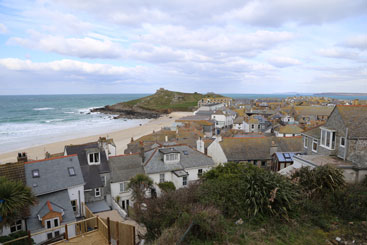 | 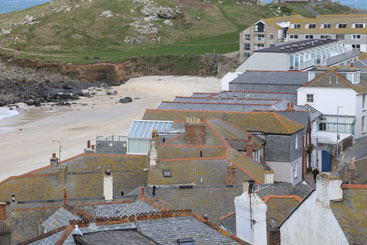 | |
| 24-105mm at 24mm | 24-105mm at 105mm |
Being an L lens, as well as high quality optics the 24-105mm f4 has weather sealing on the mount, high quality construction with very smooth manual zoom and focus rings and comes with a lens hood that’s reversible adding to its portability when not in use. The focus and zoom rings are operated via mechanical linkages and even with the lens set to autofocus you can make full-time manual focus adjustments.
If there were a criticism to make of the 24-105mm f4L as a general purpose kit zoom, it would be that the f4 maximum aperture isn’t ideally suited to low light use or for producing extremely shallow depth of filed for portraiture shots. If that’s a concern, the older, now discontinued and less expensive 24-70mm f2.8 might be a better choice. Just bear in mind that although you’re getting a 1 stop wider maximum aperture it lacks the additional telephoto reach of the 24-105mm plus you’ll sacrifice image stabilisation. Alternatively if you want a really good portrait lens without breaking the budget, just head to Canon’s EF 85mm f1.8 USM.
Returning to the 24-105mm, there are two switches on the lens barrel, one for choosing between manual and auto focus and the other to activate the stabilisation. Canon claims three stops of stabilisation for the EF 24-104mm and I tested it by zooming in to the 105mm focal length and shooting a sequence in Shutter priority mode at progressively slower speeds with the stabilizer turned off then repeated the process with it on.
Canon EOS 6D EF 24-105mm f4L IS USM IS Off/On | ||||
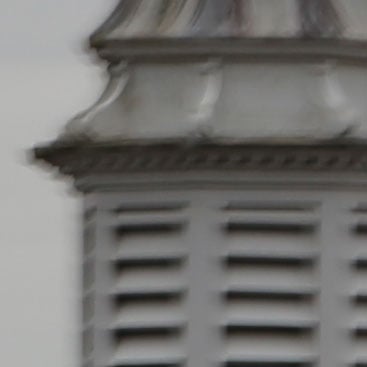 | 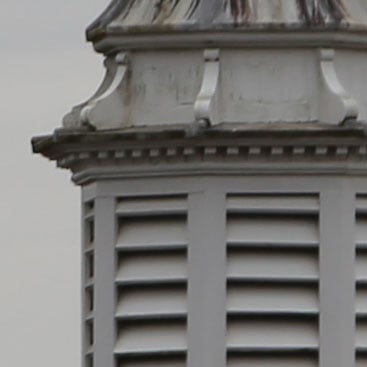 | |||
100% crop, 24-105mm 100 ISO 1/8th IS Off. | 100% crop, 24-105mm 100 ISO 1/8th IS On. | |||
As you can see form the above crops, with the IS enabled you can hold the 6D steady at speeds down to 1/8th – a little more than three stops slower than conventional wisdom advices without stabilisation and slightly better than Canon’s three stop claim.
Canon EOS 6D shooting modes
The EOS 6D’s mode dial is much less cluttered than the 60D’s because the individual scene mode positions have been dropped in favour of a single SCN position which sets the currently selected scene mode, changed from the Quick control screen. About the only difference 60D users will need to get accustomed to is the lack of a movie position.
But just because the 6D is a full frame camera doesn’t mean Canon has abandoned Fully automatic and other novice-friendly shooting modes. Scene Intelligent Auto uses similar scene detection algorithms as found on Canon compact models to determine the best exposure setting for the situation including scenes containing people, moving subjects, close-ups and a variety of lighting conditions. In Live view, an icon indicating the camera’s chosen scene option is displayed in the upper left corner of the screen.
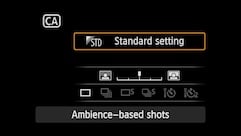
The 6D also offers the Creative Auto (CA) shooting mode that allows creative control of depth of field, white balance and other factors via easy-to-use screen-based choices. Like Scene Intelligent Auto, the Creative Auto mode is much better in Live View where the controls are more intuitive and you get visual feedback or, to put it another way, what you see is what you’ll get.
Like the 5D Mark III, the 6D offers Auto Lighting Optimiser and Highlight Tone Priority to boost contrast and recover blown highlight areas respectively. Highlight Tone Priority operates at a minimum of 200 ISO and expands the dynamic range from standard 18% grey to bright highlights.
Historically, bracketing control on EOS DSLRs has lagged behind other manufacturers but things look to be changing with first the 5D Mark III and now the 6D offering the option of up to 7-frame bracketing in a range of +/- 8EV with a choice of sequence. White balance bracketing is also offered, but not ISO bracketing. All told, it’s a step up from the three-frame exposure bracketing on the 60D and for that matter all other EOS models with the exception of the 1Ds and 5D Mark III. More importantly, it outperforms the basic 3-frame bracketing of the D600; if you want better than that on a Nikon full-frame DLSR you’ll have to step up to the D800, which will shoot up to 9 bracketed frames.
One thing worth noting though is that the 6D lacks anything to compare with the D600’s sophisticated interval timer functions. Canon has always lagged behind Nikon for time-lapse features and the 6D doesn’t change that, however, with built-in wireless control via the EOS utility application you can now remotely shoot time-lapse sequences using a laptop PC or MacBook, which is an improvement. See the section on Wi-Fi below for more detail on how that works.
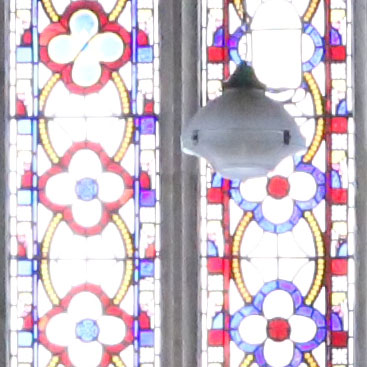
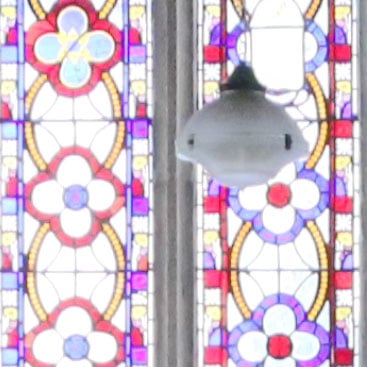
Canon EOS 6D Aperture priority / HDR Backlight Control | ||||
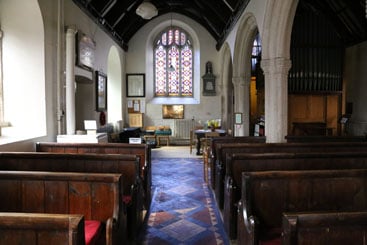 | 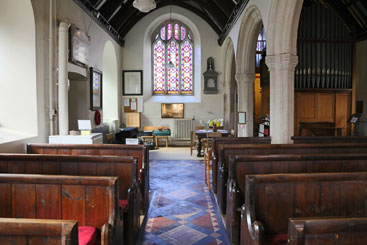 | |||
Aperture priority 12800 ISO f8 1/60 | HDR Backlight Control 12800 ISO f4 1/160 | |||
 |  | |||
 |  | |||
The 6D also includes the HDR Backlight Control scene mode introduced on the EOS 650D; this takes three consecutive shots which in combination produce a result with extended dynamic range. HDR Backlight Control sets the ISO sensitivity and exposure automatically. I tested it by taking a shot in HDR Backlight Control mode and comparing it with a shot taken in Aperture priority mode with the ISO sensitivity set to same level – in this case 12800.
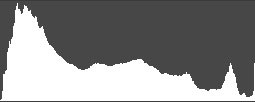
The result shown above is more impressive than my earlier tests with the 650D and it looks like Canon has improved on the HDR processing to retain more highlight detail as well as making a significant improvement in the shadows. The crops above from the backlit stained glass window show markedly improved detail in the highlights. You don’t need crops to see the improvement in the shadows which is most obvious in the pews in the bottom left corner and the organ top right. The histograms provide confirmation of the degree to which the highlight and shadow detail has been recovered.
One other thing worth noting about HDR backlight control is that the image area is reduced slightly as a result of the compositing process which aligns all three frames and crops any surplus, even when, as here, the camera is on a tripod.
Finally, there’s also a multiple exposure option which allows you to shoot from two to nine images which are then superimposed in the camera. If you shoot in Live view you can see the effect on screen as the multiple exposures accumulate. This kind of thing is probably far better managed in Photoshop, but it’s a useful alternative for those who want it without having to resort to image editing.
Canon EOS 6D movie modes
Like all high end Canon DSLRs including the 60D and 5D Mark III, the EOS 6D can shoot 1080p HD video at 30, 25 and 24fps. If you want 50p or 60p you’ll still need to drop the resolution to 720p and there’s also a 640 x 480 mode at 50 or 60fps. Note that unlike the Mark III, the horizontal sensor resolution is not perfectly divisible by 1920, so some non-integer scaling may take place with the increased risk of moire as a result.
Like the EOS 5D Mark III the 6D offers the choice of intra-frame (ALL-i) or inter-frame (IPB) compression formats, the former capturing higher quality and more easily editable footage, albeit at a hungrier data rate. In my tests the IPB 1080p footage consumed about 240MB per minute and ALL-i 1080p footage about 660MB per minute. Canon recommends using a card with a minimum write speed of 20MB/s for All-I mode shoting. The 6D also inherits the 5D Mark III’s SMTPE timecode embedding, allowing easier syncing in post production, and making it a good B-camera for projects shot with the Mark III.
What you still don’t get though is a clean output over HDMI to feed an external recorder. During composition you always have the white focusing frame as a minimum, and once recording, there’s the ever-present red circle in the upper right corner – and in both instances, the image itself is framed with thick black borders, so the active area actually measures 1620×910 pixels. To be fair, the new intra-frame ALL-i compression option does reduce the need or desire for an external recorder, but some film makers would still have preferred the flexibility of a clean HDMI output either way. As for those using external monitors, the active image area of 1620×910 pixels over HDMI when recording will at least deliver a more detailed image than the earlier Mark II, making focus-pulling easier.
If you’re at the consumer-end of the movie-making world, you won’t be enjoying continuous auto-focusing while filming with the EOS 6D either. This remains an elusive goal for a traditional DSLR. Nikon may have its Full time AF mode, but it’s a ‘solution’ you’ll want to disable immediately. As such the 6D and D600, like their pricier siblings, essentially remain manual focus only for video once you start rolling. Both can perform a single refocus while filming, but it’ll take a couple of seconds, so isn’t ideal unless you can edit it out later. If you want continuous AF while filming, you should consider a mirrorless CSC or one of Sony’s SLT models.
The EOS 6D has a built-in mono microphone, so, as on the Nikon D600, if you want to record stereo sound you’ll need to connect an external microphone via the 3.5mm input jack. The D600 goes a step further with a headphone socket so you monitor audio recording.
The D600 is also capable of sending a graphics-free uncompressed signal over its HDMI port, though the 6D’s All-I option renders makes this less of an issue. On balance, I think that with its DX crop mode, uncompressed HDMI output, built-in stereo mics and headphone socket, the D600 is a more capable movie camera then the 6D. At this level at least, Nikon has reversed Canon’s long held dominance in this area.
Canon EOS 6D with EF 24-105mm f4L IS USM
sample video 1: outdoors, cloudy bright, handheld pan
Download the original file (Registered members of Vimeo only) |
| Unless otherwise stated I shot this and the other sample clips shown here in the EOS 6D’s 1080p25 IPB mode. The quality looks really nice and the stabilisation does a reasonably good job of ironing out the wobbles apart from a short section mid-pan. The zoom ring on the 24-105mm lens is very smooth, but even so it’s difficult to get a good result when hand-holding the camera. |
| |
|---|---|
| |
| |
| |
|---|---|
| |
| |
| |
|---|---|
| |
| |
Canon EOS 6D handling
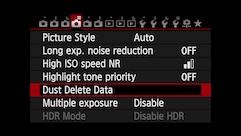
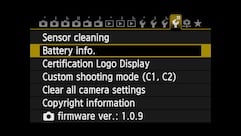
The EOS 6D is an easy camera to get on with. Personally, I like the body shape and find the control layout logical and reasonably intuitive. The menu system is easily navigable; one of Canon’s strengths is that it rarely puts more items on a menu page than you can read without scrolling, making it very easy to flip through screens to find what you’re looking for. One thing that would make life easier though is if the playback menu tabs were arranged at the end, rather than in the middle, separating the shooting and camera settings. Maybe it’s just me, but I find I need to access playback setting rarely, so it would be better if I didn’t have to scroll past them every time I wanted to get to the camera settings. Having said that, you can navigate through from the last tab to the first and the menu system remembers where you last left it, so it’s a minor gripe.
The rear Quick Control dial and Multi-controller setup is unusual and can be tricky to manipulate, particularly if you’ve got big fingers. But I found I got used to operating it pretty quickly. The eight-way pad makes it quicker and easier to select AF points and position the magnifier frame for manual focusing than a more conventional four-way controller. As with all higher-end Canon DSLRs, the Quick Control dial is also used for exposure compensation and there’s the danger of accidental operation. However, the lock button can disable it, as well as the main dial and Multi-controller if required.
 |  |  |
 |  |  |
 |  |  |
 | 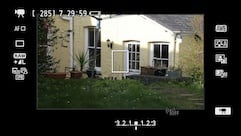 | 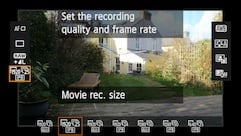 |
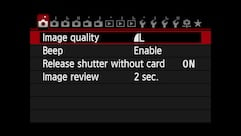
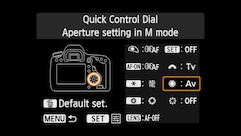
The EOS 6D provides a number of customisation options on the custom functions menu covering everything from exposure level increments and bracketing sequence to AF tracking sensitivity and dial direction. Most of the controls are customisable and the menu provides a very useful graphic display showing the button location and displaying the assignment option.
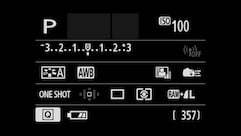
Pressing the Q button activates the info display so that you can scroll to the required setting at which point pressing the Set button takes you a screen for making adjustments, alternatively you can use the main dial to adjust the selected setting directly. Lastly, there are two custom positions on the mode dial to which you can save all of the 6D’s current settings.
Canon EOS 6D Wi-Fi
The EOS 6D is the first Canon DSLR to be equipped with both built-in Wi-Fi and GPS. The twin antennas are located on either side of the prism head and are able to function through the polycarbonate case. Canon has previously said that the inability of Wi-Fi and GPS signals to transmit through a metal casing is one reason these features haven’t been included in other models, the 5D Mark III for example. While you can add these features to the Nikon D600 via plug-in accessories, having both Wi-Fi and GPS integrated into the camera body is a much simpler, neater and more practical solution.
But integrated hardware is only half the battle. Few manufacturers have really capitalised on the potential a wireless network connection provides, so I was really hoping that Canon would pull out all the stops to provide Wi-Fi features like remote control and shooting, image transfer and upload to social networks in a way that doesn’t leave you either tearing your hair out in frustration or just flat disappointed.
I’m pleased to report that that neither of those is the case and the EOS 6D’s Wi-Fi features are broad in scope and implemented in a sensible fashion. The 6D allows you to wirelessly transfer images between suitably equipped cameras, connect to a smartphone (iOS or Android) to view images and remote shoot, print images using a Wi-Fi printer, operate the camera remotely via a wireless connection using EOS utility on a PC or Mac, upload images to Facebook or Canon’s Image Gateway platform, and view images on a suitably equipped TV.
Lets start with smartphone operation. You can connect your phone to the 6D either by connecting both to a wireless network via an access point, or by configuring the camera as an access point and connecting to it. Once Wi-Fi is enabled the connection modes and other features are chosen from the Wi-Fi function menu.
You can connect to the camera using either an Android or iOS smartphone, I tested it using my iPhone 4S with the EOS Remote app which allows you to view, rate, delete and download images from the camera as well as operate it remotely. You need to be in Live view mode so that the camera can relay the view to your phone, and a button is provided on the app to switch in and out of live view if you can’t easily access the camera. There’s a big shutter release button next to a smaller one which activates the AF. Down the left side of the screen is a series of info icons to tell you the shooting mode, White balance, AF, mode and Drive mode. Quality and exposure information is arrayed along the bottom of the screen in a similar fashion to the 6D’s LCD screen which remains active itself during remote operation. But one failing is that not all the exposure information is displayed until the shot is taken. In Program mode you can’t see the shutter speed or aperture and in Aperture and shutter priority modes you can only see the main setting (i.e. shutter speed in shutter priority).
Full control over exposure settings is provided and while you can’t change either the shooting mode or drive mode you can at least shoot continuously by holding down the shutter release. It’s a well-designed functional app that does a good job of allowing you to control the EOS 6D remotely. The only criticism I’d make of it is that it occasionally becomes unresponsive and you have to wait for a few seconds, which in some situations could spell disaster. As long as you have a reliable wireless network connection though, this happens pretty rarely.
The app isn’t the only option for controlling the EOS 6D though, you can also operate it remotely using the EOS utility, though it does involve using a PC or Mac. I tested this aspect of the 6D’s remote operation on my MacBook Pro on my home wireless network and it worked in much the same way as if I’d had the camera connected to the computer with a USB cable, though slower and more hesitant. The EOS Utility of course offers much greater scope for remote operation including interval timer facilities.
When you configure the camera for connection this way the EOS utility launches automatically. As with the smartphone app, you need the camera in Live view mode to get a preview, but you can also switch out of live view mode and continue to shoot blind with all the speed and low-light advantages ofthe 6D’s phase-detect AF.
 |  |  |
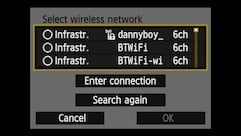 |  | 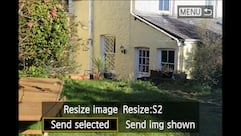 |
The 6D can also connect and upload to social networks including Facebook, Twitter and Youtube. To set this up you need to register with Canon’s Image Gateway platform, to which you can also upload photos. You also need to register the camera as a device on your Image Gateway profile using the EOS Utility application. Once that’s done, uploading is a pretty straightforward process of selecting the site you want to upload to from the menu, selecting the image, resizing it if required and then uploading. For smaller images the upload process took just a few seconds on a fast broadband connection, to upload a 3MB to the Image Gateway site file took me a couple of minutes.
Images uploaded to Twitter are saved to Image Gateway with a link in the tweet, but you don’t get the option of adding a caption or comment, which is a shame. Photos uploaded to Facebook are added to a Canon Image Gateway album and posted on your wall.
Overall I found the experience of using the EOS 6D’s Wi-Fi features a positive and enjoyable one. It all works as it should bar a few minor gripes the most frustrating of which is slow speed with which the remote preview window updates and the tendency for the app to freeze up for short periods. If you want to control the Nikon D600 over Wifi, you’ll need to get the WU-1a wireless adapter which plugs into the USB port. Compared with the 6D’s built-in Wi-Fi, you’ll of course have to pay extra for the Nikon adapter and put up with it sticking out of the port with the flap open, but it is fairly tiny, so that’s just a minor inconvenience.
I recently tested the WU-1A with the Nikon D5200. The Nikon iOS app isn’t as well designed or fully featured as the Canon one, and when I tested it the D5200 screen remained blank while the adapter was in use. The Nikon app doesn’t provide anything like the degree of control that’s available on the 6D, it doesn’t allow you do downsample images and you can’t upload directly to sharing and social networking sites – you first need to download images to your phone and then go from there.
Given it’s aimed at landscape and travel photographers, the inclusion of a GPS receiver in the 6D makes a lot of sense and is likely to be one of its big selling points. The GPS features work in a similar way to those Canon compacts that include it like the PowerShot S100 and SX260HS. With the GPS activated images are automatically tagged with geopositional data and thier location can be pinpointed on a map.
In use, the only indication that the GPS is active is a screen icon. You can set the interval between which data is updated and the 6D will also record a track log that you can download and use to plot your travels on a map. One other useful feature is the ability to set the camera’s clock from the GPS satellite. There’s aslo a separate map utility provided that allows you to plot your images on a map and manually add location data to shots that don’t have it. However, my guess is that most 6D owners will be doing this king of thing in Aperture, Lightroom or other applications that support it.
In the use, the GPS proved accurate and reasonably quick, though there were plenty of occassions when it took more than a minute to find sufficient satellites for a position to be fixed after it was enabled. Once it’s enabled of course it remains on, even when you switch the camera off. That’s something you’ll need to do if you want to record a track log, but it does drain the battery noticeably more quickly and if you plan to make frequent use of the GPS it would be wise to invest in a spare.
Note some regions offer a version of the 6D without Wifi or GPS built-in, normally for regulatory purposes – this model is called the EOS 6D (N).
Canon EOS 6D Autofocus
The EOS 6D has an 11-point AF system with just one cross-type point, sensitive to both horizontal and vertical lines, at the centre. This sounds basic compared to the 39-point AF system of the D600 with its nine cross-type sensors, and resulted in many observers discounting the Canon based on specification at launch. But while the D600’s AF system undoubtedly outperforms the 6D when it comes to tracking action, the Canon has an important advantaghe of its own: the claim to autofocus under much lower light levels.
To test it out, I set up the EOS 6D and the D600 on a tripod in a dimly lit room at night and focussed on a bookshelf about two metres away; both cameras were using the same focal length lens with the same maximum aperture of f4. Even with the room lighting dimmed this proved no problem for the AF systems on either camera; Canon claims the EOS 6D can maintain AF down to EV -3, roughly the equivalent of the light level provided by a full moon.
With the room lights off the only illumination on the bookshelf was provided by the screen of my 15 inch MacBook Pro on a desk also about two meters from the bookshelf. This time, while the 6D was able to focus (though it took a second or so get there) the Nikon D600 wasn’t. To give you an idea of the light levels, at 1600 ISO the 6D metered an exposure of 1 second at f4.
In order to get the D600 to focus using AF I had to move the light source closer, to about one metre from the bookshelf so, applying the inverse square law, the D600 required about four times the light level of the 6D to be able to autofocus. While it’s hardly a rigorous scientific test I think its reasonable to conclude that the Canon EOS 6D’s AF is indeed capable of functioning in significantly lower light levels than the Nikon D600’s.
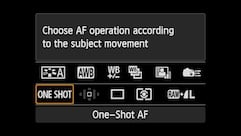
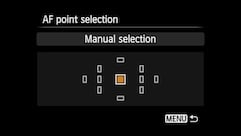
Like all Canon DSLRs The 6D offers three AF modes, One Shot AF for still subjects, AI Servo AF for moving subjects, and AI Focus AF which automatically switches from One Shot to Servo when it detects a subject starting to move. Canon DLSR users will also be familiar with the process of AF point selection by which you use the command dial or control pad to cycle through the AF points as they illuminate in the viewfinder.
The EOS 6D also provides a limited version of the AF customisation options available on the EOS 5D Mark III including Tracking sensitivity and Acceleration/Deceleration, though without the ‘case’ presets. There’s also the option to set the AI focus/release priority independently for the first and subsequent images. So for a camera aimed at Landscape and portrait photographers, the EOS 6D offers quite sophisticated controls for focusing on moving subjects.
In Live view the EOS 6D offers the choice of three AF modes, the default option is Live Mode which employs a silent and uninterrupted contrast-based system. The second option sticks with contrast-based focusing, but adds face detection. Finally, the Quick Mode flips the mirror down to take a reading from the traditional 11-point phase-change AF system. A half-press of the shutter release can be used to trigger the autofocus in any mode, although pressing the AF-ON button on the rear has the same effect if preferred.
Canon EOS 6D Continuous shooting
The EOS 6D can shoot continuously at 4.5 frames per second. With a UHS-1 card it can shoot a lengthy burst of 1250 Large fine JPEGS – for most situations as good as indefinitely – and if you’re shooting RAW you’ll run out of buffer and the camera will stop after 17 frames.
To check Canon’s claims I fitted the 6D with a 16GB SanDisk Extreme Pro UHS-1 SD card rated at 95MB/s. To begin with, I set the image quality to large fine JPEG, turned off the lens stabilisation, set the ISO to 100 and the shutter speed to 1/250 and pressed the shutter release. The 6D shot 100 frames at a consistent rate of 4.4fps after which I stopped shooting. There’s no reason to suppose the 6D wouldn’t continue shooting for 1250 frames, but I was curious, so I reformatted the card and this time kept the shutter pressed for several minutes (at 4.5fps the 6D would take around four and a half minutes to shoot 1250 frames). After nearly seven minutes my finger was starting to ache a little, but the 6D was still shooting with metronomic regularity and when I stopped the frame count was 1831 with the buffer still showing capacity for 1600 shots. So it looks like Canon’s estimate is on the conservative side and you can shoot Large fine JPEGs more or less indefinitely at 4.5fps, though it will obviously depend on the performance of your SD card.
Incidentally, after shooting the 1831 frames the 6D’s buffer cleared pretty much immediately. I shot another 100-frame burst and timed how long it took for the buffer to clear – the light went out before I could even start the clock. Switching to RAW the EOS 6D fired a burst of 21 frames at just over 4.5fps before hesitating and then slowing to a slightly erratic pace under 2fps. This time the buffer took just over 8 seconds to clear.
All told, this is a good performance which bears out Canon’s claims for the relatively modest continuous shooting capabilities of the EOS 6D. If you’re shooting Large Fine JPEGS you can shoot more or less indefinitely at 4.5fps and begin a new burst any time. With RAW files, you’re limited to a burst of around 20 shots, and though the buffer takes a little while to write you can shoot shorter bursts while that’s happening.
The Nikon D600 can shoot at a marginally faster 5fps and also provides the option of shooting in reduced resolution DX mode for an extra half a frame per second speed gain. When I tested the D600, however, I found there was no difference in speed between the two modes and the only advantage to be gained was a slightly longer burst. The D600 can shoot a burst of 100 Fine JPEGs or 16 RAW files, so, in a nutshell the 6D can shoot for longer at a slightly slower frame rate.
Canon EOS 6D Sensor
The EOS 6D’s newly designed 20.2 Megapixel full-frame sensor produces images with a maximum size of 5472 x 3648 pixels. The expanded ISO sensitivity range is 50 -102400 ISO outreaching the maximum 25600 ISO of the D600. The shutter speed range is from 30 seconds to 1/4000 plus bulb which is exactly the same as on the D600.
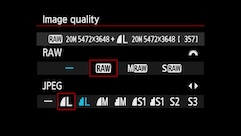
Image data is saved as JPEG files at one of two compression ratios, Large fine JPEGs are typically between 6-9MB in size, RAW data can also be recorded in CRW files.
To see how the quality of the Canon EOS 6D measures-up in practice, take a look at my Canon EOS 6D quality and Canon EOS 6D noise results pages, browse my Canon EOS 6D sample images, or skip to the chase and head straight for my verdict.