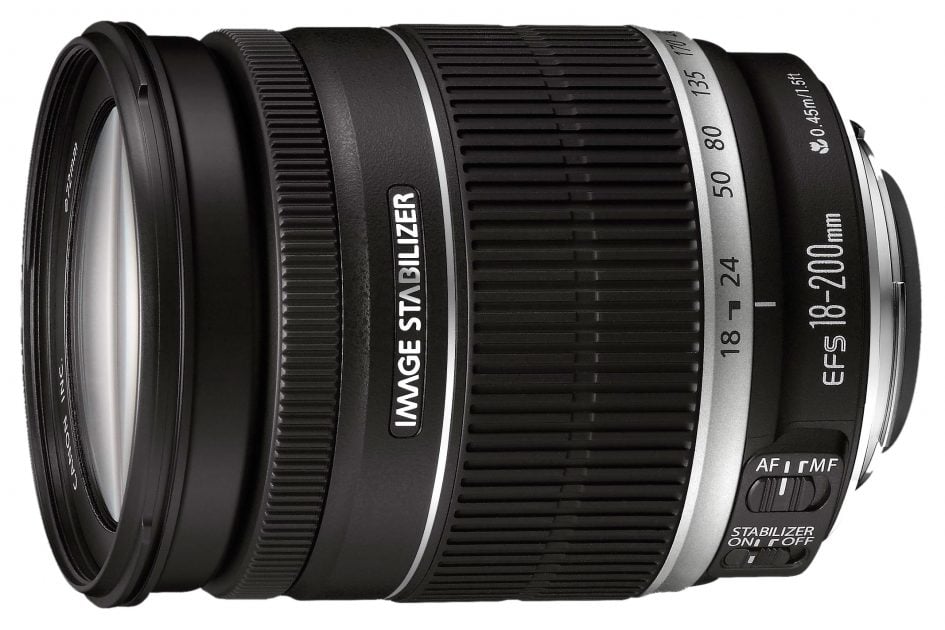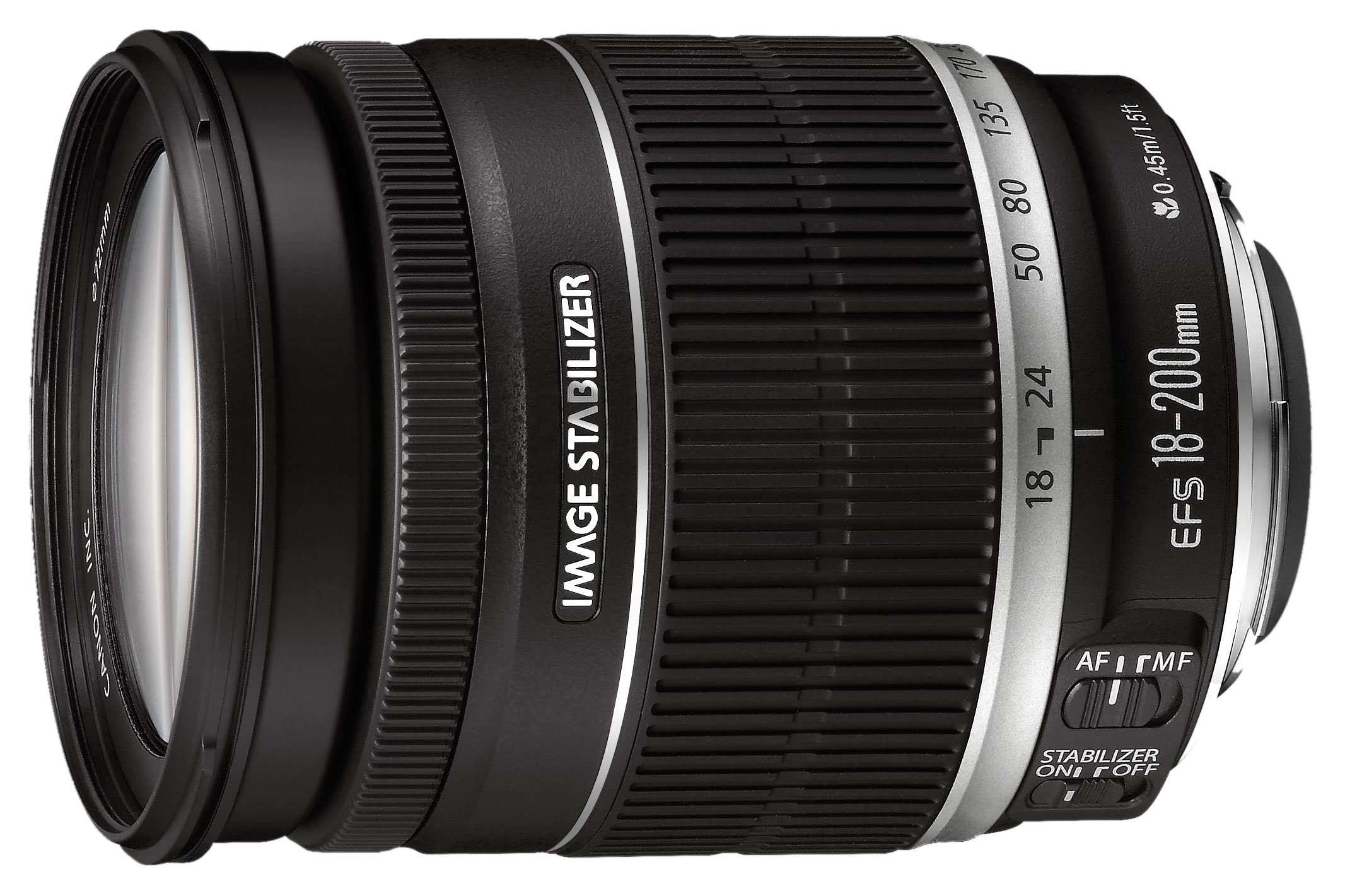
Canon EF-S 18-200mm IS verdict Canon’s EF-S 18-200mm IS is quite simply the lens many Canon DSLR owners have been waiting for. It equips EF-S compatible models with a massive 11.1x optical zoom range, equivalent to 29-320mm, and crucially includes Image Stabilisation to iron out any camera shake. By delivering wide angle to decent telephoto coverage, it could be the only lens many owners will ever need. Like other super-zoom lenses, this massive range brings enormous compositional flexibility. You could be shooting an expansive landscape or large group shot of people at one moment, then spot a photo opportunity in the distance and capture it with a simple twist of the zoom ring. In a natural landscape, this could be a bird perched on a branch, or in a gathering of people, it could be a close-up of someone. Quite simply, while others are busy switching lenses to achieve the desired effect and possibly missing the shot, a super-zoom lets you grab spontaneous moments with ease. A single all-round lens also brings great convenience. You don’t have to lug around multiple lenses, waste time changing them, or run the risk of dust entering the body when you do so. They’re ideal whether you’re going on holiday, shooting a wedding, or attending a sporting event where the action takes place both near and far.
Like most super-zooms, there’s also reduced contrast, especially when zoomed-in – the results just aren’t as punchy as decent lenses with shorter ranges. We also measured some of the worst light fall-off in the corners that we’ve seen on any lens, both zoomed-out and in, which is even visible when composing through the viewfinder. In addition, there’s visible fringing in the corners, along with softness, which can extend across the frame when zoomed-out at large apertures. Finally in terms of optical resolution, while the EF-S 18-200mm IS has sufficient resolving power for 8, 10 and 12 Megapixel DSLRs, it begins to struggle with higher resolution models like the 15.1 Megapixel EOS 50D. The bottom line is if you want to enjoy the maximum resolution of the 50D, you’ll need to fit it with a higher quality lens. You can see examples of all these optical issues and artefacts across our results and gallery pages. The EF-S 18-200mm IS’s problems extend beyond the optics. Canon has unforgivably not equipped it with a USM focusing motor, so while the focusing was actually pretty quick in practice, it was audibly loud, rotated the manual focusing ring and needed to be disengaged before you could manually tweak it – you can see and hear this in action on our video tour. The absence of USM focusing is a bizarre and disappointing decision, especially as Canon’s own ‘EF Lens Work’ book states the company's intention to fit USM across the range, not to mention the fact Nikkor’s DX 18-200mm VR sports the equivalent SWM technology. The Canon lens also suffers from creep, where the barrel can extend or retract under its own weight when pointed up or down at certain focal lengths, although to be fair, the Nikkor model equally suffers in this regard. And like all of Canon’s non-L lenses, you’ll need to buy your own hood, which continues to be a stingy business strategy. Crumbs, that’s certainly a few downsides, but before our final verdict, how does the EF-S 18-200mm IS compare against its rivals?
Also consider:
Canon EF-S 18-200mm IS final verdict Owners of Canon’s EF-S compatible bodies have long-requested a Canon-branded 18-200mm super-zoom. For years they’ve gazed enviously at Nikon’s DX 18-200mm VR super-zoom and the flexibility it gave owners of that system. Sigma and Tamron may have offered super-zoom options of their own with a Canon fit, but earlier models didn’t feature stabilisation, and neither company has the perceived cachet (justified or otherwise) of the Canon brand. So now it’s finally with us, does the EF-S 18-200mm IS fulfil everyone’s expectations? On the plus side, the lens certainly delivers the enormous 11.1x optical range many desired, along with the flexibility and convenience this gives in practice. The Image Stabilisation, while not quite managing the quoted four stops in practice, did deliver at least three stops in our tests, providing very effective combat against camera-shake – and as an optical system, you’ll see that reassuring stabilising effect through the viewfinder. But as described above, there’s a number of optical compromises with the lens, which include softness and fringing in the corners, pronounced geometric distortion (especially at wide angle), reduced contrast (especially when zoomed-in), significant vignetting and lack of resolution for the top DSLRs in the range. It’s worth looking a little closer at the last two points though. The EF-S 18-200mm IS may suffer from noticeable darkening in the corners at both ends of its range, but this can easily be corrected (or at least greatly improved) in software. Canon’s Digital Photo Professional software can apply peripheral illumination correction to RAW images which virtually eliminates the darkening, while newer models like the EOS 50D can also apply it in-camera to JPEGs. As far as resolving power is concerned, the EF-S 18-200mm IS may not make the most of the highest resolution DSLRs in the cropped-format range like the EOS 50D – but it does have sufficient resolving power for the lower resolution 6, 8, 10 and 12 Megapixel models. So that includes all Digital Rebels to date, or everything from the original EOS 300D to the EOS 1000D and 450D, along with the 20D, 30D and 40D. While the resolving power is sufficient for these models though, remember the other optical issues remain. The bottom line is all lenses with this kind of huge range will involve optical compromises and you simply have to weigh these up against their convenience and flexibility. What can’t be excused though is the decision not to fit a USM focusing motor, and of course the continued absence of a lens hood when virtually all rivals include them as standard even on cheaper models. So if you demand the ultimate optical quality, need decent manual or quiet focusing, require specialist capabilities like a bright focal ratio or simply want to make the most of a body like the EOS 50D, then look elsewhere – such as one of the options compared above. But while the EF-S 18-200mm IS has its fair share of issues, the simple fact is they’re outweighed by the sheer convenience and flexibility of a stabilised 11.1x range for most of its target audience – and there’s no denying the draw of finally having this on a Canon-branded model. It’s far from perfect, but the EF-S 18-200mm IS becomes one of the most compelling general-purpose lenses for owners of compatible Canon bodies, both old and new. Optical issues and the absence of USM focusing means the EF-S 18-200mm IS misses out on our top award, but the convenience factor makes it an easy recommendation.
|
||||||||||||||||||||||||||||||||||||||||||||||||