Support Camera Labs by price checking using the flags below


or by shopping via our affiliate stores
- thanks!

RSS Feed Camera Labs RSS Feed


Latest camera reviews

Sony Cyber-shot DSC-T77
Canon PowerShot SX10 IS
Canon PowerShot A2000IS
Canon PowerShot G10
Canon IXUS 870 / SD 880IS
Sony Alpha A900
Canon EOS 50D
Nikon D90
Panasonic Lumix LX3
Canon EOS 1000D / XS
Nikon D700

Olympus E-520
Panasonic Lumix FX500

Canon EOS 450D / XSi
Sony Alpha A350

Panasonic Lumix TZ5


All reviews ....
   
 
  Latest DSLRs


Canon
Olympus
Pentax
Nikon
Panasonic
Sony
     
 
  Best Buys: our top models


Compacts / Super-zooms
Budget DSLRs / Mid-range DSLRs / Semi-pro / Lenses


Camera Labs Forum

Any questions, comments or a great tip to share? Join our Forum and let everyone know.
   
 
  DSLR Tips


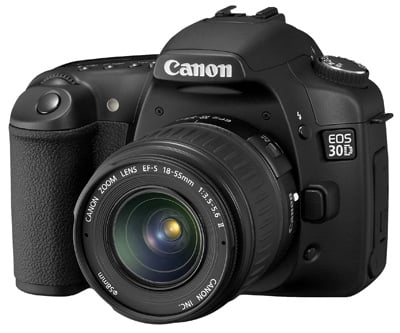
Canon EOS 30D review Gordon Laing, July 2006

Lenses
/ Screen and menus / Sensor and processing
 

Canon EOS 30D sensor and files

The Canon 30D is fitted with the same 8.2 Megapixel CMOS sensor as the 20D. Measuring 22.5 x 15mm, it effectively crops the field of view of all lenses by 1.6 times – so the optionally bundled 18-55mm zoom performs like a 29-88mm lens on a 35mm body. Again like its predecessor, the 30D is compatible with all EF and EF-S lenses, each effectively having their focal length multiplied by 1.6 times.

The 30D’s sensor delivers a maximum image size of 3504x2336 pixels. If you’re reproducing at 300dpi, these should contain sufficient detail for up to 11.7 x 7.8in. The next step-up from the 20D and 30D are the Nikon D200 and Sony Alpha A100, who’s 10.2 Megapixel sensors deliver images with 3872x2592 pixels which at 300dpi gives them a printable advantage of approximately one inch on each axis.

Support this site by price checking below

Canon Speedlite 580EX II

The differences are greater when compared against Canon’s own 12.8 Megapixel EOS-5D. Its 4368x2912 pixel images have sufficient detail to be reproduced up to 15x10in at 300dpi, or about 3in wider and 2in taller than those made with the 20D or 30D.

Quality settings

Canon EOS 30D Quality settings


Images can be recorded at three different resolutions, each with the choice of two JPEG compression levels; best quality JPEGs typically measure between 3 and 4MB each. Full resolution images can alternatively be recorded in Canon’s CR2 RAW format, accompanied by a JPEG using any of the six JPEG settings if desired. As with all its DSLRs, Canon supplies a copy of Digital Photo Professional for processing RAW files.


Colour and styles


Like the 5D before it, the 30D has adopted Canon’s Picture Styles for image processing, and the options available are identical to its bigger brother. The five main and three user-defined Picture Styles offer adjustment of sharpness (from 0 to 7), contrast (+/-4), saturation (+/-4) and colour tone (+/-4). An additional monochrome Picture Style switches the options to sharpness, contrast, filter effect and toning effect. The filter effects consist of none, yellow, orange, red or green, while toning offers none, sepia, blue, purple or green.

Canon EOS 30D Picture styles

We used the default Standard Picture Style for our day-to-day and Gallery shots. This is set to a sharpness level of three and a zero / middle value for contrast, saturation and colour tone. Despite its neutral-sounding characteristics, the Standard Picture Style delivered good-looking, punchy JPEGs which were ready to use without any post-processing. Resolution aside, they unsurprisingly appear very similar to the Standard JPEGs out of the 5D.

The 30D supports both sRGB and Adobe RGB colour spaces.

Image processing and handling

The 30D employs exactly the same DIGIC II image processor as every other model in Canon’s current DSLR range, allowing it to deliver a responsive user-experience. The camera’s ready to go in 0.15 seconds and during playback the command wheel zips through images showing a low res preview instantly, followed by the full resolution version about half a second later. Thumbnails of nine images also appeared in less than half a second with a decent CF card.

Like its predecessor, the 30D’s fastest continuous shooting mode is rated at 5fps, a decent step-up from the fastest 3fps of the 5D. Canon quotes an increased buffer size over the 20D, allowing 30 JPEGs or 11 RAW images to be captured. Also new to the 30D is an alternative, slower 3fps mode.

We tested the 30D with a SanDisk Ultra II 1GB Compact Flash card and took a burst of 18 best quality JPEGs in four seconds before the camera paused – this equates to around 4.5fps. In other circumstances we shot longer bursts, but the speed worked out around the same. And while we may not have personally achieved 5fps, the 30D still shot bursts 50% faster than the 5D and felt a world apart in this respect.

Lenses / Screen and menus / Sensor and processing


Support this site by checking prices below or shopping via our affiliate stores

USA readers


UK readers


All words, images, videos and layout, copyright 2005-2008 Gordon Laing. May not be used without permission.

About Us / How we test / Best Buys / Home