Support Camera Labs by price checking using the flags below


or by shopping via our affiliate stores
- thanks!

RSS Feed Camera Labs RSS Feed


Latest camera reviews

Nikon D90
Panasonic Lumix LX3
Canon EOS 1000D / XS
Nikon D700

Pentax K200D
Olympus E-520
Panasonic Lumix FX500

Olympus E-420
Pentax K20D
Canon EOS 450D / XSi
Sony Alpha A350

Panasonic Lumix TZ5

Nikon D60
Sony Alpha A200
Nikon D300
Canon EOS 40D

All reviews ....
   
 
  Latest DSLRs


Canon
Olympus
Pentax
Nikon
Panasonic
Sony
     
 
  Best Buys: our top models


Compacts / Super-zooms
Budget DSLRs / Semi-pro / Lenses


Camera Labs Forum

Any questions, comments or a great tip to share? Join our Forum and let everyone know.
   
 
  DSLR Tips


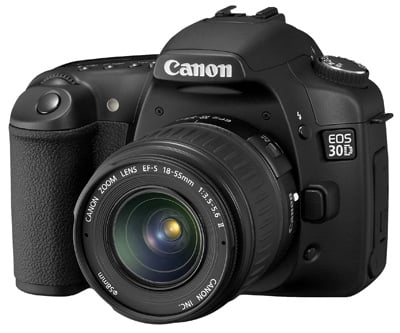
Canon EOS 30D review Gordon Laing, July 2006

Canon EOS 30D features continued... Lenses / Screen and menus / Sensor and processing
 

Canon EOS 30D lenses

The Canon EOS 30D can take any EF or EF-S lens, and its APS-C sensor results in all focal lengths effectively being multiplied by 1.6 times. The 30D is commonly bundled with Canon’s EF-S 18-55mm f/3.5-5.6 lens which therefore delivers equivalent coverage to 29-88mm; this is shown below.

While the EF-S 18-55mm lens is a budget option, it performs surprisingly well, and is virtually given away in the bundle. We’d therefore recommend going for the bundle than the body alone, as it gives you a backup lens and better resale value as a kit for little extra expense. If you’re looking for a more up-market lens though, check out our Canon EF-S 17-85mm review which includes comparisons with the bundled EF-S 18-55mm and the premium EF 17-40 L. While this lens group test was conducted with the 350D / Rebel XT, this body has the same size sensor and virtually identical resolution to the 30D, so the results are applicable. If you're interested in portraiture or low-light work, check out our Canon EF-S 17-55mm f/2.8 review.


Canon EOS 30D with EF-S 18-55mm f/3.5-5.6 (bundled lens) coverage
Canon EOS 30D with 18-55mm lens at 18mm f8
Canon EOS 30D with 18-55mm lens at 55mm f8
18-55mm at 18mm, f8 (29mm equivalent)
  18-55mm at 55mm, f8 (88mm equivalent)

Canon EOS 30D viewfinder

The view through the Canon EOS 30D is essentially identical to the earlier 20D apart from a circle indicating the spot-metering area – a long overdue upgrade for this product range. The 30D viewfinder delivers 95% coverage, identical to the Nikon D200 and only 1% below the 5D.

Superimposed on the viewfinder screen are the nine focusing points arranged in a diamond pattern. The points are shown as small squares or rectangles with outlines which illuminate red when active.

Below the main view you’ll see the shutter speed, aperture, exposure compensation scale and the number of shots remaining in the buffer, along with a selection of icons to indicate various options. Like the 5D, if you want to see the current ISO or flash compensation value in the viewfinder or on the status screen, you’ll need to press their adjustment buttons.

In contrast, the Nikon D200’s detailed viewfinder additionally shows the ISO value along with both the metering and exposure modes at all times. These are more useful than you’d think if you’re the kind of photographer who frequently uses high ISOs or manual modes and forgets to reset them afterwards. We’ve been caught out by this with the 5D, accidentally shooting at, say, a high ISO and not realising until afterwards.

The focusing screen is bright and clear, but unlike the 5D there’s no options to switch it for one with different markings. This would be fine if Canon followed Nikon’s innovation by offering LCD-based viewfinder grid lines on demand, but sadly it hasn’t. So if you’re into precision alignments, you may have to consider a different body.

Canon EOS 30D features continued...

Lenses / Screen and menus / Sensor and processing


Support this site by checking prices below or shopping via our affiliate stores

USA readers


UK readers


All words, images, videos and layout, copyright 2005-2008 Gordon Laing. May not be used without permission.

About Us / How we test / Best Buys / Home