Canon EOS 30D review
-
-
Written by Gordon Laing
Intro
Canon EOS 30D introduction
The Canon EOS 30D is the successor to the popular EOS 20D, aimed at the higher-end enthusiast market. When it was announced in February 2006 though, there was some surprise and disappointment to learn it used exactly the same 8.2 Megapixel sensor as its predecessor. Until this point, Canon buyers could traditionally look forward to higher resolution sensors on new bodies.
But after this initial surprise wore off, Canon’s reasoning became clearer. The earlier 20D already delivered excellent image quality with very low noise, so beyond marketing numbers, was there really any point increasing the resolution of its sensor? Instead Canon took the already successful 20D and addressed its criticisms.
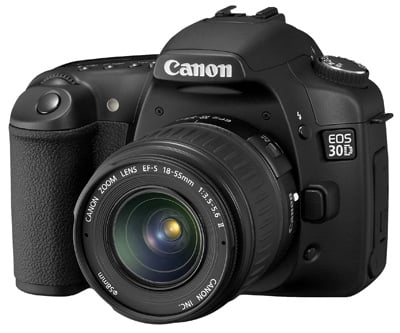 |
So the new EOS 30D now sports a larger 2.5in screen and spot-metering facilities – both long overdue on this product line – along with tweaked ergonomics, improved battery life, and the EOS 5D’s Picture Styles.
If Canon’s reasoning’s right, it’s made a great camera even better. But the 30D was launched soon after Nikon’s D200 which represented a massive leap forward from its predecessor, albeit a much older model. In today’s highly competitive market, is simply tweaking a decent older product good enough, or do people expect more? Find out in our full review of the Canon EOS 30D.
Testing notes
Note: the firmware tested was version 1.0.4, and due to many design and control similarities with the 5D, some descriptions are taken from that review.
Following our convention of using default factory and best quality JPEG settings to test camera bodies unless otherwise stated, the EOS 30D was set to Large Fine JPEG mode, sRGB, Auto White Balance, Evaluative Metering and its Standard Picture Style.