Support Camera Labs by price checking using the flags below


or by shopping via our affiliate stores
- thanks!

RSS Feed Camera Labs RSS Feed


Latest camera reviews

Pentax K200D
Olympus E-520
Canon 1000D / XS preview

Sigma DP1
Panasonic Lumix FX500

Olympus E-420
Pentax K20D
Olympus E-3
Sony Alpha A300
Canon EOS 450D / XSi
Sony Alpha A350

Panasonic Lumix FX35

Panasonic Lumix TZ5

Nikon D60
Sony Alpha A200
Nikon D300
Sony Alpha A700
Canon EOS 40D

All reviews ....
   
 
  Latest DSLRs


Canon
Olympus
Pentax
Nikon
Panasonic
Sony
     
 
  Best Buys: our top models


Compacts / Super-zooms
Budget DSLRs / Semi-pro / Lenses


Camera Labs Forum

Any questions, comments or a great tip to share? Join our Forum and let everyone know.
   
 
  DSLR Tips


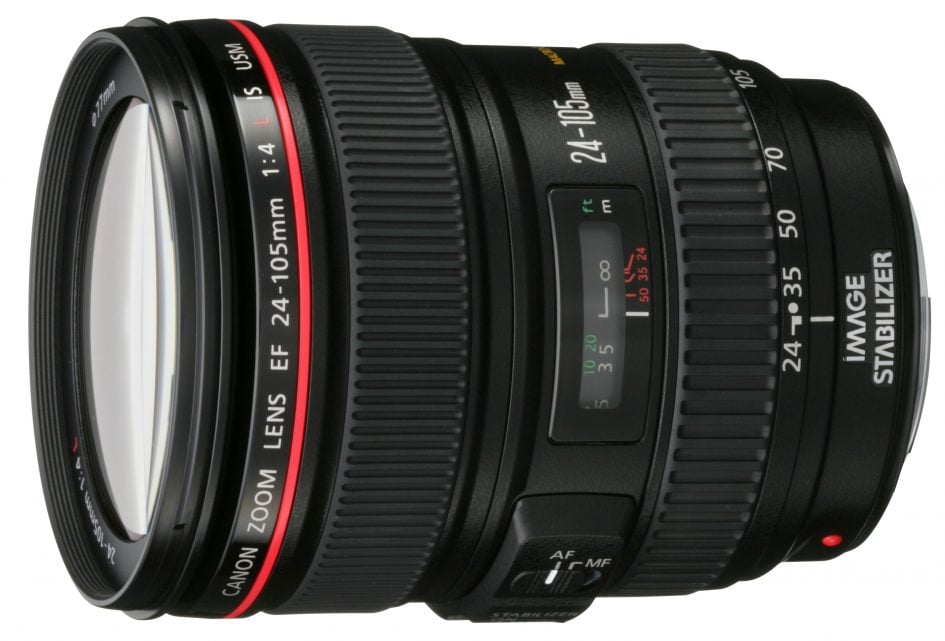
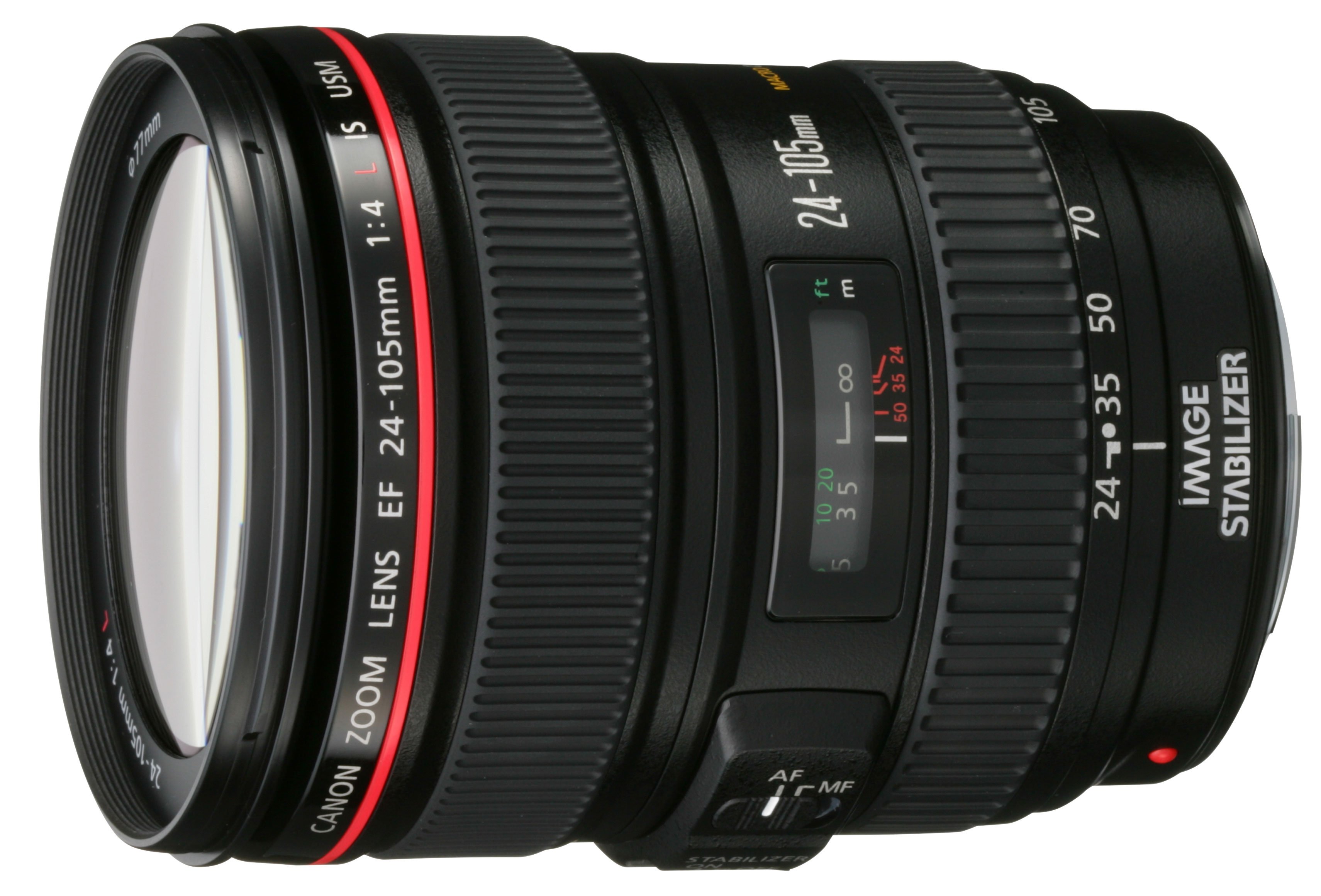
Canon EF 24-105mm f/4L IS USM for cropped-frame bodies Gordon Laing, March 2008
 
Support this site by shopping via these links


Support this site by shopping via these links


Canon EF 24-105mm f4L coverage for cropped-frame

The Canon EF 24-105mm is designed as a general-purpose zoom lens for full-frame DSLR bodies. Mounted on a full-frame body like the EOS 5D it will deliver decent wide angle to short telephoto coverage. Mounted on a cropped-frame APS-C body like the EOS 400D / XTi or EOS 40D though, the effective range is multiplied by 1.6 times to deliver an equivalent of 38-168mm.

This is noticeably less wide than most general purpose lenses that are designed for cropped-frame bodies, but remains sufficiently wide for many photographers. To illustrate the coverage of the EF 24-105mm we fitted it on an EOS 400D mounted on a tripod and took photos fully zoomed-out, then fully zoomed-in. We then repeated the process with the standard EF-S 18-55mm kit lens. Below are the coverage shots with each lens zoomed-out to their shortest focal lengths.

Canon EF 24-105mm f/4L IS USM
Canon EF-S 18-55mm f/3.5-5.6
Canon EF 24-105mm at 24mm f8
Canon EF-S 18-55mm at 18mm f8
24-105mm at 24mm, f8 (38mm equivalent)   18-55mm at 18mm, f8 (29mm equivalent)


It’s clear to see from the photos above that the EF-S 18-55mm delivers a much wider field of view when zoomed-out. This is useful not just for capturing sweeping landscapes, but also large buildings, cramped interiors or simply big group shots.

In contrast, the EF 24-105mm doesn’t capture as large a field of view, but it’s more than you’d get with a zoom starting at 28mm, and in technical terms, an equivalent of 38mm could still be classified as wide angle. The ultimate question for potential owners of this lens though is if it will be wide enough for them, although you could of course supplement it with an additional, wider lens like the excellent Canon EF-S 10-22mm.

Where the EF 24-105mm scores in coverage is when zoomed-in. The examples below show it clearly zooming-in much closer than the kit lens – indeed it gets almost twice as close. The EF 24-105mm also gives a longer reach than the popular EF-S 17-85mm.

Canon EF 24-105mm f/4L IS USM
Canon EF-S 18-55mm f/3.5-5.6
Canon EF 24-105mm at 105mm f8
Canon EF-S 18-55mm at 55mm f8
24-105mm at 105mm, f8 (168mm equivalent)   18-55mm at 55mm, f8 (88mm equivalent)


So the range when mounted on a cropped-frame body is ideal for anyone who’s willing to sacrifice a little on the wide-angle end for more powerful telephoto facilities. That said, it still doesn’t get really close, so if you’re into sports or wildlife photography, you’ll want something longer like a 70-200mm or a 70-300mm.

To see how the range compares to other general purpose zooms, see our Canon lens group test.


Canon EF 24-105mm Image Stabilisation for cropped-frame

The Canon EF 24-105mm is equipped with Image Stabilisation (IS) technology to reduce camera-shake. Canon claims its latest IS system offers three stops of compensation, which should allow you to handhold shutter speeds eight times slower than normal. For example, if the slowest exposure you could confidently handhold at a certain focal length was, say, 1/60 of a second, three stops of compensation should enable you to enjoy the same result at 1/8 (or more accurately, 1/7.5).

Like other Canon wide zooms with IS, there’s only one mode available with a switch on the side of the lens to switch it on or off; there's no panning mode here. The IS system kicks in with a faint click when you depress the shutter halfway after which you’ll see the reassuring stabilising effect through the viewfinder. The system stays on for a few seconds before deactivating to save power.

To test its effectiveness we shot the same scene zoomed-into 105mm with and without IS enabled. We used a Canon EOS 400D / XTi which effectively multiplied the 105mm focal length to 168mm. Traditional photographic advice would recommend a shutter speed of one over the effective focal length to avoid camera shake, so without IS, you’d really need something between 1/160 and 1/200 to be safe.

Canon EF 24-105mm f/4L IS USM Image Stabilisation off / on
Canon EF 24-105mm at 105mm - IS off
Canon EF 24-105mm at 105mm - IS on
24-105mm at 105mm (168mm equivalent), 1/25, IS off   24-105mm at 105mm (168mm equivalent), 1/25, IS on

Above are 100% crops from two examples taken at 1/25 with the EF 24-105mm fully zoomed-in, one without IS and the other with IS enabled. Without stabilisation we found we needed a shutter speed of 1/100 or faster to eliminate camera shake, whereas with IS enabled, we could achieve similar results at shutter speeds of 1/25. In this particular example, this gives the lens two stops of compensation, or around three compared to traditional advice.

As always, optical stabilisation allows you to handhold at slower shutter speeds than normal, but this will only be effective if the subject is stationary – unless of course if you want to show motion blur. Either way, it’s a valuable facility on the EF 24-105mm.


Support this site by checking prices below or shopping via our affiliate stores

USA readers


UK readers
Jessops discount voucher

All words, images, videos and layout, copyright 2005-2008 Gordon Laing. May not be used without permission.

About Us / How we test / Best Buys / Home